What Is BCT and Why It Matters for Export Packaging
When exporting products from Asia to Australia, one of the most overlooked factors in packaging design is:
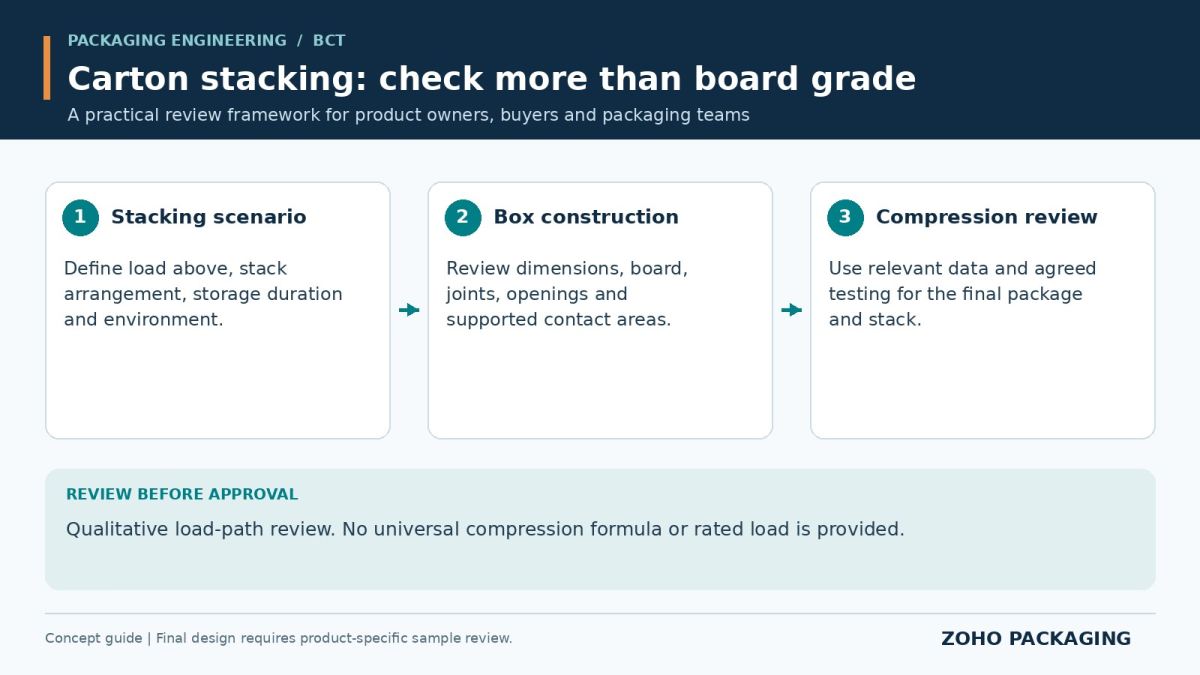 Qualitative load-path review. No universal compression formula or rated load is provided.
👉 BCT (Box Compression Test)
Many businesses focus on box thickness or material grade —
but still experience collapsed cartons and damaged products.
Why?
Because they are not designing for real stacking conditions.
BCT is the key to solving this problem.
📦 What Is BCT (Box Compression Test)?
BCT=k×ECT×P×tBCT = k \times ECT \times \sqrt{P \times t}BCT=k×ECT×P×t
BCT measures how much vertical load a corrugated box can withstand before collapsing.
In simple terms:
👉 It tells you how much weight your box can handle when stacked.
This is critical for export packaging because cartons are stacked for long periods during shipping.
🚨 Why BCT Matters in Export Packaging
During sea freight, cartons are:
- Stacked on pallets
- Loaded into containers
- Stored in warehouses
- Transported across long distances
The bottom boxes must support the weight of all boxes above them.
If BCT is insufficient:
- Boxes collapse
- Products get damaged
- Entire shipments may be compromised
👉 BCT is not optional — it is essential.
1️⃣ Stacking Load Is Higher Than You Think
Many companies underestimate stacking pressure.
In real conditions:
- Multiple layers (often 5–10+)
- Long storage duration (weeks)
- High humidity weakening strength
👉 The actual load can be several times higher than expected.
Without proper BCT design, failure is inevitable.
2️⃣ Thickness Alone Does Not Guarantee Strength
A common misconception:
Thicker box = stronger box
This is not always true.
BCT depends on:
- Material strength (ECT)
- Box dimensions
- Structural design
- Load distribution
👉 A poorly designed thick box can fail
👉 A well-designed box can perform better with less material
3️⃣ Humidity Reduces BCT Significantly
Sea shipping exposes packaging to high humidity.
This weakens corrugated material and reduces compression strength.
Impact:
- Lower BCT performance
- Increased risk of collapse
- Unpredictable packaging behavior
👉 Good design includes a safety margin to compensate for this.
4️⃣ BCT Directly Affects Damage Rate
Low BCT → Higher damage rate
Proper BCT → Stable packaging performance
Even a small improvement in compression strength can:
- Reduce product damage
- Improve stacking stability
- Lower return costs
👉 BCT is directly linked to your bottom line.
5️⃣ BCT and Pallet Design Must Work Together
BCT is not just about the box —
it must align with:
- Pallet configuration
- Stacking pattern
- Container loading
If these are not integrated:
- Uneven load distribution
- Localized stress points
- Increased failure risk
👉 Packaging must be designed as a system.
🟨 How to Design Packaging with Proper BCT
A professional approach includes:
- Calculating required stacking load
- Selecting appropriate ECT material
- Optimizing box dimensions
- Reinforcing load-bearing areas
- Considering real shipping conditions
👉 This is engineering — not guesswork.
🧠 Key Insight
Most packaging failures are not due to weak materials.
They are due to:
❌ Lack of BCT calculation
❌ Ignoring real shipping conditions
❌ Poor structural design
👉 When BCT is properly designed, packaging becomes predictable and reliable.
Make Your Packaging Work Under Real Conditions
At Zoho Packaging, we design packaging using engineering calculations like BCT — not assumptions.
We help businesses:
- Prevent carton collapse
- Reduce shipping damage
- Optimize packaging cost
- Improve logistics efficiency
👉 Get a Free Packaging Assessment
👉 Request a Quote in 24 Hours
🟪 FAQ(10題)
1. What does BCT stand for?
BCT stands for Box Compression Test, which measures how much weight a box can withstand before collapsing.
2. Why is BCT important in export packaging?
Because cartons are stacked during shipping, and insufficient strength leads to collapse and product damage.
3. How is BCT calculated?
It is based on factors like ECT (Edge Crush Test), box dimensions, and material properties.
4. What is a good BCT value?
It depends on stacking height, product weight, and shipping conditions.
5. Does humidity affect BCT?
Yes. High humidity reduces the strength of corrugated material significantly.
6. Can thicker boxes replace BCT calculation?
No. Thickness alone does not guarantee strength.
7. How can I improve BCT?
By optimizing structure, selecting better materials, and reinforcing key areas.
8. What is the relationship between ECT and BCT?
ECT measures material strength, while BCT reflects overall box performance.
9. Is BCT necessary for all packaging?
It is especially critical for export packaging and stacked shipping environments.
10. How do I know if my packaging is strong enough?
Through testing, calculations, and real-world simulation.