Heavy Duty Packaging Solutions for Industrial Equipment
When shipping heavy or high-value equipment, packaging is not just protection —
👉 it is risk management.
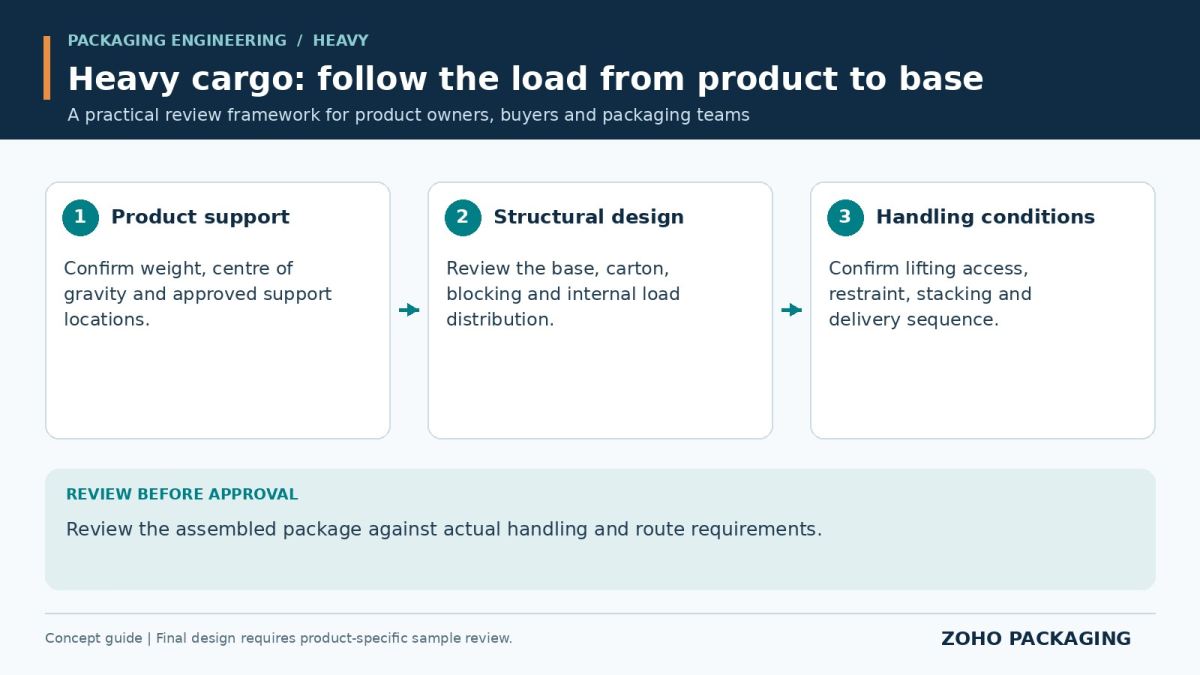 Review the assembled package against actual handling and route requirements.
Industrial products such as machinery, automotive parts, and precision equipment require packaging that can withstand:
- Heavy loads
- Long-distance transportation
- Multiple handling stages
- Harsh shipping environments
Yet many companies still rely on standard cartons or overbuilt solutions.
👉 Both approaches create problems.
This is where heavy duty packaging engineering becomes critical.
🚨 The Real Risk of Poor Heavy Packaging
Packaging failure for heavy products is costly:
- Equipment damage
- Structural deformation
- Safety risks during handling
- Delays in delivery
👉 Unlike small products, one failure can result in significant financial loss.
1️⃣ Load Distribution Is the Core of Strength
For heavy packaging, strength is not just about material thickness.
👉 It’s about how the load is distributed.
Key design considerations:
- Reinforced corners
- Bottom load-bearing structure
- Internal support systems
- Force transmission paths
👉 A properly designed structure prevents localized stress and collapse.
2️⃣ Corrugated vs Wooden Crates: Which to Use?
Choosing the right material is critical.
📦 Heavy-Duty Corrugated Packaging
- Lighter weight
- Cost-effective
- Suitable for medium-heavy loads
- Easier handling
🪵 Wooden Crates
- Extremely strong
- Suitable for very heavy equipment
- Better for long-distance or high-risk shipping
👉 The best solution is often a hybrid approach.
3️⃣ Shock Protection Matters
Heavy products are not immune to impact.
During transport:
- Forklift handling
- Drops and vibration
- Sudden movement
👉 These can damage internal components.
Solutions include:
- Internal cushioning (EPE, molded pulp)
- Suspension design
- Impact absorption layers
4️⃣ Pallet Integration Is Essential
Heavy packaging must work with pallets.
Poor integration leads to:
- Instability
- Uneven load distribution
- Handling difficulties
Key factors:
- Pallet size compatibility
- Weight distribution
- Forklift access points
👉 Packaging and pallet must be designed together.
5️⃣ Export Conditions Add Complexity
Shipping heavy equipment overseas introduces:
- High humidity
- Long transit times
- Repeated handling
👉 Packaging must be designed for real-world conditions, not ideal scenarios.
6️⃣ Over-Engineering vs Smart Engineering
Many companies overcompensate by:
- Using excessive material
- Increasing cost unnecessarily
👉 This leads to inefficiency.
Smart engineering focuses on:
- Targeted reinforcement
- Structural efficiency
- Optimized material usage
👉 Stronger does not mean heavier — it means smarter.
🟨 Engineering Approach to Heavy Duty Packaging
A professional solution includes:
- Load analysis
- Structural design optimization
- Material selection
- Pallet and container integration
- Real-world simulation
👉 This reduces risk while controlling cost.
🧠 Key Insight
Heavy duty packaging is not about building a stronger box.
👉 It is about designing a complete protection system.
When done correctly, it:
- Prevents damage
- Improves handling efficiency
- Reduces total logistics cost
Protect Your Equipment with Engineered Packaging
At Zoho Packaging, we design heavy duty packaging systems for industrial and export applications.
- Machinery packaging solutions
- Reinforced corrugated and wooden packaging
- Pallet-integrated design
- Export-ready engineering
👉 Get a Free Packaging Consultation
👉 Request a Quote in 24 Hours
🟪 FAQ(10題)
1. What is heavy duty packaging?
Packaging designed to protect heavy or high-value products during transportation and handling.
2. When should I use heavy duty packaging?
For machinery, industrial parts, automotive components, and high-value equipment.
3. Are wooden crates better than corrugated boxes?
It depends on weight and risk. Wooden crates are stronger, but corrugated solutions can be more efficient when properly designed.
4. How can I prevent damage to heavy products?
Through proper load distribution, shock protection, and structural design.
5. Does heavy packaging increase cost?
Not necessarily. Smart design can reduce total cost while improving protection.
6. What materials are used in heavy packaging?
Corrugated board, wood, foam (EPE), molded pulp, and hybrid materials.
7. Why is pallet design important?
It ensures stability, safe handling, and efficient transport.
8. Can heavy packaging reduce shipping cost?
Yes, by optimizing structure and container loading.
9. What industries need heavy duty packaging?
Manufacturing, automotive, electronics, and industrial equipment sectors.
10. How do I choose the right packaging solution?
Based on product weight, fragility, shipping conditions, and logistics requirements.