Article
2026/04/07
How Much Does Packaging Failure Really Cost?
Packaging Doesn’t Fail in the Factory. It Fails in Transit.
Most companies believe their packaging works.
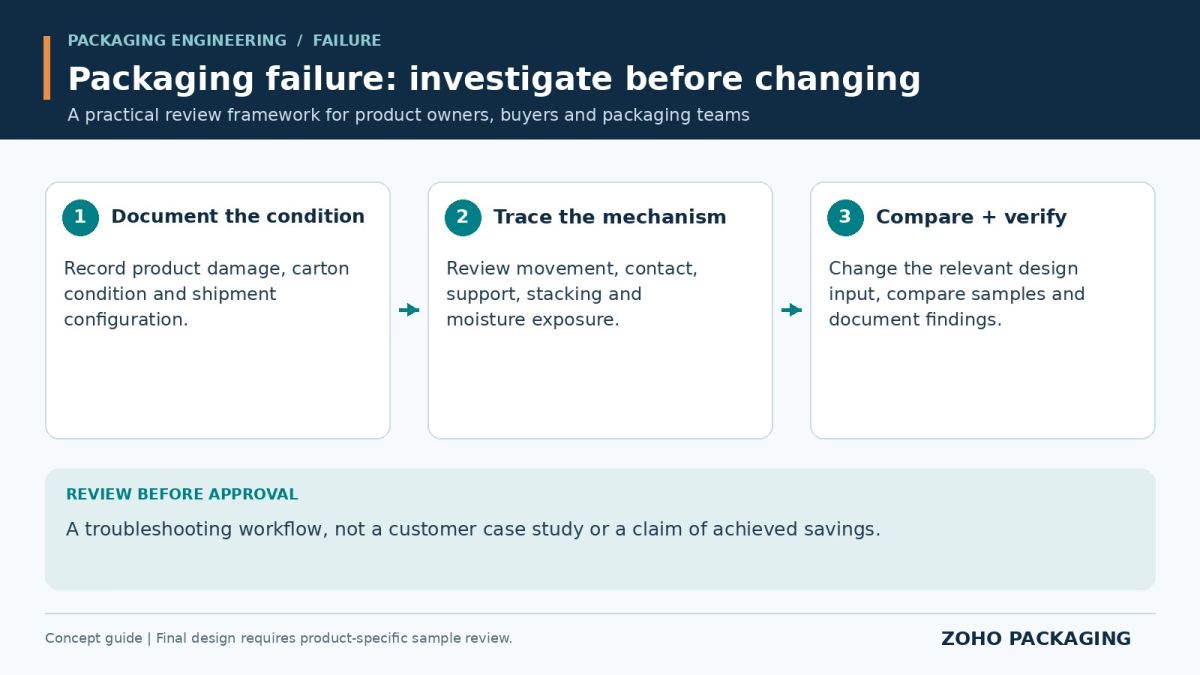 A troubleshooting workflow, not a customer case study or a claim of achieved savings.
Because nothing goes wrong…
until the shipment arrives.
That’s when the real cost begins.
The Visible Cost
When packaging fails, the first loss is obvious:
- Damaged products
- Replacement units
- Scrapped inventory
This is the cost most companies track.
But it’s only the beginning.
The Hidden Cost (What Most Companies Ignore)
The real cost of packaging failure is not the product.
It’s everything that follows:
1. Return Logistics
- International return shipping
- Handling and reprocessing
- Warehouse labor
2. Customer Impact
- Complaints
- Refund requests
- Delayed orders
3. Brand Damage
- Loss of trust
- Reduced repeat orders
- Negative reputation
4. Operational Disruption
- Production rescheduling
- Inventory imbalance
- Emergency shipments
The biggest cost of packaging failure is not damage.
It’s disruption.
Real Cost Breakdown
Let’s look at a typical export scenario:
- Monthly shipments: 1,000 units
- Damage rate: 5%
- Product value: $100
Direct Damage Cost:
👉 1,000 × 5% × $100 = $5,000/month
Additional Costs:
- Return logistics: $2,000
- Customer handling: $1,000
- Emergency replacement shipping: $1,500
Total Monthly Loss:
👉 $9,500/month
Now Compare That to Better Packaging
After implementing engineered packaging:
- Damage rate reduced to 1%
New Cost:
- Damage cost: $1,000
- Additional costs: ~$1,500
👉 Total: ~$2,500/month
Net Savings:
👉 $7,000/month
The question is not “Can you afford better packaging?”
The question is “Can you afford not to fix it?”
Why Packaging Failure Happens
Most packaging is designed for:
- Storage
- Cost reduction
- Basic protection
But not for:
- Long-distance shipping
- Multi-stage handling
- Heavy or sensitive products
Packaging designed for storage will fail in logistics.
The Shift: From Cost Reduction to Risk Reduction
Old mindset:
👉 “How do we make packaging cheaper?”
New mindset:
👉 “How do we reduce total cost of failure?”
What Engineering-Based Packaging Changes
- Controls product movement
- Distributes load correctly
- Protects surfaces
- Adapts to real shipping conditions
Who Needs This Most?
This matters most if you:
- Export automotive parts
- Ship heavy or fragile products
- Experience recurring damage
- Sell high-value goods
If your packaging fails, your profit leaks. Let’s stop it.
👉 Request a cost analysis
👉 Get a packaging evaluation
👉 Talk to our engineering team
❓ FAQ
1. What is the biggest hidden cost of packaging failure?
Operational disruption and customer impact often exceed product damage cost.
2. How do I calculate my real packaging cost?
You need to include damage, returns, logistics, and customer-related costs—not just packaging materials.
3. Can better packaging really improve ROI?
Yes. Reducing damage significantly improves overall profitability.
4. What is a normal damage rate?
Many companies operate at 2–5% without realizing the full cost impact.
5. Is it worth increasing packaging cost?
If it reduces damage, it almost always lowers total cost.
6. What industries are most affected?
Automotive, electronics, machinery, and export-driven businesses.
7. How fast can improvements be seen?
Usually within the first few shipments.
8. Can you analyze my current packaging?
Yes. We can identify failure points and recommend improvements.
9. What is the biggest mistake companies make?
Focusing only on box price instead of total cost.
10. How do I start?
Send your product and shipping data—we’ll evaluate your packaging system.
“Packaging doesn’t just protect products. It protects your profit, your reputation, and your operations.”