Shipping Damage Doesn’t Happen by Accident — It Happens by Impact
During transportation, your product is constantly exposed to:
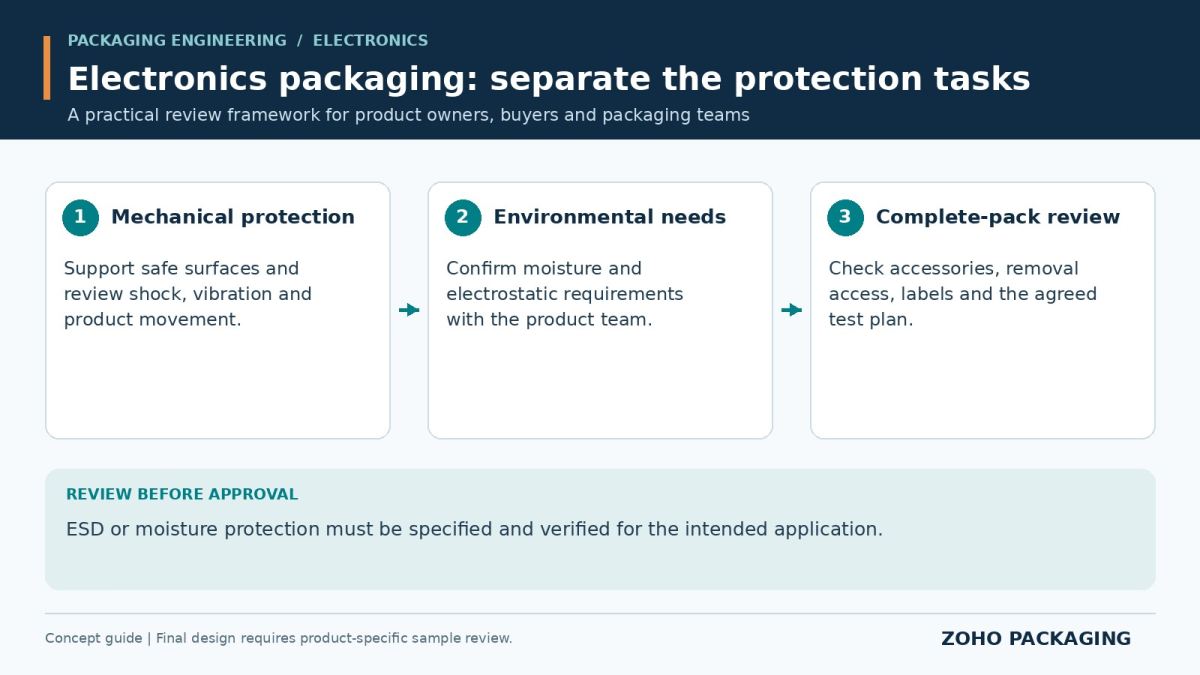 ESD or moisture protection must be specified and verified for the intended application.
- Drops (handling & loading)
- Continuous vibration (trucks & sea freight)
- Sudden impact (forklift, stacking shifts)
👉 Most damage doesn’t happen in one big accident.
👉 It happens through repeated micro-impact and vibration accumulation.
If your packaging is not designed to absorb shock, damage is guaranteed.
Common Shock Damage Problems
Without proper shockproof design, you will see:
- Internal component loosen or break
- Surface scratches or cracks
- Precision misalignment
- Functional failure after delivery
👉 These are not product defects.
👉 These are packaging failures.
Our Shockproof Packaging Engineering Approach
At Zoho Packaging, we don’t rely on “extra foam”.
We design based on force distribution and energy absorption.
1. Cushioning System Design (Not Random Filling)
We engineer cushioning to:
- Absorb impact energy
- Control deformation
- Protect critical points
Common materials:
- EPE foam (lightweight & flexible)
- Molded pulp (eco + structure)
- Honeycomb paper (high strength buffering)
👉 Key concept:
Not thicker = better.
Correct structure = protection.
2. Drop Test-Based Design (ISTA Standard)
We simulate real-world handling conditions:
- Free fall drop (height-based testing)
- Corner / edge / flat drop scenarios
- Repeated drop simulation
👉 Packaging must survive worst-case scenarios, not ideal conditions.
3. Vibration Control for Long-Distance Shipping
Especially for export (sea freight):
- Continuous vibration over days/weeks
- Internal friction damage
- Component fatigue
We design packaging that:
- Reduces resonance
- Stabilizes product position
- Prevents internal movement
4. Critical Point Protection (Most Important)
Not all parts need protection.
👉 We identify stress concentration points:
- Corners
- Connectors
- Fragile edges
- Load-bearing zones
Then reinforce only where necessary.
Before vs After: Shockproof Upgrade
Before (Standard Packaging):
- Loose product inside box
- Random foam placement
- No drop test validation
👉 Damage rate: 6%–15%
After (Engineered Shockproof Packaging):
- Fixed positioning structure
- Controlled cushioning zones
- Drop-tested design
👉 Damage rate: <1%
Applications
Our shockproof packaging is used for:
- Electronics & consumer devices
- Server & IT equipment
- Automotive parts (brake discs, sensors)
- Precision instruments
- Industrial machinery components
Why Most Shockproof Packaging Fails
Because people think:
❌ Add more foam = safer
❌ Use thicker carton = stronger
❌ Tight packing = no movement
👉 Wrong.
Real protection comes from:
✔ Energy absorption
✔ Force distribution
✔ Structural positioning
Real Cost of Not Using Shockproof Packaging
- Product replacement cost
- Return shipping
- Customer complaints
- Brand damage
👉 One damaged shipment can cost more than
100 properly designed packages.
Work With Zoho Packaging
If you are facing:
- Frequent shipping damage
- Unstable packaging
- High return rates
We help you:
✔ Redesign packaging structure
✔ Reduce damage rate
✔ Improve shipping reliability
👉 Contact us for a shockproof packaging evaluation.
FAQ
1. What is shockproof packaging?
Shockproof packaging is designed to absorb impact and reduce vibration during shipping. It protects products from drops, shocks, and continuous movement.
2. What materials are used for shockproof packaging?
Common materials include EPE foam, molded pulp, honeycomb paper, and corrugated structures. The key is how they are designed, not just the material.
3. Is more cushioning always better?
No. Too much cushioning can cause instability. Proper design focuses on controlled deformation and energy absorption.
4. What is a drop test?
A drop test simulates real shipping conditions by dropping the package from specific heights to test durability.
5. How do I reduce vibration damage?
By stabilizing the product inside the package and using materials that absorb vibration energy.
6. Can shockproof packaging reduce return rates?
Yes. Proper design can reduce damage rates from over 10% to below 1%.
7. Is shockproof packaging necessary for all products?
Not always. It depends on product fragility, value, and shipping conditions.
8. What is the biggest mistake in packaging design?
Ignoring force distribution and relying only on thicker materials.
9. Do you offer custom shockproof packaging?
Yes. All designs are based on your product size, weight, and shipping method.
10. How can I start?
Send us your product details and shipping conditions. We will recommend a solution.
Shock doesn’t break your product.
Bad packaging design does.