Stop Paying for Packaging Failure
Most companies think packaging cost = box price.
Wrong.
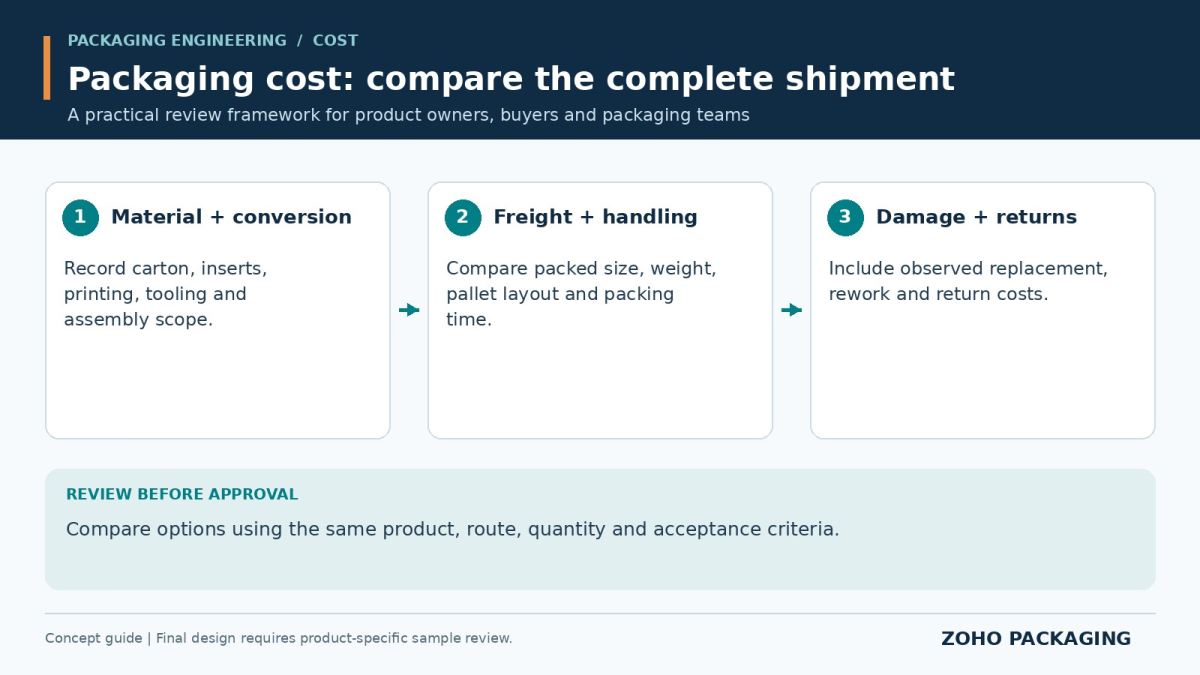 Compare options using the same product, route, quantity and acceptance criteria.
Real cost =
👉 Damage rate
👉 Return cost
👉 Re-shipping
👉 Brand damage
Q1: Can you reduce cost without reducing strength?
Yes. In most cases, packaging cost reduction does not come from using cheaper materials, but from improving structural design. We analyze load paths, stacking conditions, and real shipping environments to redesign the packaging system. By optimizing board grade, internal support, and box dimensions, we eliminate unnecessary material while maintaining or even improving strength. The result is a packaging solution that is lighter, more efficient, and still capable of protecting your product throughout transportation. This approach ensures that cost savings do not come at the expense of product safety.
Q2: How much cost can be saved?
Cost savings vary depending on your current packaging condition, but most clients see a 10% to 30% reduction in total logistics cost. This includes not only packaging material cost, but also freight savings from better pallet utilization and reduced dimensional weight. Additionally, lowering the damage rate significantly reduces hidden costs such as returns, replacements, and customer complaints. When all factors are considered together, the total cost impact is often much greater than expected. Our goal is to optimize the entire system, not just the box price.
Q3: Do you support export packaging?
Yes, export packaging is one of our core specialties. We design packaging specifically for long-distance transportation, including sea freight and air shipping. This involves accounting for stacking pressure, humidity, vibration, and handling conditions across multiple logistics stages. Our designs ensure that your products remain stable and protected from factory to final destination. Whether you are shipping heavy automotive parts or high-value components, we provide solutions that meet real export challenges rather than relying on generic packaging standards.
Q4: Can you redesign existing packaging?
Absolutely. In fact, redesigning existing packaging is where we deliver the most value. Many companies already have packaging in place, but it is often inefficient, overbuilt, or underperforming. We evaluate your current design, identify weaknesses in structure and logistics efficiency, and propose improvements. This may include resizing, material adjustment, or internal structural upgrades. The goal is to enhance protection while reducing cost and improving shipping efficiency, without disrupting your existing operations.
Q5: Do you calculate pallet loading?
Yes, pallet optimization is a key part of our process. We design packaging based on standard pallet sizes, such as the 48"x40" pallet commonly used in the United States. By optimizing box dimensions and stacking patterns, we increase the number of units per pallet and improve container utilization. This directly reduces shipping costs per unit and improves warehouse handling efficiency. Proper pallet design also minimizes instability during transportation, reducing the risk of damage.
Q6: What’s the biggest mistake companies make?
The most common mistake is focusing only on the unit price of the box. While a cheaper box may seem cost-effective initially, it often leads to higher overall costs due to damage, inefficient shipping, and operational issues. Companies also tend to overlook structural design and load distribution, assuming that thicker material automatically means better protection. In reality, poor design can cause failure even with strong materials. True cost optimization requires a system-level approach, not just price comparison.
Q7: Do you handle fragile auto parts?
Yes, we specialize in protecting fragile and high-value automotive components such as brake discs, rotors, suspension parts, and electronic modules. These products often require precise internal support and shock absorption to prevent movement and impact damage. We design custom inserts, separators, and structural reinforcements to ensure that each component remains secure throughout the shipping process. Our approach focuses on eliminating movement and distributing forces evenly.
Q8: Can you reduce damage rate?
Yes, reducing damage rate is one of the primary outcomes of our engineering approach. By improving structural design, optimizing load paths, and adding appropriate protective elements, we can significantly reduce the likelihood of damage during transportation. Many clients experience reductions of 50% to 70% in damage rates after redesigning their packaging. This not only saves cost but also improves customer satisfaction and brand reputation.
Q9: Do you provide testing?
We design packaging based on real-world conditions, including stacking pressure, handling, and transportation scenarios. While we may not always conduct formal lab testing, our designs are grounded in engineering principles such as BCT (Box Compression Test) and practical logistics experience. This ensures that the packaging performs reliably in actual use, rather than just meeting theoretical standards.
Q10: Is this suitable for small MOQ?
Yes, our solutions are scalable and suitable for both small and large production volumes. For small MOQ clients, we focus on flexible designs that can be produced efficiently without excessive tooling or cost. This allows startups and growing brands to access high-quality packaging solutions without large upfront investment. As your business grows, the design can also be scaled and optimized further.
👉 Warehouse inefficiency
👉 We don’t reduce packaging cost.
👉 We reduce TOTAL LOSS.
Where You’re Losing Money
1. Over-Engineering (Wasting Material)
Too thick. Too heavy. Too expensive.
2. Under-Engineering (Hidden Risk)
Boxes collapse → damage → full loss
3. Poor Pallet Utilization
Air shipping + empty space = wasted money
4. No Structural Design
No load path = random performance
Our Approach: Engineering-Based Cost Optimization
1️⃣ Structural Load Design (BCT-Based)
We design strength based on stacking, not guessing.
👉 You get:
- Right board grade (not overkill)
- Predictable stacking performance
- Lower material cost
2️⃣ Pallet Optimization (Logistics First)
We design packaging around:
- 48"x40" pallet (US standard)
- Container loading efficiency
- Warehouse handling
👉 Result:
- +15~30% more units per shipment
- Lower freight cost per unit
3️⃣ Right-Sizing (No Air Shipping)
We redesign packaging to:
- Eliminate empty space
- Fit product tightly
- Reduce dimensional weight
👉 Especially critical for:
- Brake discs
- Suspension parts
- Engine components
4️⃣ Damage Rate Reduction
We optimize:
- Shock absorption
- Load distribution
- Corner protection
👉 Result:
- Damage rate ↓ up to 70%
- Total cost ↓ massively
Before vs After (Real Impact)
| Metric |
Before |
After |
| Packaging Cost |
Low |
Slightly optimized |
| Damage Rate |
High |
Low |
| Shipping Cost |
High |
Reduced |
| Total Cost |
VERY HIGH |
CONTROLLED |
👉 Cheap packaging = expensive mistake.
Best Fit Industries
- Auto parts manufacturers
- Export suppliers
- E-commerce auto brands
- Industrial component suppliers
Why ZOHO01 (Engineering Mindset)
👉 We don’t sell boxes
👉 We design systems
- Packaging = part of your supply chain
- Not just a container
- Not just cost
👉 It’s profit protection
🚀 Want to reduce packaging cost WITHOUT increasing risk?
👉 Get a Free Packaging Cost Analysis
FAQ
Q1: Can you reduce cost without reducing strength?
Yes. Through structural optimization, not material cutting.
Q2: How much cost can be saved?
Typically 10–30% total logistics cost reduction.
Q3: Do you support export packaging?
Yes, especially heavy-duty and international shipping.
Q4: Can you redesign existing packaging?
Yes, that’s where most savings come from.
Q5: Do you calculate pallet loading?
Yes, including container optimization.
Q6: What’s the biggest mistake companies make?
Focusing only on box price.
Q7: Do you handle fragile auto parts?
Yes (rotors, suspension, electronics).
Q8: Can you reduce damage rate?
Yes, often significantly.
Q9: Do you provide testing?
We design based on real stacking & transport conditions.
Q10: Is this suitable for small MOQ?
Yes, we support scalable solutions.