Packaging Failure Is Not an Accident
It’s a Design Problem.
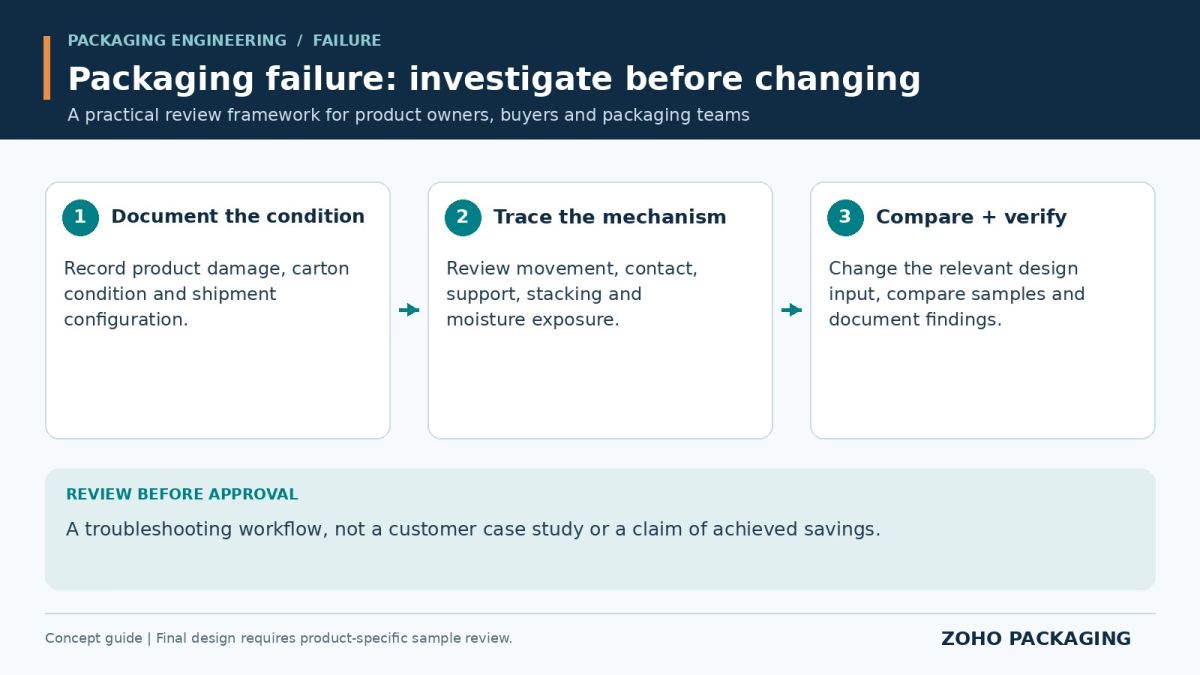 A troubleshooting workflow, not a customer case study or a claim of achieved savings.
Every damaged shipment has a reason:
👉 Wrong structure
👉 Wrong material
👉 Wrong load path
👉 No testing
Case Study #1 — Brake Disc Damage
Problem:
- Heavy brake discs stacked directly
- No separation layer
- Edge impact during shipping
Result:
❌ Surface scratches
❌ Customer complaints
❌ Returns
Solution:
- Add die-cut separators
- Reinforce outer box
- Improve stacking alignment
👉 Damage reduced by 80%
Case Study #2 — Shock Absorber Collapse
Problem:
- Vertical load not supported
- Weak box structure
Result:
❌ Box collapse
❌ Internal bending damage
❌ Total loss
Solution:
- Internal support structure
- Reinforced load path design
👉 Stacking strength improved significantly
Case Study #3 — Engine Component Damage
Problem:
- No shock absorption
- Loose internal space
Result:
❌ Movement inside box
❌ Impact damage
Solution:
- Custom-fit inserts
- Tight packaging design
👉 Zero movement → Zero damage
Case Study #4 — Export Failure (Sea Shipping)
Problem:
- Humidity + stacking pressure
- Low BCT box used
Result:
❌ Box deformation
❌ Product failure
Solution:
- Upgrade board structure
- Moisture-resistant design
👉 Stable long-distance shipping
Root Causes of Packaging Failure
1. No Engineering Design
Just “standard box”
2. Ignoring Load Path
Force not distributed correctly
3. No Real Testing
No drop test / stacking validation
4. Cost-Driven Decisions
Cheap box → expensive loss
Our Philosophy
👉 Packaging is not protection
👉 Packaging is risk control
Before vs After Impact
| Metric |
Before |
After |
| Damage Rate |
High |
Low |
| Customer Complaints |
Frequent |
Minimal |
| Return Cost |
High |
Reduced |
| Brand Trust |
Decreasing |
Increasing |
Who Needs This Most
- Exporters
- Automotive parts manufacturers
- High-value product suppliers
- Industrial exporters
🚨 Experiencing packaging damage?
👉 Send us your case → We diagnose for FREE
💥 10|Automotive Packaging Failure Case Studies
Q1: Why does packaging fail?
Packaging failure usually occurs because the design does not account for real-world conditions. Many packaging solutions are created based on assumptions rather than engineering analysis. Factors such as stacking pressure, vibration, humidity, and handling are often ignored. Without proper load path design and structural support, even strong materials can fail. In most cases, packaging failure is not random—it is the result of poor design decisions and lack of testing.
Q2: Can all damage be prevented?
While it may not be possible to eliminate all risk, most packaging-related damage can be significantly reduced through proper design. By analyzing how forces act on the product during transportation and addressing weak points in the packaging structure, we can minimize movement, impact, and compression failure. The goal is not perfection, but risk control. A well-designed packaging system can reduce damage rates to a very low and manageable level.
Q3: Do you analyze existing failures?
Yes, analyzing existing packaging failures is a key part of our service. We review damaged packaging, identify the root causes, and determine whether the issue is related to structure, material, or logistics conditions. This allows us to develop targeted solutions that directly address the problem. Instead of guessing, we use real failure data to improve performance and prevent recurrence.
Q4: How fast can you improve packaging?
The timeline depends on the complexity of the product and packaging system. For simple improvements, changes can often be implemented quickly. For more complex cases involving structural redesign or multiple product variations, the process may take longer. However, our approach focuses on rapid iteration and practical solutions, allowing you to see improvements in a relatively short time frame.
Q5: Do you handle export packaging issues?
Yes, export packaging is one of the most common sources of failure, especially in sea shipping where products are exposed to long durations, humidity, and stacking pressure. We design packaging specifically to handle these conditions, including reinforced structures and moisture-resistant materials. Our solutions ensure that products remain intact throughout international transportation.
Q6: What industries do you serve?
We serve a wide range of industries, including automotive, electronics, heavy equipment, and industrial components. Each industry has unique packaging challenges, and our solutions are tailored to meet specific requirements. For automotive parts, this often involves handling heavy loads and preventing surface damage, while electronics require shock protection and precision support.
Q7: Do you redesign packaging from scratch?
Yes, when necessary, we can redesign packaging entirely from the ground up. This is often the best approach when existing packaging is fundamentally flawed or inefficient. By starting from scratch, we can create a solution that fully integrates product protection, logistics efficiency, and cost optimization. This ensures the best possible performance.
Q8: Can you reduce return rate?
Yes, reducing return rates is a direct result of improved packaging performance. When products arrive in good condition, customer complaints decrease and return processes are minimized. This not only saves cost but also improves customer satisfaction and brand trust. Many clients see a noticeable reduction in returns after implementing optimized packaging solutions.
Q9: Do you provide testing standards?
Our designs are based on established engineering principles and real-world logistics conditions. While we may not always follow formal testing protocols such as ISTA in every case, we incorporate the same concepts into our design process. This ensures that packaging performs reliably under actual transportation conditions rather than just theoretical scenarios.
Q10: What’s the biggest takeaway?
The key takeaway is that packaging failure is not a random event—it is a design failure. When packaging is treated as a critical part of the supply chain rather than a simple container, performance improves significantly. Investing in proper packaging design is not an added cost; it is a way to protect your product, reduce risk, and improve overall efficiency.