Most Companies Reduce Cost the Wrong Way
They try to:
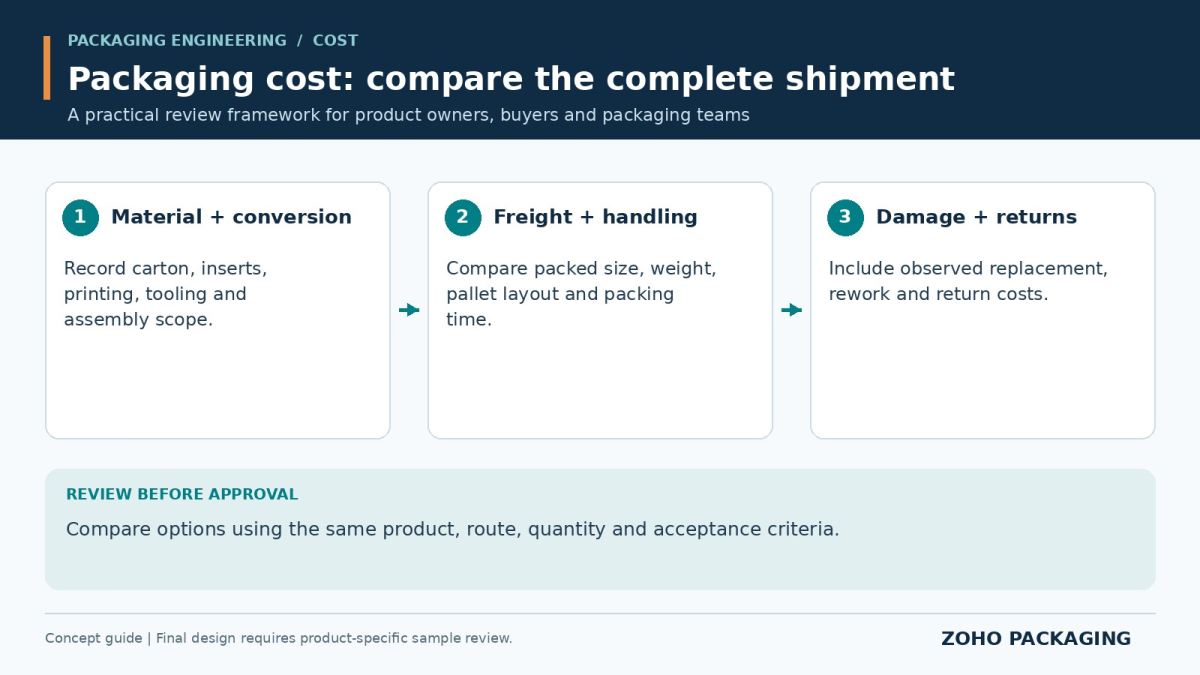 Compare options using the same product, route, quantity and acceptance criteria.
❌ Use cheaper material
❌ Reduce thickness
❌ Cut corners
👉 Result:
More damage → higher total cost
Real Cost Reduction = System Optimization
Packaging cost is controlled by 3 key factors:
👉 If you don’t optimize all three, you’re losing money.
7 Proven Packaging Cost Reduction Strategies
1️⃣ Structural Engineering Instead of Material Reduction
Most companies reduce cost by switching to weaker material.
👉 We do the opposite.
We redesign structure to:
- Improve load distribution
- Reduce stress concentration
- Maintain strength with less material
👉 Result: Lower cost + better performance
2️⃣ Right-Sizing Packaging (Eliminate Air)
Oversized packaging increases:
- Shipping cost
- Storage cost
- Damage risk
👉 Strategy:
- Fit packaging tightly to product
- Remove unnecessary void space
- Reduce dimensional weight
3️⃣ Pallet Optimization (Logistics First Thinking)
We design packaging based on:
- 48"x40" pallet
- Container loading efficiency
👉 Result:
- More units per pallet
- Lower shipping cost per unit
- Better warehouse handling
4️⃣ Reduce Packaging Layers
Many packaging systems are overcomplicated.
👉 Example:
Product → inner box → outer box → pallet
👉 Optimization:
- Combine functions
- Remove unnecessary layers
- Simplify structure
5️⃣ Lightweight Engineering
Instead of just using thinner board, we:
- Reinforce key stress areas
- Optimize structure geometry
- Maintain strength with less weight
👉 Result: Lower material + shipping cost
6️⃣ Damage Cost Reduction Strategy
The biggest cost is NOT packaging.
👉 It’s damage.
We reduce:
- Impact damage
- Compression failure
- Internal movement
👉 Result:
- Lower return rate
- Lower replacement cost
- Higher customer satisfaction
7️⃣ Standardization & Modular Design
We create standardized packaging systems:
- Fewer SKUs
- Easier inventory management
- Lower production cost
👉 Especially useful for:
- Automotive parts
- E-commerce brands
- Industrial components
Before vs After
| Area |
Before |
After |
| Material Cost |
Low |
Optimized |
| Damage Rate |
High |
Reduced |
| Shipping Cost |
High |
Lower |
| Total Cost |
High |
Controlled |
👉 Cheap packaging = expensive system.
Who Should Apply These Strategies
- Export manufacturers
- Automotive parts suppliers
- High-volume e-commerce brands
- Industrial packaging users
🚀 Want to cut packaging cost WITHOUT increasing risk?
👉 Get a Free Packaging Strategy Consultation
📊 FAQ
Q1: What is the most effective packaging cost reduction strategy?
The most effective packaging cost reduction strategy is to optimize the entire system rather than focusing on a single factor such as material cost. This includes improving structural design, reducing unnecessary packaging size, and optimizing pallet loading efficiency. By addressing all these aspects together, companies can significantly reduce total cost while maintaining or improving product protection. A system-level approach ensures long-term savings and avoids hidden costs such as damage and returns.
Q2: Why is reducing material not always the best solution?
Reducing material may lower initial cost, but it often compromises structural strength and increases the risk of damage. When packaging fails, the resulting costs from returns, replacements, and customer dissatisfaction can far exceed the savings from using less material. Instead of simply reducing material, companies should focus on improving design efficiency. A well-engineered structure can achieve the same or better performance with optimized material usage.
Q3: How does right-sizing packaging reduce cost?
Right-sizing packaging reduces cost by eliminating unused space, which directly lowers dimensional weight in shipping calculations. Smaller packaging also allows more units to fit on a pallet or in a container, improving logistics efficiency. Additionally, tighter packaging reduces internal movement, which decreases the risk of damage. This combination of benefits leads to lower shipping cost, better protection, and improved overall efficiency.
Q4: What is the impact of pallet optimization on cost?
Pallet optimization has a significant impact on cost because it determines how efficiently products are transported and stored. By maximizing the number of units per pallet, companies can reduce shipping cost per unit and improve warehouse utilization. Proper pallet design also enhances stability during transportation, reducing the risk of damage. This makes pallet optimization a critical component of packaging cost strategy.
Q5: Can simplifying packaging structure reduce cost?
Yes, simplifying packaging structure can reduce cost by eliminating unnecessary components and reducing complexity. Fewer layers and simpler designs lead to lower material usage, faster production, and easier handling. However, simplification must be done carefully to ensure that product protection is not compromised. A well-designed simplified structure can maintain performance while reducing cost.
Q6: How does packaging affect damage cost?
Packaging directly affects damage cost because it determines how well a product is protected during transportation. Poor packaging design can lead to impact damage, compression failure, and internal movement. These issues result in returns, replacements, and customer complaints, all of which increase cost. By improving packaging design, companies can significantly reduce damage rates and associated costs.
Q7: What industries benefit most from these strategies?
Industries that deal with heavy products, high shipping volumes, or fragile items benefit the most from packaging cost reduction strategies. This includes automotive parts, electronics, industrial equipment, and e-commerce businesses. These industries face higher risks of damage and logistics inefficiency, making optimization especially valuable.
Q8: Is lightweight packaging always safe?
Lightweight packaging can be safe if it is properly engineered. The key is to maintain structural integrity while reducing weight. This involves optimizing load paths, reinforcing critical areas, and using appropriate materials. Poorly designed lightweight packaging can increase damage risk, so engineering expertise is essential.
Q9: How often should packaging strategies be updated?
Packaging strategies should be reviewed regularly, especially when there are changes in product design, logistics requirements, or market conditions. Continuous improvement ensures that packaging remains efficient and effective. Companies that regularly update their strategies are better able to adapt to changing conditions and maintain competitive advantage.
Q10: What is the biggest mistake in cost reduction?
The biggest mistake in packaging cost reduction is focusing only on material price. This approach ignores other important factors such as shipping efficiency, damage rate, and operational cost. As a result, companies may reduce upfront cost but increase total cost. A comprehensive approach that considers the entire packaging system is essential for true cost optimization.