Article
2026/04/08
Heavy Duty Packaging Engineered Packaging for Industrial Equipment, Machinery, and High-Value Cargo
Heavy Products Don’t Break Easily
They Fail Catastrophically
Unlike small products:
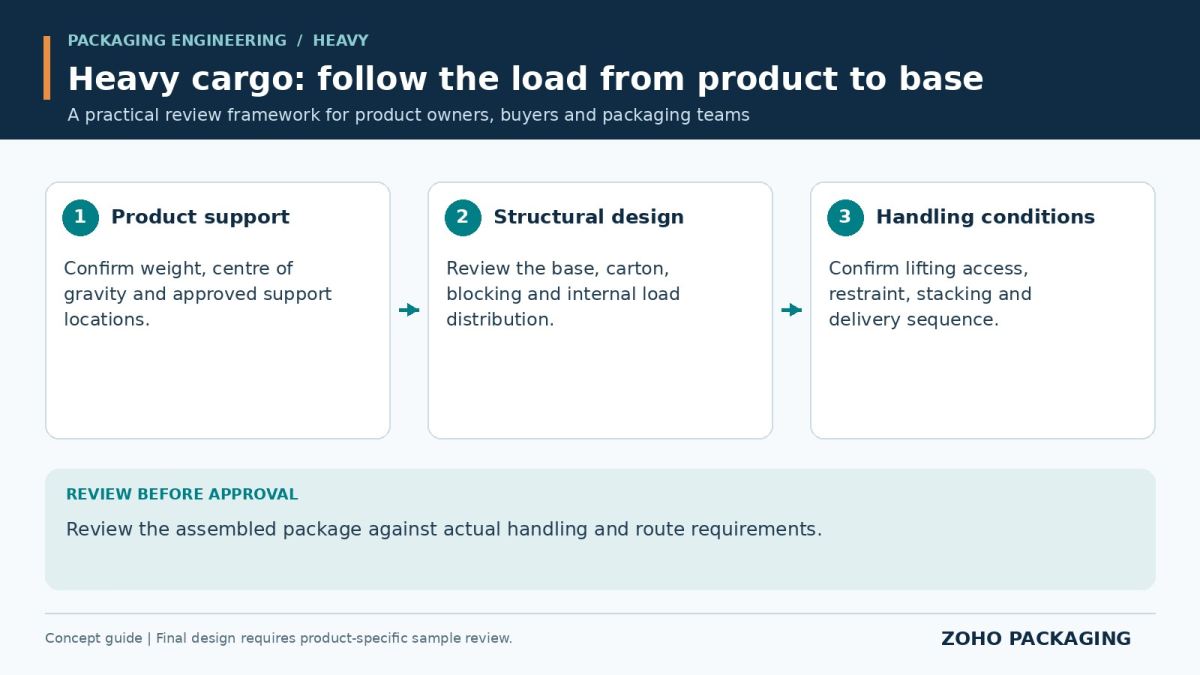 Review the assembled package against actual handling and route requirements.
- they don’t just get scratched
- they don’t just get dented
👉 When heavy products fail:
- packaging collapses
- internal structure shifts
- entire shipment becomes unusable
Reality
Heavy duty packaging is not about protection
It’s about preventing catastrophic loss
What Is Heavy Duty Packaging?
Heavy duty packaging is engineered for:
- high weight products
- large dimensions
- long-distance shipping
- high stacking pressure
Typical Applications:
- machinery
- automotive parts
- industrial equipment
- generators
- precision components
Why Heavy Packaging Fails
❌ Incorrect Load Distribution
- weight not supported evenly
- stress concentrated on weak points
❌ Weak Structural Design
- structure designed like normal cartons
- no reinforcement strategy
❌ No Internal Fixation
- product moves inside packaging
- causes impact damage
❌ Ignoring Stacking Load
- no BCT calculation
- collapse during transport
Core Engineering Principles of Heavy Duty Packaging
1. Load Path Design
👉 This is the most critical concept
The load must travel through designed paths—not random surfaces
Goal:
- transfer weight safely
- avoid stress concentration
2. Structural Reinforcement
- double wall / triple wall corrugated
- corner reinforcement
- base strengthening
3. Internal Fixation
- prevent movement
- absorb shock
4. Stacking Design
- BCT calculation
- stacking height control
Materials for Heavy Duty Packaging
Corrugated Heavy Duty Cartons
- double wall / triple wall
- high ECT strength
Wooden Crates(木箱)
- maximum strength
- suitable for export
- UN certified options
Hybrid Packaging(紙+木結構)
- combine flexibility and strength
- cost-efficient alternative
Real Case — Machinery Packaging Failure
Before
- standard carton used
- no reinforcement
- no load path design
Result
❌ carton collapse
❌ internal damage
❌ high replacement cost
After Engineering Redesign
- reinforced base
- load path optimized
- internal fixation added
Result
✔ zero collapse
✔ stable transport
✔ reduced total cost
Heavy Duty Packaging vs Standard Packaging
| Standard Packaging |
Heavy Duty Packaging |
| light products |
heavy products |
| basic structure |
engineered structure |
| low risk |
high risk |
| minimal reinforcement |
load path design |
Key Insight
Heavy products require engineered systems—not upgraded cartons
BCT and Heavy Packaging
Heavy packaging relies heavily on BCT:
- stacking multiple layers
- long-term pressure
👉 Without proper calculation:
❌ collapse is guaranteed
👉 With engineering:
✔ predictable stacking
✔ stable performance
Internal Protection Strategy
Common Methods:
- molded pulp
- EPE / foam (if needed)
- paper cushioning
Correct Approach
Fix the product first — then protect it
Cost vs Risk — The Truth
Cheap Packaging:
- lower upfront cost
- higher failure risk
Engineered Packaging:
- optimized cost
- controlled risk
Final Equation
Heavy packaging cost < Failure cost
Zoho Heavy Duty Packaging Approach
Step 1 — Product Analysis
- weight
- center of gravity
- fragility
Step 2 — Load Path Design
- define force distribution
- eliminate weak points
Step 3 — Structural Design
- reinforcement strategy
- material selection
Step 4 — Internal Fixation
- secure product position
- reduce movement
Step 5 — Testing & Validation
- compression
- drop
- simulation
Result
✔ no structural failure
✔ stable export performance
✔ reduced total cost
Who Needs Heavy Duty Packaging?
- machinery manufacturers
- automotive suppliers
- industrial exporters
- high-value equipment suppliers
👉 If your product is heavy, this is not optional.
Internal Link Strategy
Final Insight
Most companies try to “make the box stronger.”
Smart companies do this:
Design how the force flows through the packaging
FAQ
1. What is heavy duty packaging?
Heavy duty packaging is engineered packaging designed for large, heavy, or high-value products.
2. Why do heavy products need special packaging?
Because they create high stress on packaging structure, requiring load distribution and reinforcement.
3. What is load path design in packaging?
It is the design of how forces move through packaging to prevent failure.
4. Can corrugated packaging handle heavy products?
Yes, with proper engineering, double or triple wall corrugated can handle significant loads.
5. When should I use wooden crates?
For extremely heavy or export-critical products requiring maximum strength and compliance.
6. What causes heavy packaging failure?
Incorrect structure, poor load distribution, lack of fixation, and no BCT calculation.
7. How do I prevent product movement inside packaging?
By using internal fixation systems like inserts, supports, or molded structures.
8. Is heavy packaging always more expensive?
Not necessarily. Engineering can optimize cost while improving performance.
9. How do I know if my packaging is strong enough?
Through BCT calculation and real-world testing.
10. How do I start designing heavy duty packaging?
Begin with product analysis, then design structure, select materials, and validate performance.