If Your Packaging Fails Testing — Your Shipment Doesn’t Move
UN certification is not optional.
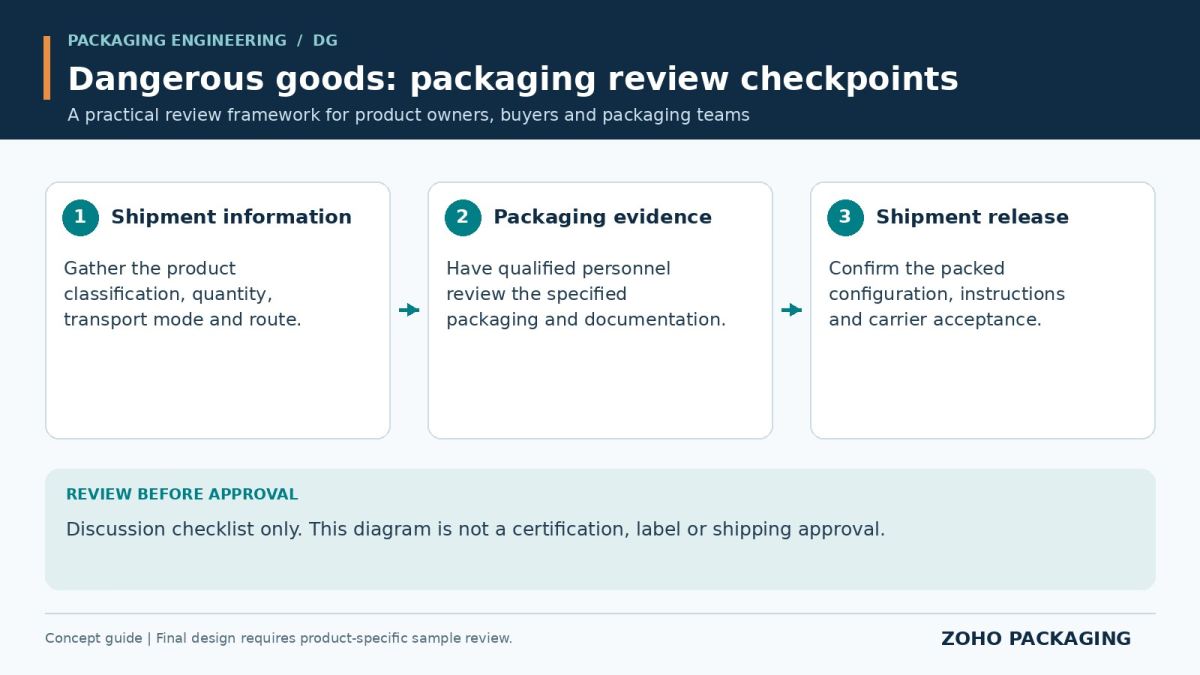 Discussion checklist only. This diagram is not a certification, label or shipping approval.
It is the minimum requirement for shipping dangerous goods internationally.
👉 And failing it means:
- Shipment rejection
- Delays
- Financial loss
What Is UN Packaging Certification?
UN certification ensures that your packaging can:
✔ Withstand real-world shipping conditions
✔ Protect dangerous goods safely
✔ Meet international transport regulations
The 4 Core UN Tests You Must Pass
1. Drop Test
Simulates:
- Handling drops
- Loading accidents
- Warehouse impact
👉 Your packaging must survive multiple drops at specific heights.
2. Stacking Test
Simulates:
- Container stacking
- Long-term warehouse pressure
👉 Usually tested over 24 hours or more.
3. Compression / Load Test
Tests:
- Structural strength
- Resistance to crushing
4. Leakproof / Integrity Test
Ensures:
- No leakage
- Sealing performance
What Most Companies Get Wrong
❌ Treat testing as a final step
❌ Design packaging without engineering
❌ Assume “UN mark = always compliant”
👉 Reality:
Certification depends on how you use the packaging — not just what you buy
Certification Is a System — Not a Product
UN packaging includes:
- Outer packaging (box or crate)
- Inner packaging system
- Cushioning materials
- Closure method
- Labeling
👉 If any part fails — the system fails
Engineering Approach (How to Pass the First Time)
At Zoho Packaging, we don’t “try and test.”
We:
1. Design for Test Conditions
We simulate:
- Drop angles
- Load pressure
- Shipping environment
2. Build Load Path Structure
👉 Force is distributed — not absorbed randomly
3. Optimize Packaging System
✔ Material selection
✔ Structural design
✔ Internal fixation
4. Align With Regulations
✔ UN standards
✔ Transport requirements
✔ Customer expectations
Real Risk of Failing Certification
If your packaging fails:
- You must redesign and retest
- Lead time increases
- Cost increases
- Shipment delays
👉 Testing failure is expensive — prevention is cheaper
Zoho One-Line
👉 UN certification doesn’t prove your packaging works — it proves it survives failure conditions.
Need to pass UN certification without trial-and-error?
We design packaging systems that are built to pass testing from the start.
👉 Send us your product details — we’ll engineer a compliant solution.
FAQ
1. What is UN packaging certification?
UN packaging certification is a process that verifies whether packaging can safely transport dangerous goods under international regulations. It involves testing the packaging against real-world conditions such as drops, stacking pressure, and handling stress. Only packaging systems that pass these tests are allowed for dangerous goods shipping. Certification ensures both safety and compliance.
2. Why is UN testing required?
UN testing is required to ensure that packaging can withstand the physical stresses of transportation. Dangerous goods pose risks during shipping, and improper packaging can lead to accidents or environmental hazards. Testing helps prevent these issues by verifying structural integrity and safety performance.
3. What is included in UN packaging testing?
UN testing typically includes drop tests, stacking tests, compression tests, and leakproof tests for liquids. These tests simulate real-world shipping conditions and ensure that the packaging system can protect its contents effectively.
4. What is a drop test in UN packaging?
A drop test evaluates how packaging performs when dropped from a specific height. It simulates handling accidents and ensures that the packaging can protect the contents from impact damage. The height and conditions depend on the weight and type of goods.
5. What is a stacking test?
A stacking test measures how well packaging can withstand pressure from other packages stacked on top of it. This test simulates warehouse storage and container shipping conditions. It ensures that the packaging does not collapse over time.
6. Does having a UN mark guarantee compliance?
No. A UN mark indicates that the packaging design has passed testing under specific conditions. However, compliance also depends on how the packaging is used, including weight limits, internal structure, and closure method. Incorrect use can still result in failure.
7. Can I reuse UN certified packaging?
In some cases, yes—but only if the packaging remains in good condition and is used within its certified limits. Damaged or modified packaging should not be reused, as it may no longer meet safety standards.
8. How long does UN certification take?
The certification process can take several weeks, depending on testing availability, design readiness, and required modifications. Planning ahead is critical to avoid delays in shipment schedules.
9. What happens if packaging fails the test?
If packaging fails, it must be redesigned and retested. This increases both cost and lead time. Working with an experienced provider helps reduce the risk of failure and speeds up the certification process.
10. How can I ensure my packaging passes UN testing?
The best approach is to design packaging based on engineering principles and test requirements from the beginning. This includes proper load calculations, structural design, and compliance planning. Expert guidance significantly increases the success rate.