Most Companies Don’t Have a Packaging Problem — Until It Fails
Packaging issues are invisible…
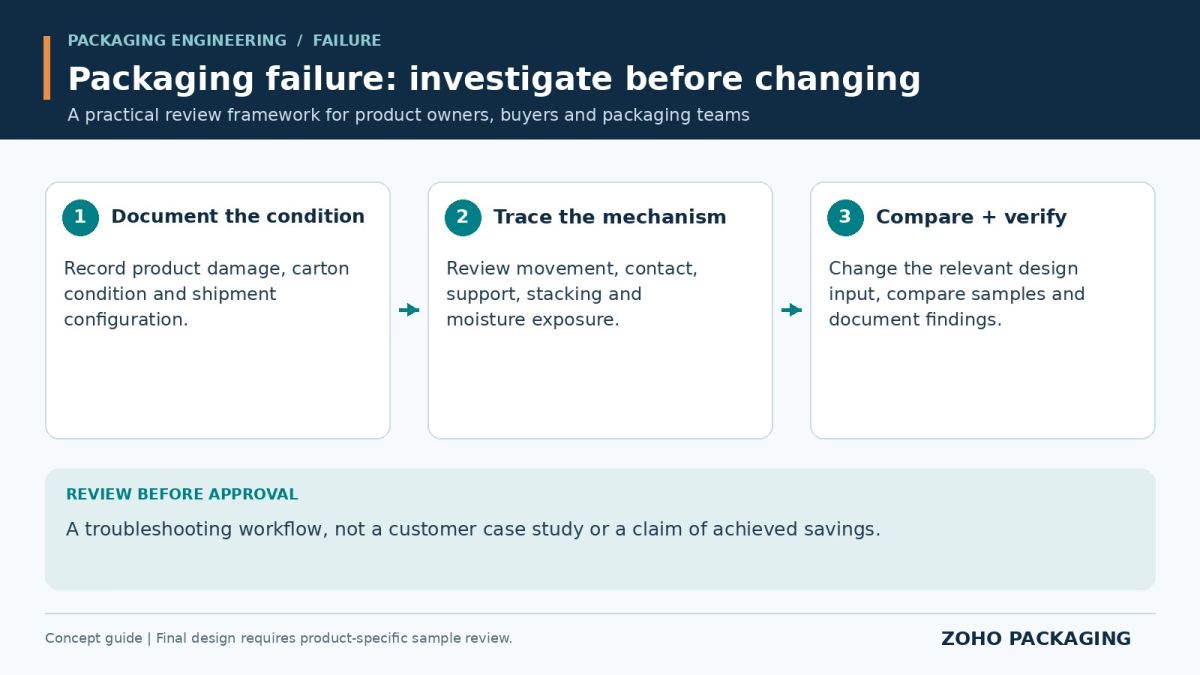 A troubleshooting workflow, not a customer case study or a claim of achieved savings.
👉 Until:
- Your shipment gets rejected
- Your product arrives damaged
- Your customer files a complaint
These Are Not Theories — These Are Real Failures
Below are real cases we’ve seen.
If they look familiar, you’re already at risk.
Case 1 — Wooden Crate Collapse During Shipping
Problem
- Heavy equipment
- Standard wooden crate
- No stacking calculation
👉 Result:
- Crate deformation
- Internal damage
- Full shipment loss
Root Cause
❌ No load path design
❌ No stacking pressure calculation
❌ Weak structural reinforcement
Solution
✔ Redesigned structural frame
✔ Added load-bearing base
✔ Reinforced stress points
Result
✔ Passed stacking test
✔ Zero damage in next shipment
👉 Lesson:
A crate is not wood — it’s structure.
Case 2 — Lithium Battery Shipment Rejected
Problem
- Lithium batteries (UN3480)
- Standard carton + foam
- No UN certification
👉 Result:
- Shipment rejected at port
- Delay + extra cost
Root Cause
❌ No UN packaging
❌ Incorrect compliance understanding
❌ Missing labeling
Solution
✔ Switched to UN 4G packaging
✔ Designed internal fixation system
✔ Applied correct labels
Result
✔ Passed inspection
✔ Shipment released immediately
👉 Lesson:
Compliance failure = shipment failure
Case 3 — Correct Box, Wrong Setup
Problem
- Used UN-certified box
- Wrong internal packaging
- Product movement inside
👉 Result:
- Product damage
- Customer complaint
Root Cause
❌ Ignored internal structure
❌ No fixation system
❌ Wrong load distribution
Solution
✔ Added internal support system
✔ Designed anti-movement structure
✔ Rebalanced load distribution
Result
✔ Damage rate dropped significantly
👉 Lesson:
A UN box alone is not a system
Case 4 — Labeling Error Caused Shipment Delay
Problem
- Correct packaging
- Incorrect hazard label
👉 Result:
- Shipment held at port
- Inspection required
Root Cause
❌ Wrong label class
❌ Incorrect placement
Solution
✔ Corrected labeling system
✔ Standardized placement rules
Result
✔ Faster customs clearance
✔ No further delays
👉 Lesson:
Labeling is not decoration — it’s compliance
Case 5 — Over-Packaging Increased Cost
Problem
- Excessive material use
- Over-designed crate
👉 Result:
- High packaging cost
- Reduced profit margin
Root Cause
❌ No optimization
❌ Misunderstanding risk
Solution
✔ Redesigned structure
✔ Reduced unnecessary material
✔ Maintained strength
Result
✔ Lower cost
✔ Same protection level
👉 Lesson:
More material ≠ better packaging
What All These Cases Have in Common
👉 The problem is never just the box
It’s:
- Structure
- System
- Compliance
- Engineering
Zoho One-Line
👉 Packaging failures don’t happen by accident — they are designed that way.
Does your packaging look like one of these cases?
Then you already have risk.
👉 Send us your product and packaging details.
We’ll identify the problem before it becomes a loss.
FAQ
1. What are packaging case studies?
Packaging case studies are real examples of how packaging performs in actual shipping scenarios. They highlight both failures and successful solutions, helping businesses understand risks and best practices. These cases provide valuable insights into how proper packaging design can prevent damage and improve performance.
2. Why are packaging failures common?
Packaging failures often occur due to poor design, lack of testing, or misunderstanding of shipping conditions. Many companies focus only on material cost and ignore structural design, which leads to weak performance during transport.
3. Can a UN-certified box still fail?
Yes. A UN-certified box can fail if it is used incorrectly. Certification applies to specific conditions, and improper use—such as exceeding weight limits or using incorrect internal packaging—can lead to failure.
4. What causes damage during shipping?
Damage is usually caused by impact, stacking pressure, and product movement inside the package. Without proper design and protection, these factors can lead to significant loss.
5. How can packaging reduce shipping risk?
Proper packaging reduces risk by protecting products from external forces and ensuring compliance with regulations. It minimizes damage, delays, and rejection, improving overall reliability.
6. Why is internal packaging important?
Internal packaging stabilizes the product and prevents movement during transport. Without it, even strong outer packaging cannot fully protect the product.
7. Can better packaging improve customer satisfaction?
Yes. Reliable packaging ensures products arrive in good condition, reducing complaints and improving customer trust. This directly impacts brand reputation.
8. Is packaging design worth the investment?
Yes. Investing in proper packaging design reduces long-term costs by preventing damage, returns, and delays. It improves efficiency and profitability.
9. How do I identify packaging risks?
You can identify risks by evaluating your packaging system under real shipping conditions. This includes checking structure, materials, and compliance. Expert analysis helps uncover hidden issues.
10. Can packaging optimization prevent failures?
Yes. Optimizing packaging design improves performance and reduces risk. It ensures that the packaging system is aligned with product requirements and shipping conditions.