Fragile Products Don’t Break by Accident
If your fragile products are arriving damaged,
it’s not bad handling.
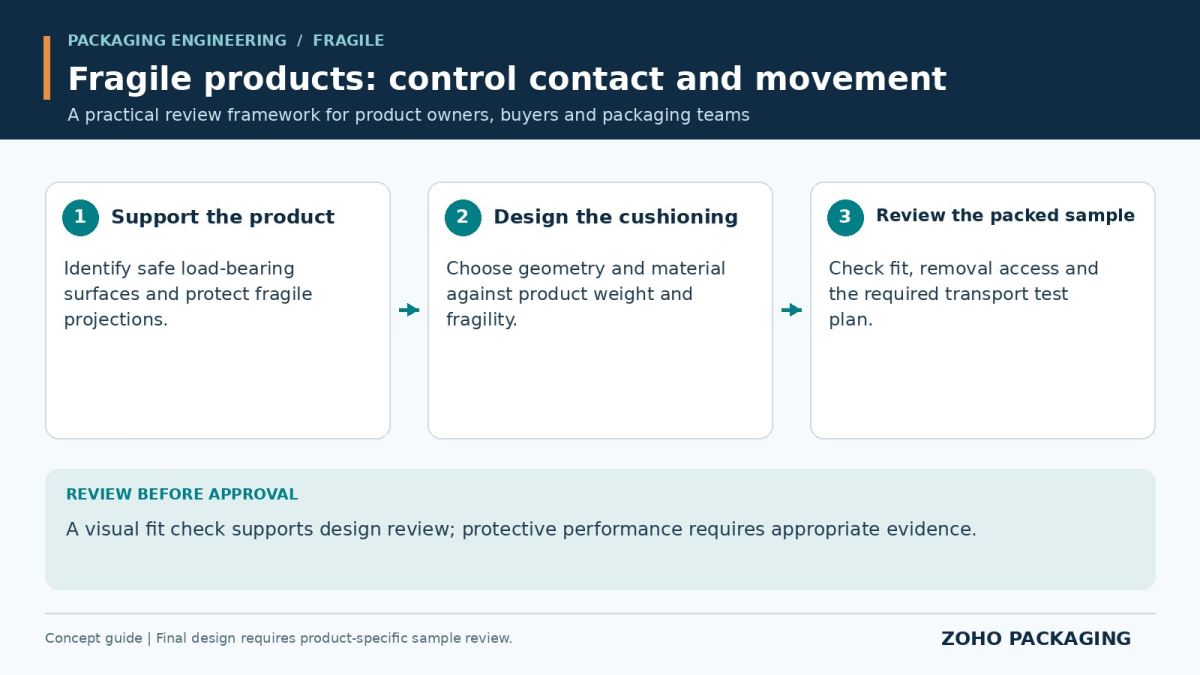 A visual fit check supports design review; protective performance requires appropriate evidence.
👉 It’s packaging failure.
Common fragile product issues:
- Glass breakage
- Surface scratches
- Internal component damage
- Micro-cracks from vibration
- Product shifting inside box
👉 Every failure = loss + customer dissatisfaction
The Real Challenge of Fragile Product Packaging
Fragile products face multiple risks during shipping:
- Drops (last-mile delivery)
- Continuous vibration (transport)
- Compression (stacking in warehouse)
👉 Most packaging only addresses one problem
but fails in real-world conditions
Our Fragile Packaging Engineering Approach
We design protection systems — not just boxes.
1. Shock Absorption Design
We use:
- Honeycomb paper structures
- Molded pulp inserts
- Multi-layer cushioning
👉 Absorb impact energy instead of transferring it to the product
2. Product Fixation System
We ensure:
- Zero internal movement
- Stable positioning
- Secure holding structure
👉 Movement = damage → eliminate movement first
3. Multi-Directional Protection
We design for:
- Vertical drops
- Side impacts
- Edge compression
👉 Protection from all angles, not just one direction
4. Structural Reinforcement
We strengthen:
- Corners
- Load-bearing panels
- Critical stress points
👉 Prevent box collapse during stacking
5. Material Matching
We select materials based on:
- Product fragility level
- Weight
- Surface sensitivity
👉 Right material = better protection + cost control
Types of Fragile Packaging Solutions
Glass & Bottle Packaging
- Impact-resistant inserts
- Anti-breakage structure
- Leak prevention design
Electronics Packaging
- Anti-shock structures
- Vibration protection
- Static-safe options
Precision Parts Packaging
- Anti-scratch protection
- Fixed positioning
- Multi-layer cushioning
High-Value Product Packaging
- Reinforced outer box
- Premium protective structure
- Export-ready design
Before vs After Fragile Packaging Optimization
| Factor |
Before |
After |
| Breakage Rate |
High |
<1% |
| Returns |
Frequent |
Reduced |
| Customer Complaints |
High |
Minimal |
| Total Cost |
Unstable |
Controlled |
👉 Protection = profit stability
Why Most Fragile Packaging Fails
- Too much empty space
- Incorrect cushioning placement
- Weak outer box
- No fixation system
- Designed without real shipping scenarios
👉 These are design failures, not material problems
Why Choose Zoho Packaging
✔ Engineering-based protection design
✔ Real-world shipping experience
✔ Custom solutions for fragile products
✔ Fast prototyping & testing
✔ Focus on damage prevention + cost optimization
Who Needs Fragile Product Packaging
- Glass product brands
- Electronics companies
- Automotive parts suppliers
- Export manufacturers
- E-commerce fragile product sellers
Final Thought
Fragile packaging is not about being “careful.”
👉 It’s about being engineered.
If your packaging is not designed for impact,
your product is designed to break.
FAQ
1. What is the best packaging for fragile products?
The best packaging combines strong outer boxes with effective internal cushioning and product fixation. Materials like molded pulp, honeycomb paper, and multi-layer cushioning systems provide excellent shock absorption. The key is designing the system as a whole, not just choosing materials.
2. How can I prevent fragile items from breaking during shipping?
Preventing breakage requires eliminating product movement, absorbing shock, and reinforcing structure. Proper box sizing, internal supports, and cushioning placement are critical. Testing packaging under real shipping conditions helps ensure performance.
3. Why do fragile items break even with cushioning?
If the product is not properly fixed, it can still move and collide with the box, causing damage. Also, poorly designed cushioning may not absorb impact effectively. Packaging must be engineered, not just filled with material.
4. What materials are best for fragile packaging?
Common materials include corrugated cardboard, molded pulp, honeycomb paper, and paper cushioning systems. The best choice depends on product weight, fragility, and shipping conditions. Material selection must match the application.
5. How does box size affect fragile product safety?
Oversized boxes increase movement and impact risk. A well-fitted box reduces internal space and stabilizes the product. Proper sizing is one of the most important factors in preventing damage.
6. Is stronger packaging always better for fragile items?
Not necessarily. Overly strong packaging increases cost without improving protection if the internal design is poor. The key is balanced design — combining structure, cushioning, and fixation.
7. What is shockproof packaging?
Shockproof packaging is designed to absorb and dissipate impact energy before it reaches the product. This includes using cushioning materials and structural design that reduce force transmission during drops or impacts.
8. How do I test fragile packaging effectiveness?
Testing methods include drop tests, vibration tests, and compression tests. These simulate real shipping conditions and help identify weak points. Iterative testing improves packaging performance.
9. Can eco-friendly materials protect fragile products?
Yes. Materials like molded pulp and honeycomb paper can provide strong protection while being environmentally friendly. Proper design ensures they perform as well as traditional materials.
10. How do I start improving fragile product packaging?
Start by analyzing current damage patterns and identifying failure points. Then redesign the packaging system with a focus on movement control, shock absorption, and structural strength. Testing is essential to validate improvements.