If your packaging fails, it is not bad luck.
It is bad structure.
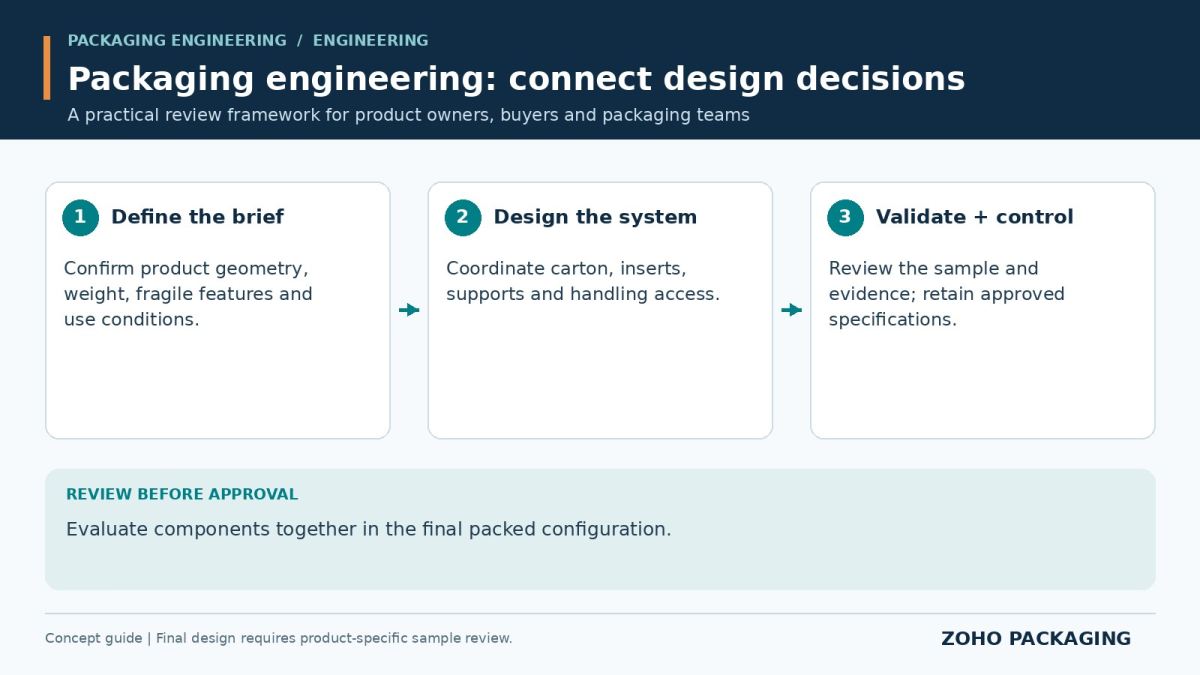 Evaluate components together in the final packed configuration.
Most companies think packaging is about size and cost.
In reality, packaging is about load paths, compression strength, and structural design.
A corrugated box is not just folded paper.
It is a load-bearing system.
And if that system is wrong, your product will fail somewhere between your warehouse and your customer.
The Real Problem: Most Boxes Are Not Designed — They Are Chosen
Here is what typically happens:
- Someone picks a “close enough” box size
- Chooses a standard board grade
- Adds filler material
- Hopes it survives shipping
This is not design. This is guessing.
And guessing leads to:
- Crushed cartons in stacking
- Product movement and internal damage
- Pallet instability
- Higher shipping cost due to inefficient sizing
- Increased returns and complaints
If you are shipping at scale, this is not acceptable.
Corrugated Box Structure = Protection + Efficiency + Cost Control
A properly engineered corrugated box must solve three things at the same time:
1. Load Distribution
Where does the weight go when boxes are stacked?
If the load path is not aligned with the structure,
your box collapses—even if the material looks “thick enough.”
2. Compression Strength
Stacking in warehouses and containers creates vertical pressure.
Without proper structure and board selection,
boxes deform → products get damaged → claims happen.
3. Internal Stability
Even if the box survives, the product inside can still fail.
Movement = friction = impact = damage.
A good design locks the product in place.
Engineering-Driven Corrugated Box Design
We do not start with a box.
We start with your risk.
Our corrugated box design process focuses on:
- Product weight and fragility
- Shipping distance (domestic vs export)
- Pallet stacking height
- Warehouse storage conditions
- Container loading pressure
- Handling conditions (drops, vibration)
Then we design structure accordingly.
Not guessing. Not copying.
Engineering.
Structure Options That Actually Matter
Most suppliers only offer “single wall” or “double wall.”
That is not design—that is limitation.
We design corrugated box structures including:
- RSC (Regular Slotted Container) for standard shipping
- Die-cut structures for precise fit
- Reinforced corners for stacking strength
- Double-wall / triple-wall for heavy-duty loads
- Partition systems for multi-product packaging
- Integrated inserts to eliminate movement
- Retail-ready structures (RRP/SRP)
- Export-grade reinforced cartons
The goal is simple:
Make the box do the work, not the filler.
Why Structure Design Reduces Cost (Not Increases It)
Many buyers assume better packaging = higher cost.
That is only true if you look at unit price.
When structure is correct, you get:
- Fewer damaged products
- Lower return rates
- Reduced need for fillers
- Better pallet efficiency (more units per shipment)
- Faster packing time
- Lower total logistics cost
A well-designed box is not an expense.
It is a cost control tool.
Export Packaging Requires Structural Thinking
Domestic packaging can survive mistakes.
Export packaging cannot.
Long-distance shipping introduces:
- High stacking pressure
- Humidity changes
- Long handling chains
- Container compression
If your corrugated box structure is not designed for export,
you are taking a risk every time you ship.
We design export packaging based on:
- Container stacking logic
- Load-bearing calculations
- Real-world shipping conditions
- Structural reinforcement where needed
Because export damage is not cheap.
From Weak Boxes to Engineered Packaging (Before vs After)
Before:
- Generic box size
- Overuse of filler
- Carton deformation
- High damage rate
After:
- Product-fit structure
- Controlled load distribution
- Stable stacking
- Reduced damage and claims
The difference is not material.
The difference is design thinking.
Who Needs Corrugated Box Structure Design?
If any of the following apply to you, you need real packaging design:
- You ship heavy products
- You export goods internationally
- You have frequent damage complaints
- Your cartons collapse in stacking
- Your packing process is inefficient
- You are scaling and cannot afford failure
At scale, packaging failure is not a small issue.
It becomes a systemic cost problem.
Why Work With Us
We are not just a box supplier.
We are a packaging engineering partner.
We focus on:
- Structural design, not just manufacturing
- Real shipping performance, not theory
- Long-term cost reduction
- Scalable packaging systems
- Consistent production quality
We help you design packaging that works in reality—not just in a quote sheet.
Call to Action
If your current packaging:
- Feels “good enough” but still fails sometimes
- Relies too much on filler
- Was never actually engineered
Then it is time to fix it.
Tell us your product, weight, and shipping conditions.
We will help you design a corrugated box structure that actually works.
FAQ
1. What is corrugated box structure design and why is it important?
Corrugated box structure design is the process of engineering how a box performs under real-world conditions, including stacking, shipping, and handling. It is not just about size—it is about how forces move through the box. A well-designed structure ensures that weight is distributed correctly, preventing collapse and deformation. Without proper design, even a thick or expensive box can fail. This is why structure design directly impacts product safety, shipping reliability, and total logistics cost.
2. Why do corrugated boxes fail during shipping?
Most corrugated box failures are caused by poor structural design rather than poor material. Common issues include incorrect load distribution, insufficient compression strength, oversized boxes that allow product movement, and lack of internal support. During shipping, boxes experience stacking pressure, vibration, and impact. If the structure does not account for these conditions, failure becomes inevitable. Proper engineering addresses these risks before they occur.
3. How do you determine the right corrugated box structure?
The correct structure is determined by evaluating product weight, dimensions, fragility, shipping method, stacking height, and environmental conditions. For example, export shipments require stronger structures due to longer transit and higher stacking pressure. Internal product stability is also considered to reduce movement. A professional manufacturer will analyze these factors and recommend the appropriate box style, board grade, and reinforcement strategy rather than offering a one-size-fits-all solution.
4. What is the difference between single-wall and double-wall corrugated boxes?
Single-wall corrugated boxes have one layer of fluting and are suitable for lighter products or shorter shipping distances. Double-wall boxes have two layers of fluting, providing higher strength and better resistance to compression. However, choosing between them should not be based only on strength. Proper structure design may allow a single-wall box to perform better than a poorly designed double-wall box. Material and structure must work together.
5. Can better box design reduce shipping costs?
Yes, significantly. A well-designed corrugated box reduces wasted space, minimizes the need for fillers, and improves pallet efficiency. This allows more units to be shipped per load, lowering freight costs. Additionally, reducing product damage lowers return and replacement expenses. While the unit cost of a better-designed box may be slightly higher, the overall logistics cost is often much lower.
6. What role does internal packaging play in box design?
Internal packaging, such as inserts or partitions, plays a critical role in stabilizing the product inside the box. Even if the outer box is strong, internal movement can cause damage due to vibration or impact. Proper internal design ensures that the product remains fixed in position, reducing friction and shock exposure. In many cases, a well-designed insert can eliminate the need for excessive filler materials.
7. Why is export packaging more demanding than domestic packaging?
Export packaging must withstand longer transit times, multiple handling stages, and varying environmental conditions such as humidity and temperature changes. It also faces higher stacking pressure in containers. These factors significantly increase the risk of failure. As a result, export corrugated box design requires stronger structures, better load distribution, and more precise engineering compared to domestic packaging.
8. What industries benefit most from engineered corrugated box design?
Industries that ship high-value, heavy, fragile, or large-volume products benefit the most. This includes electronics, automotive parts, industrial equipment, e-commerce, and export manufacturing. In these sectors, packaging failure can result in significant financial loss, making structural design a critical investment rather than an optional improvement.
9. Can corrugated box design improve warehouse efficiency?
Yes. Properly designed boxes stack more efficiently, maintain their shape under pressure, and are easier to handle during storage and picking. Optimized dimensions also improve pallet utilization, allowing warehouses to store and ship more products in the same space. This leads to better operational efficiency and reduced handling time.
10. How do I start improving my current packaging structure?
Start by reviewing your product specifications, current packaging issues, and shipping conditions. Identify where failures occur—whether in stacking, transport, or handling. Then work with a packaging partner who can analyze these factors and propose structural improvements. Even small adjustments in box size, board grade, or internal support can lead to significant performance improvements.