Heavy-Duty Corrugated Boxes
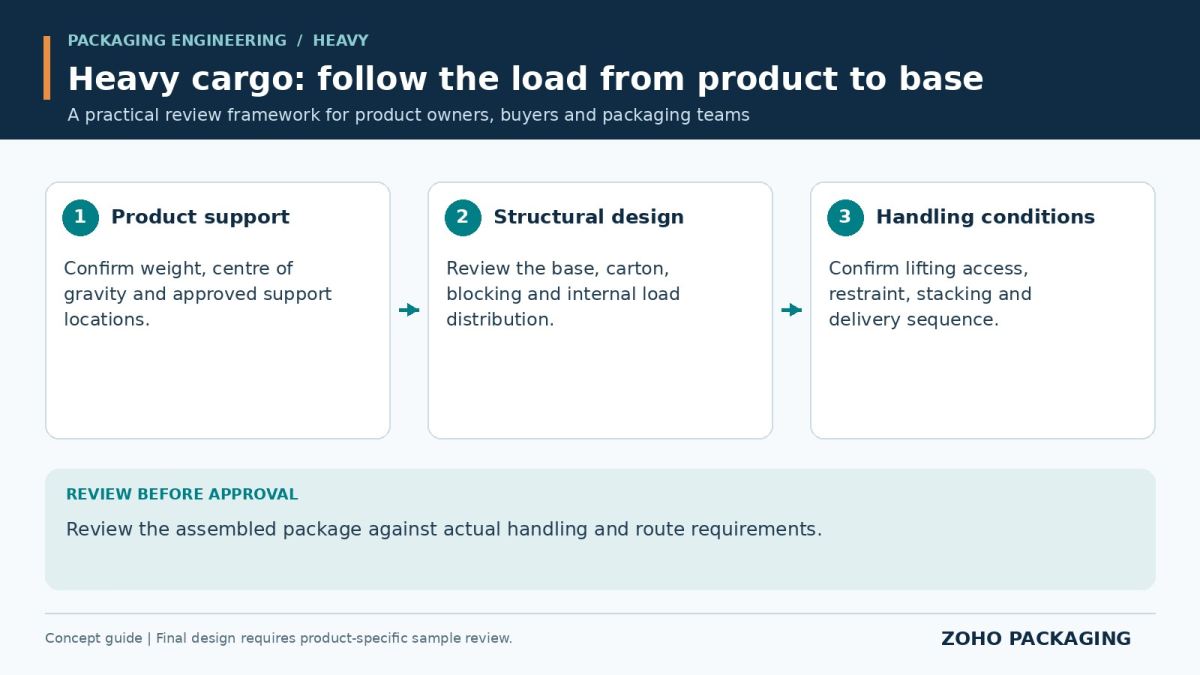 Review the assembled package against actual handling and route requirements.
If your product is heavy, valuable, or exported,
your packaging is no longer a box.
It is a load-bearing structure.
And if that structure fails,
you are not losing packaging—you are losing product, margin, and customer trust.
Heavy-Duty Packaging Is Not About Thickness
Most buyers think:
“Just use thicker cardboard.”
That is wrong.
Heavy-duty corrugated packaging is not about thickness.
It is about:
- Load distribution
- Compression strength
- Structural reinforcement
- Internal stabilization
A thick box with poor design still fails.
A properly engineered box prevents failure before it happens.
What Makes a Corrugated Box “Heavy-Duty”
A true heavy-duty corrugated box is designed to handle:
- High product weight
- Long-distance shipping
- High stacking pressure
- Rough handling conditions
- Export container loading
This is achieved through:
- Double wall or triple wall construction
- Reinforced edges and corners
- High-strength corrugated board
- Structural design aligned with load paths
- Optional internal support systems
This is not standard packaging.
This is engineering packaging.
Where Standard Boxes Fail
Standard cartons break down under heavy load because:
- Vertical compression exceeds strength
- Load is not aligned with structure
- Corners collapse under stacking pressure
- Internal product shifts create impact damage
Common results:
- Crushed cartons in containers
- Product deformation
- Broken components
- Costly returns and claims
Heavy-duty packaging exists to eliminate these risks.
Designed for Real Shipping Conditions
Heavy-duty boxes must survive:
1. Warehouse Stacking
Multiple layers create continuous compression force.
2. Container Loading
Weight from above during transport increases pressure.
3. Long-Distance Shipping
Vibration, humidity, and handling add stress over time.
4. Multiple Handling Points
Every transfer increases risk.
We design packaging that performs under all these conditions—not just in a factory test.
Double Wall vs Triple Wall: What You Actually Need
Double Wall Corrugated Boxes
- Suitable for medium to heavy products
- Good balance between cost and strength
- Common for export packaging
Triple Wall Corrugated Boxes
- Designed for very heavy loads
- High compression resistance
- Often replaces wooden crates in some applications
But again:
Choosing between them without design analysis is guesswork.
We recommend based on real use, not assumptions.
Reduce Damage = Increase Profit
Heavy-duty packaging is often seen as a cost increase.
In reality, it reduces:
- Product damage
- Return logistics
- Repacking labor
- Customer complaints
- Brand reputation risk
The real ROI is not in the box.
It is in what the box prevents.
Internal Design Is Critical
Even the strongest box fails if the inside is wrong.
Heavy-duty packaging often includes:
- Corrugated inserts
- Partition systems
- Cushioning structures
- Product locking designs
Without internal stability:
Movement = impact = damage
A strong outer box alone is not enough.
Industries That Require Heavy-Duty Corrugated Boxes
Heavy-duty packaging is essential for:
Industrial Equipment
Heavy components that require structural support.
Automotive Parts
Brake discs, suspension parts, engine components.
Electronics & High-Value Goods
Sensitive equipment needing stability and protection.
Machinery & Export Products
Large, heavy items shipped internationally.
Bulk Distribution
High stacking environments with large volumes.
If failure is expensive, heavy-duty packaging is necessary.
From Failure to Control (Real Scenario)
Before:
- Using standard cartons
- Boxes collapse under stacking
- Frequent damage claims
After:
- Upgraded to engineered heavy-duty structure
- Stable stacking
- Reduced damage rate
- Predictable shipping performance
The difference is not just stronger material.
It is designed performance.
Why Work With Us
We specialize in:
- Heavy-duty corrugated structure design
- Export packaging engineering
- Load-bearing packaging solutions
- Industrial packaging systems
- Stable mass production
We do not sell “boxes.”
We build packaging that holds under pressure.
Call to Action
If you are shipping heavy or high-value products,
you cannot afford packaging failure.
Tell us:
- Product weight
- Dimensions
- Shipping conditions
We will design a heavy-duty corrugated box that works in real-world logistics.
Because strong packaging is not an upgrade.
It is protection for your business.
FAQ
1. What are heavy-duty corrugated boxes?
Heavy-duty corrugated boxes are packaging solutions designed for heavier products, high stacking conditions, and long-distance shipping. Unlike standard boxes, they use stronger materials such as double wall or triple wall corrugated board and are often reinforced structurally. These boxes are engineered to handle compression, impact, and environmental stress during transport. They are commonly used in industrial, export, and high-value product applications where packaging failure is not acceptable.
2. When should I use heavy-duty corrugated packaging?
You should use heavy-duty corrugated packaging when your product is heavy, fragile, high-value, or shipped over long distances. It is especially important for export shipments, where boxes are exposed to higher stacking pressure, multiple handling points, and varying environmental conditions. If your current packaging results in damage, deformation, or instability, upgrading to heavy-duty packaging is necessary.
3. What is the difference between double wall and triple wall boxes?
Double wall boxes have two layers of corrugated fluting and provide strong compression resistance for medium to heavy products. Triple wall boxes have three layers and are designed for very heavy loads or extreme conditions. In some cases, triple wall boxes can replace wooden crates. However, the choice should depend on product requirements, not assumptions about strength.
4. Can heavy-duty corrugated boxes replace wooden crates?
In some cases, yes. Triple wall corrugated boxes can provide enough strength to replace wooden crates, especially for export packaging. They are lighter, easier to handle, and often more cost-effective in shipping. However, this depends on the product weight, dimensions, and shipping conditions. Proper structural design is required to ensure performance.
5. How do heavy-duty boxes reduce damage?
Heavy-duty boxes reduce damage by increasing compression strength, improving load distribution, and stabilizing the product inside. They are designed to withstand stacking pressure, vibration, and impact during transport. When combined with proper internal support, they significantly reduce the risk of product movement and breakage.
6. Are heavy-duty boxes more expensive?
Yes, the unit cost is higher than standard boxes. However, the total cost is often lower when you consider reduced damage, fewer returns, and improved logistics efficiency. Heavy-duty packaging should be evaluated based on total cost of ownership, not just unit price.
7. Do I always need triple wall for heavy products?
No. Not all heavy products require triple wall construction. In many cases, a well-designed double wall box with proper reinforcement is sufficient. Using triple wall unnecessarily can increase cost and weight. The best solution depends on actual load requirements and shipping conditions.
8. What role does internal packaging play in heavy-duty boxes?
Internal packaging is critical. It prevents product movement, absorbs shock, and distributes load evenly. Without proper internal design, even the strongest outer box can fail to protect the product. Inserts, partitions, and cushioning systems are often used to improve performance.
9. How does stacking affect heavy-duty packaging design?
Stacking creates continuous vertical pressure on the bottom boxes. The higher the stack, the greater the compression force. Heavy-duty packaging must be designed to withstand this pressure without collapsing. This includes selecting the right board grade, structure, and reinforcement strategy.
10. How can I get started with heavy-duty corrugated packaging?
Start by providing your product specifications, including weight, size, and shipping conditions. A packaging expert can evaluate these factors and recommend the appropriate structure, material, and design. This ensures that your packaging performs reliably under real-world conditions.