Export Corrugated Boxes
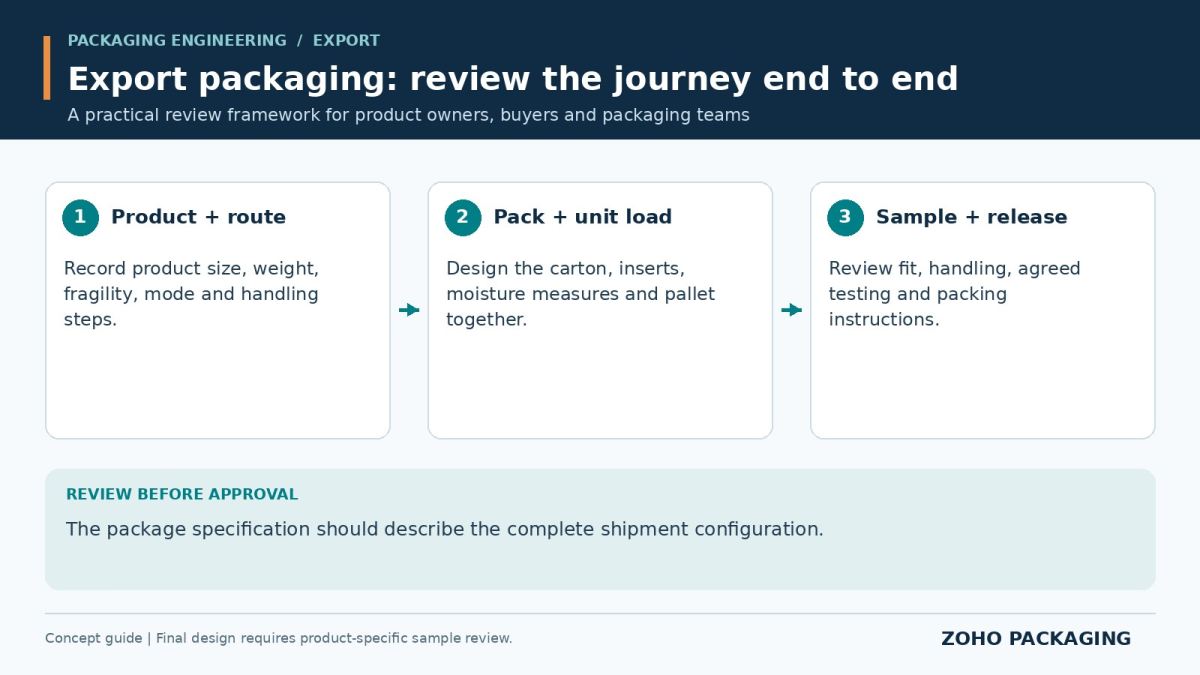 The package specification should describe the complete shipment configuration.
Export is where packaging gets tested.
Not in theory.
Not in the factory.
But across:
- Long-distance shipping
- Multiple handling points
- High stacking pressure
- Changing environments
If your packaging fails here,
you are not just losing products.
You are losing international trust.
Export Packaging Is a Different Game
Domestic shipping can tolerate mistakes.
Export cannot.
Why?
Because export introduces:
- Longer transit time
- Container stacking pressure
- Humidity and temperature variation
- Multiple transfers between handlers
A standard corrugated box is not designed for this.
What Goes Wrong in Export Packaging
Most export damage is caused by:
- Insufficient compression strength
- Poor stacking design
- Weak box structure
- Product movement inside the carton
- Incorrect pallet configuration
Common results:
- Collapsed cartons in containers
- Damaged or deformed products
- Rejected shipments
- Customer disputes
These are not rare cases.
They are preventable failures.
What an Export Corrugated Box Must Do
A proper export box must be engineered to:
1. Withstand Stacking Pressure
Multiple layers inside containers create continuous load.
2. Maintain Structure in Humidity
Moisture weakens paper strength.
3. Protect Against Movement
Long transit = repeated vibration and impact.
4. Fit Pallet & Container Logic
Efficient loading reduces both cost and risk.
5. Deliver Consistent Performance
Every shipment must perform the same way.
Anything less creates uncertainty.
Designed for Container Shipping
Container shipping adds unique stress:
- Bottom cartons تحمل maximum load
- Uneven weight distribution
- Long storage periods
We design export corrugated boxes based on:
- Pallet stacking height
- Container loading pattern
- Load distribution across layers
- Reinforced structural zones
Because container failure is not visible
until it is too late.
Double Wall Is Standard — But Not Enough
Most export packaging uses double wall corrugated boxes.
That is a starting point.
But real performance depends on:
- Board quality
- Flute combination
- Structural design
- Internal support
Without these, even double wall boxes fail.
Reduce Export Damage = Protect Your Margin
Export damage is expensive:
- Product loss
- Freight waste
- Re-shipment cost
- Customer dissatisfaction
- Reputation damage
A stronger box costs more upfront.
But failure costs far more.
Export packaging is not a cost center.
It is a risk management tool.
Internal Protection Is Critical
Export damage is often caused by movement inside the box.
We design internal systems such as:
- Corrugated inserts
- Partition structures
- Cushioning layouts
- Product locking mechanisms
Because:
If the product moves, it will get damaged.
Pallet Optimization Matters
Many export failures come from poor pallet design.
We help optimize:
- Carton size vs pallet size
- Layer stacking configuration
- Weight distribution
- Container space utilization
Better pallet logic means:
- Less damage
- Lower shipping cost
- More predictable performance
Before vs After (Export Scenario)
Before:
- Standard carton
- No structural design
- High damage rate
After:
- Engineered export packaging
- Stable stacking
- Reduced claims
- Reliable delivery
The difference is not material.
It is engineering.
Who Needs Export Corrugated Boxes?
If you:
- Ship internationally
- Export industrial or consumer goods
- Have experienced shipping damage
- Need reliable delivery performance
- Care about long-term overseas clients
Then export packaging is critical.
Why Work With Us
We specialize in:
- Export packaging design
- Corrugated structural engineering
- Container load optimization
- Industrial packaging solutions
- Consistent production quality
We do not just supply boxes.
We help you ship without failure.
Call to Action
If your export shipments:
- Occasionally arrive damaged
- Feel unpredictable
- Depend on “hope” instead of design
Then it is time to fix it.
Tell us:
- Product size and weight
- Export destination
- Shipping method
We will design export corrugated boxes that:
protect your products from factory to final destination.
FAQ(每題 ≥150字|出口成交導向)
1. What are export corrugated boxes?
Export corrugated boxes are packaging solutions specifically designed for international shipping. They are built to handle long transit times, high stacking pressure, and environmental changes such as humidity. These boxes typically use stronger materials and structural design to ensure product safety throughout the entire shipping journey.
2. Why is export packaging different from domestic packaging?
Export packaging must withstand more extreme conditions, including longer shipping times, multiple handling stages, and higher stacking pressure in containers. Domestic packaging often does not face these conditions, which is why standard boxes may fail during export shipments. Export packaging requires stronger design and better materials.
3. Are double wall boxes enough for export shipping?
Double wall boxes are commonly used for export, but they are not always sufficient. The effectiveness depends on product weight, stacking conditions, and shipping environment. In some cases, additional reinforcement or internal support is required. Proper design is more important than simply choosing thicker material.
4. How can I reduce damage during export shipping?
Damage can be reduced by improving box strength, optimizing structure, minimizing internal movement, and ensuring proper pallet configuration. Understanding the shipping environment and designing packaging accordingly is essential. A packaging expert can help identify weak points and improve performance.
5. What role does humidity play in export packaging?
Humidity can weaken corrugated board, reducing its compression strength. This increases the risk of carton collapse during stacking. Export packaging must account for environmental conditions by selecting appropriate materials and designing structures that maintain strength under varying humidity levels.
6. Do I need internal inserts for export packaging?
In many cases, yes. Internal inserts help stabilize the product and reduce movement during long-distance shipping. Without proper internal support, products can shift and become damaged even if the outer box remains intact. Inserts are especially important for fragile or high-value items.
7. How does pallet design affect export performance?
Pallet design determines how weight is distributed across cartons. Poor pallet configuration can create uneven pressure, leading to carton failure. Optimizing pallet layout improves stability, reduces damage risk, and increases shipping efficiency.
8. Can export corrugated boxes replace wooden packaging?
In some cases, yes. High-strength corrugated boxes, such as triple wall designs, can replace wooden crates for certain applications. They offer advantages such as lighter weight and easier handling. However, the decision depends on product requirements and shipping conditions.
9. What industries rely on export corrugated packaging?
Industries such as manufacturing, electronics, automotive, machinery, and consumer goods rely heavily on export corrugated packaging. Any business that ships products internationally needs reliable packaging to ensure safe delivery and maintain customer satisfaction.
10. How do I start improving my export packaging?
Start by reviewing your current packaging performance and identifying where failures occur. Provide product details, shipping conditions, and export destinations to a packaging expert. From there, a customized solution can be developed to improve reliability and reduce risk.