Export Packaging Design That Protects Products and Profit
When products move across borders, packaging is no longer just a container. It becomes a critical part of logistics, product protection, and cost control. Good export packaging design helps manufacturers, exporters, and international brands reduce damage, improve loading efficiency, and deliver products safely to customers worldwide.
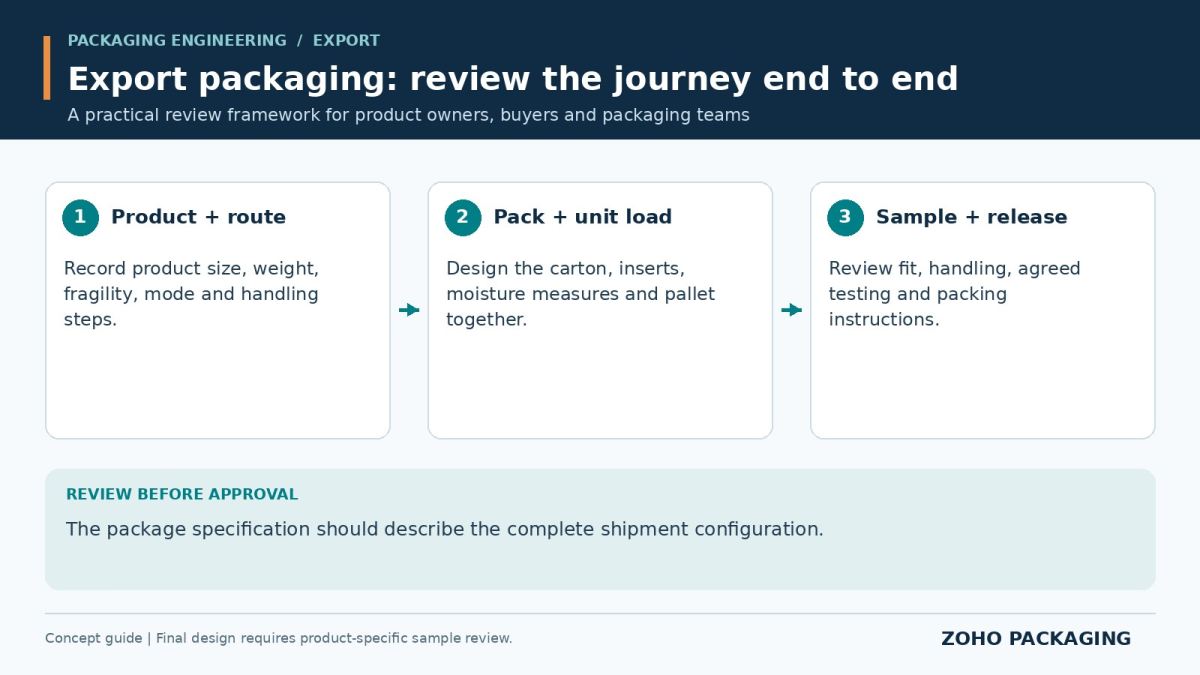 The package specification should describe the complete shipment configuration.
At Zoho Packaging, we believe export packaging design is an engineering decision, not just a visual one. A well-designed export box should withstand stacking pressure, vibration, drop impact, humidity changes, and the long handling chain of international transportation. If the packaging fails, the product may arrive damaged, the shipment may be rejected, and the supplier may lose money far beyond the box price itself.
Why Export Packaging Design Matters
Many companies focus only on product cost, but overlook packaging risk. In domestic delivery, the transport route is usually shorter and simpler. In export shipping, products may go through factory handling, warehousing, pallet stacking, container loading, ocean freight, customs inspection, unloading, inland delivery, and final warehousing. Every stage adds risk.
This is why export packaging design must consider more than appearance. It should address:
- carton strength under long-distance stacking
- shock resistance during rough handling
- moisture exposure in sea freight conditions
- pallet arrangement and container space usage
- internal protection for fragile or high-value products
- labeling, compliance, and shipping efficiency
A cheaper box that fails in transit is never truly cheaper. The real cost of packaging failure includes damaged goods, replacement shipments, delayed projects, customer complaints, and lost trust.
What Makes a Good Export Packaging Design
A proper export packaging solution starts from the product itself. Weight, dimensions, fragility, load points, product surface condition, and shipping method all affect the packaging structure.
For example, heavy industrial parts may need reinforced corrugated boxes with internal blocking and load-distribution supports. Fragile electronics may require shock-absorbing inserts, anti-scratch protection, and carefully engineered void control. Export packaging for retail-ready products may also need to balance shipping protection with shelf presentation.
A good export packaging design usually includes the following elements:
1. Structural Strength
The outer packaging must support stacking load during storage and transport. This includes choosing the right corrugated board grade, flute combination, and box style.
2. Internal Protection
Products should not move freely inside the carton. Internal pads, partitions, corner supports, molded inserts, or paper-based cushioning systems can reduce impact and surface damage.
3. Pallet Optimization
The packaging dimensions should match pallet layout and container loading logic. Better pallet design improves transport efficiency and lowers shipping cost.
4. Moisture and Transit Risk Control
For export shipments, especially sea freight, humidity and compression loss are real problems. Packaging must be designed with environmental risk in mind.
5. Practical Handling Design
Export cartons should be easy to stack, identify, strap, and move. Good design reduces mistakes during warehouse and shipping operations.
Common Export Packaging Problems
Many export failures happen because packaging was designed only for the product, not for the full shipping journey. Some of the most common issues include:
- cartons collapsing under stacking pressure
- product damage caused by empty space inside the box
- scratched surfaces from improper contact or movement
- oversize packaging increasing freight cost
- pallet overhang causing load instability
- weak board selection for product weight
- poor packaging consistency in repeated production runs
These problems are avoidable when packaging is engineered properly from the start.
Export Packaging Design for Different Industries
Different industries require different packaging priorities.
Industrial equipment often needs heavy-duty corrugated solutions, reinforced corners, and strong load-bearing structures.
Automotive parts need anti-scratch, anti-shift, and shock-resistant internal design.
Electronics require precision fit, cushioning, and clean presentation.
Food and consumer goods may need a combination of export durability and retail display compatibility.
High-value export products often require packaging that reduces both physical damage and customer claim risk.
This is why one standard box design cannot solve every export problem. Real export packaging design should be customized around the product, shipping route, and customer expectations.
Packaging Design Is About Loss Prevention
Many buyers compare packaging by unit price alone. But experienced exporters know the real question is different: how much loss can this packaging prevent?
A stronger export packaging design can reduce returns, lower breakage rates, improve customer satisfaction, and protect brand credibility. It can also improve warehouse handling, reduce wasted container space, and support smoother international operations.
In other words, packaging is not just a material cost. It is part of the cost-control system of global trade.
Our Approach to Export Packaging Design
At Zoho Packaging, we develop export packaging with a practical engineering mindset. We do not simply make boxes. We design packaging systems based on product characteristics, shipping risk, loading method, and production stability.
Our export packaging design service can support:
- custom corrugated export cartons
- heavy-duty shipping boxes
- fragile product protection structures
- pallet and container loading optimization
- branding-compatible shipping carton design
- packaging upgrades for export damage reduction
Whether you are shipping industrial components, retail goods, electronics, or custom-made products, the goal is the same: protect the shipment, reduce avoidable loss, and make international delivery more reliable.
Export Packaging Design Should Work in the Real World
A packaging design that looks good on paper but fails in the warehouse is not a good design. Export packaging must work under pressure, under movement, and under real shipping conditions.
That is why we focus on structure, function, and repeatable production quality. Because in export business, packaging is not just about sending products out. It is about making sure they arrive in the right condition, at the right time, with the right impression.
Export packaging design is not about using more material. It is about using the right structure to protect your shipment and your profit.
FAQ
1. What is export packaging design?
Export packaging design is the process of creating packaging that protects products during international shipping. It considers stacking strength, shock resistance, humidity exposure, pallet efficiency, and product stability during long-distance transportation.
2. Why is export packaging different from domestic packaging?
Export packaging usually faces longer transit times, more handling points, container loading pressure, and higher humidity risk. Because of this, export packaging must be designed with stronger structure and better protection than standard domestic packaging.
3. What products need custom export packaging design?
Heavy products, fragile goods, precision equipment, automotive parts, electronics, branded products, and high-value exports often require custom export packaging design to reduce transit damage and improve shipping performance.
4. Can better export packaging reduce shipping damage?
Yes. A well-engineered export packaging design can reduce movement inside the carton, improve compression strength, and provide better protection against impact, vibration, and rough handling during international transport.
5. Does export packaging design help lower cost?
Yes. Good packaging design can reduce product loss, improve pallet efficiency, optimize carton size, and prevent costly damage claims. In many cases, it lowers total shipping cost even if the packaging unit price is slightly higher.
6. What should be considered in export carton design?
The main factors include product size, product weight, fragility, shipping route, pallet size, stacking height, container conditions, and whether the product needs internal inserts or cushioning materials.
7. Is stronger packaging always better?
Not always. The goal is not simply to use more material, but to use the right structure. Over-packaging can increase cost and freight volume. Smart export packaging design balances protection, efficiency, and cost.
8. Can export packaging be customized for pallets and containers?
Yes. Export packaging can be designed to fit pallet sizes and container dimensions more efficiently. This improves loading stability, reduces wasted space, and supports better logistics performance.
9. What causes export cartons to fail?
Common reasons include weak board selection, poor structural design, too much empty space inside the box, bad pallet arrangement, and failure to consider humidity and stacking conditions during shipping.
10. Why should exporters treat packaging as an engineering issue?
Because packaging performance directly affects product safety, customer satisfaction, and financial loss. Good export packaging design helps prevent damage, improve operational stability, and protect profit in international trade.