Article
2026/04/09
ESD Safe Anti-Static Packaging Solutions | Protect Electronics from Static Damage
ESD Safe Anti-Static Packaging Solutions That Protect What You Can’t See
Electrostatic discharge (ESD) is invisible.
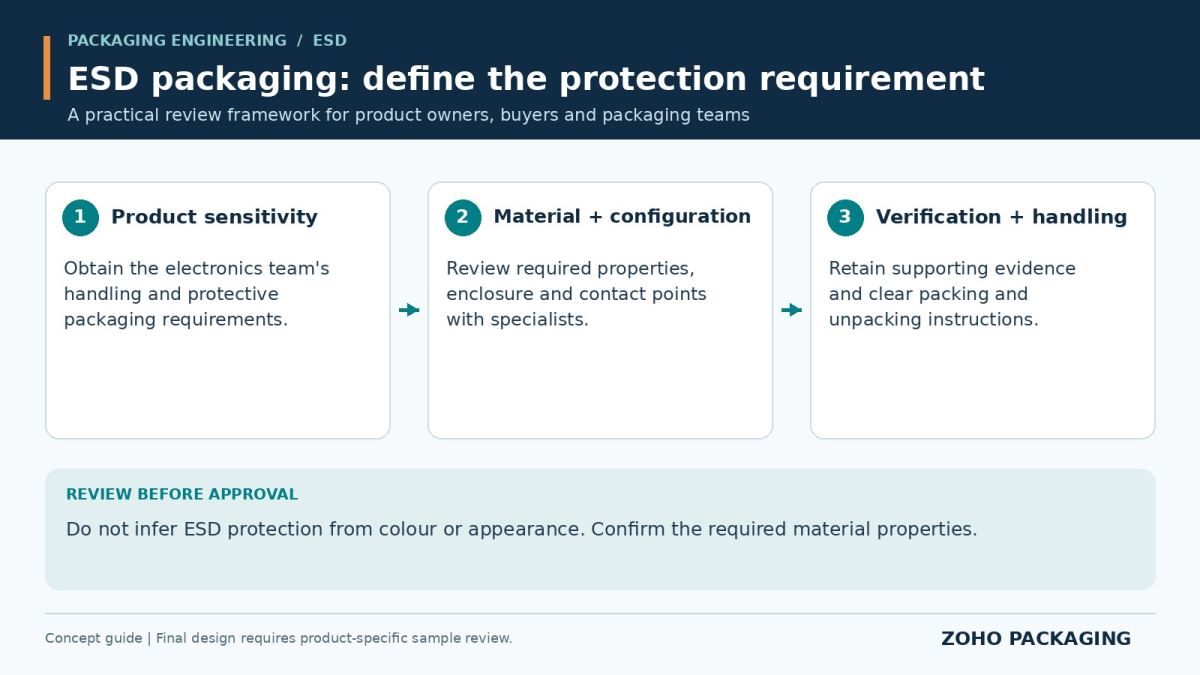 Do not infer ESD protection from colour or appearance. Confirm the required material properties.
But the damage is real.
- circuit failure
- component degradation
- reduced product lifespan
👉 And often, the failure happens after delivery.
At Zoho Packaging, we design ESD safe anti-static packaging systems that protect sensitive electronics from static damage during handling, storage, and shipping.
Why ESD Protection Is Critical
Electronics are vulnerable to:
- static buildup during handling
- friction during transport
- environmental conditions
Even a small discharge can:
- damage circuits
- reduce reliability
- cause intermittent failures
👉 Standard packaging offers no protection against ESD.
What Is ESD Safe Packaging
ESD safe packaging is designed to:
- prevent static buildup
- dissipate electrostatic charge
- shield sensitive components
👉 It protects electronics at the microscopic level.
Core Principles of Anti-Static Packaging
1. Static Dissipation
Materials allow:
- controlled discharge
- prevention of sudden static buildup
2. Shielding Protection
We use materials that:
- block external electrostatic fields
- protect internal components
3. Conductive & Anti-Static Materials
Includes:
- anti-static films
- conductive layers
- specialized packaging materials
4. Controlled Environment Packaging
We design systems that:
- reduce friction
- control contact points
- minimize static generation
5. Integrated Protection System
ESD protection must work with:
- shockproof packaging
- structural packaging
- logistics handling
ESD Packaging vs Standard Packaging
| Factor |
Standard Packaging |
ESD Packaging |
| Static protection |
None |
Yes |
| Risk level |
High |
Controlled |
| Application |
General |
Electronics |
| Protection type |
Physical only |
Physical + electrical |
| Reliability |
Limited |
High |
Common Mistakes in ESD Packaging
- using non-ESD materials
- ignoring static risk in logistics
- mixing ESD and non-ESD packaging
- focusing only on shock protection
- lack of system integration
Applications of ESD Safe Packaging
Semiconductors
→ ultra-sensitive protection
PCB and electronic components
→ static control
Consumer electronics
→ reliability protection
Industrial electronics
→ high-value systems
Prevent Invisible Damage
ESD damage often results in:
- delayed failure
- warranty claims
- customer dissatisfaction
👉 Proper packaging prevents these hidden risks.
Our ESD Packaging Approach
We design based on:
- product sensitivity
- ESD risk level
- handling conditions
- shipping environment
We deliver:
- ESD safe packaging systems
- anti-static material solutions
- integrated protection design
- export-ready electronics packaging
Built for Reliability, Not Just Protection
Electronics must not only arrive intact.
They must work perfectly.
At Zoho Packaging, we design packaging that protects performance — not just appearance.
Because:
👉 The most dangerous damage is the one you cannot see.
FAQ(每題150字以上)
1. What is ESD safe packaging?
It is packaging designed to prevent electrostatic discharge and protect sensitive electronic components.
2. Why is anti-static packaging important?
Static electricity can damage electronic circuits, even without visible signs.
3. What is electrostatic discharge (ESD)?
It is the sudden flow of electricity between two objects with different charges.
4. Can standard packaging prevent ESD?
No. Specialized materials are required.
5. What materials are used in ESD packaging?
Anti-static films, conductive materials, and shielding layers.
6. What products need ESD packaging?
Semiconductors, PCBs, and sensitive electronic components.
7. Can ESD damage be detected immediately?
Not always. Damage may appear later.
8. How does ESD packaging work?
It dissipates or blocks static charge to protect components.
9. Is ESD packaging needed for shipping?
Yes, especially for sensitive electronics.
10. How do you design ESD packaging?
By analyzing product sensitivity and applying proper materials and structure.