UN Compliance Is Not About Boxes — It’s About Getting Your Shipment Accepted
Most exporters assume:
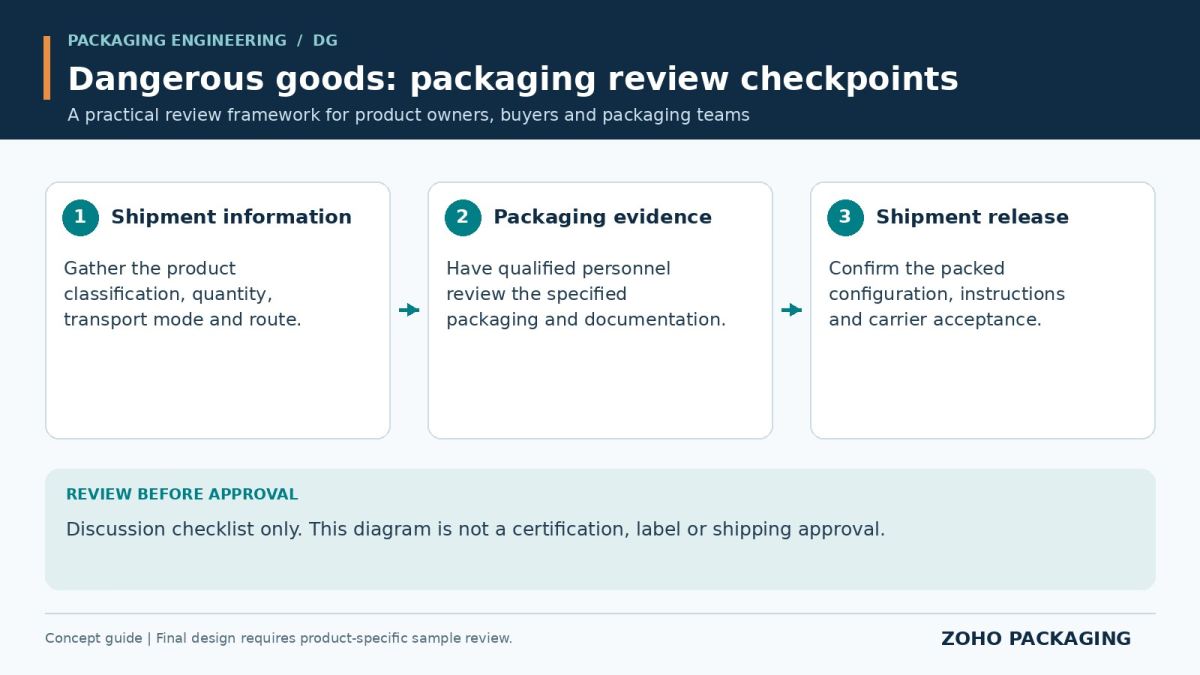 Discussion checklist only. This diagram is not a certification, label or shipping approval.
- “We’re using a UN box, so we’re fine.”
- “We added labels, so it should pass.”
That’s where shipments fail.
👉 UN compliance has two non-negotiable components:
- Certified packaging structure (passed testing)
- Correct marking & labeling
Miss one → your shipment can be rejected, delayed, or returned
1. UN Marking
UN marking is the certification code printed directly on the box.
It proves the packaging has passed UN testing.
Example (UN 4G fiberboard box):
UN 4G / Y45 / S / 23 / TW / ZOHO
What each element means:
- UN → United Nations certification
- 4G → Fiberboard box
- Y → Suitable for Packing Group II & III
- 45 → Maximum gross weight (kg)
- S → Solid contents
- 23 → Year of manufacture
- TW → Country of origin
- ZOHO → Manufacturer identification
Critical compliance failures we see:
- Blurry or unreadable markings
- Marking does NOT match test report
- Wrong packaging group (X / Y / Z misuse)
- Structural changes after certification
👉 UN marking is not decoration — it’s a legal compliance identifier
2. UN Labeling (Hazard Labels on the Outside)
Labeling refers to hazard labels applied to the outer packaging
These indicate the type of dangerous goods inside.
Common required labels:
- Class 9 → Lithium batteries
- Class 3 → Flammable liquids
- Class 8 → Corrosive materials
- Handling labels → Orientation / Fragile
Labeling rules (strictly enforced):
- Minimum size: 100mm × 100mm
- Must be visible on at least 2 sides
- Cannot be covered or obstructed
- Must match shipping documents (MSDS / DG Declaration)
Lithium battery additional requirements:
- Lithium battery mark
- UN number (UN3480 / UN3481)
- Emergency contact number
👉 Missing any of these → Airlines will reject your cargo immediately
3. Marking vs Labeling
| Category |
Marking |
Labeling |
| Location |
Printed on box |
Applied as labels |
| Purpose |
Certification proof |
Hazard communication |
| Required |
Mandatory |
Mandatory |
👉 You need BOTH — not one or the other
4. Why Shipments Get Rejected (Real Reasons)
Most issues are NOT product-related.
They come from packaging compliance failures:
- Incorrect or missing UN marking
- Wrong or missing labels
- Mismatch between packaging and documents
- Non-certified packaging used
👉 Result:
- Shipment rejection
- Customs delays
- Financial loss
- Insurance claims denied
5. How We Solve This (ZOHO Packaging Approach)
We don’t just supply boxes.
We engineer export-ready packaging systems.
What we provide:
- UN 4G fiberboard box design
- UN wooden crate solutions
- Correct marking layout planning
- Hazard labeling guidance
- Test report alignment
- Pre-shipment compliance checks
One-line positioning:
👉 We don’t sell packaging — we make sure your shipment gets accepted
6. Real Case (Lithium Battery Export)
Before:
- Regular carton + self-applied labels
→ Airline rejection
After:
- UN-certified 4G packaging
- Correct marking + labeling
- Document alignment
👉 Shipment approved → repeat orders secured
CTA (Conversion Section)
If you are dealing with:
- Shipment rejection issues
- Lithium battery export compliance
- Uncertainty about UN requirements
👉 Talk to us.
ZOHO Packaging — Your Engineering Partner for Export Compliance
FAQ
Q1: Can UN marking be applied as a sticker instead of printing?
UN marking must be permanent and durable. In most cases, it should be printed directly on the packaging or embossed. Stickers are generally not recommended unless they meet strict durability standards and cannot be easily removed or damaged during transport. The marking represents certified packaging compliance, so it must remain legible throughout the entire logistics process, including handling, stacking, and environmental exposure. If the marking fades, peels off, or becomes unreadable, the package may be considered non-compliant. For this reason, integrating the marking into the printing stage is the safest and most widely accepted practice.
Q2: Does UN marking have to match the test report exactly?
Yes, the UN marking must match the test report exactly. Every element—including packaging type, weight rating, year, and manufacturer identification—must correspond to the certified test data. If there is any mismatch, the packaging is considered non-compliant, even if the structure itself appears identical. This is a common reason shipments are rejected by carriers or customs authorities. The marking is essentially a declaration of compliance, and any discrepancy undermines its validity. Proper coordination between packaging design, certification, and printing is essential to ensure full alignment.
Q3: What happens if labels are placed incorrectly?
Incorrect label placement can lead to immediate shipment rejection. Regulations require hazard labels to be clearly visible, unobstructed, and applied on appropriate surfaces—usually on at least two sides of the package. If labels are hidden, covered by tape, or placed in non-visible areas (such as the bottom), the shipment may be treated as non-compliant. In practice, many logistics providers will refuse to accept such shipments altogether. Proper label placement should be considered during the packaging design stage, not as a last-minute step before shipping.
Q4: Do lithium batteries always require UN-certified packaging?
Not always, but in most commercial shipping scenarios, especially for air transport or higher-capacity batteries, UN-certified packaging is required. For lithium batteries exceeding 100Wh or shipped in bulk, UN 4G packaging is typically mandatory. In addition, specific labels and documentation must be provided. Even if the batteries themselves are safe, non-compliant packaging can result in shipment rejection. It is important to evaluate the battery type, capacity, and shipping mode before determining the appropriate packaging solution.
Q5: Can the same UN marking be reused across different box designs?
No. UN marking is specific to a particular packaging design that has been tested and certified. Any change in dimensions, material, structure, or manufacturing process invalidates the original certification. Reusing the same marking on a modified box is considered a compliance violation. Even small structural differences can affect performance under test conditions. Each unique packaging configuration must have its own certification and corresponding marking.
Q6: What if the UN marking becomes unclear during transport?
If the marking becomes unreadable due to moisture, abrasion, or poor print quality, the packaging may be considered non-compliant. This is especially critical in ocean freight or high-humidity environments where ink durability matters. Choosing the right printing method and material is essential to ensure long-term legibility. Compliance is not only about initial correctness but also about maintaining visibility throughout the supply chain.
Q7: Can I skip labeling if I already have UN marking?
No. Marking and labeling serve different purposes and both are mandatory. Marking certifies that the packaging has passed testing, while labeling communicates the hazard class of the contents. Having one without the other does not meet regulatory requirements. Both must be present and correctly applied to ensure safe and compliant transportation.
Q8: What should be checked before shipping dangerous goods?
At minimum, three key areas should be verified:
- UN marking accuracy and clarity
- Correct label type and placement
- Consistency between packaging and documentation (MSDS, DG declaration)
Many shipment failures occur due to inconsistencies between these elements rather than the packaging itself. A systematic pre-shipment check can prevent costly delays and rejections.
Q9: Can I use a regular box and just add hazard labels?
No. A regular box without UN certification does not meet dangerous goods transport requirements, regardless of labeling. Hazard labels alone do not validate the structural integrity or compliance of the packaging. Using non-certified packaging can lead to shipment rejection and may void insurance coverage in case of damage or incidents. Certified packaging is required to ensure safety and regulatory compliance.
Q10: Why do some companies keep facing shipping issues?
Most recurring issues stem from incomplete compliance systems. Common problems include incorrect marking, improper labeling, and mismatched documentation. These are often treated as minor details, but in international shipping, they are critical checkpoints. Without a structured packaging and compliance strategy, companies may repeatedly face delays, rejections, and financial losses. Working with an experienced packaging engineering partner can significantly reduce these risks.