Packaging Cost Is Not the Box Price
It’s the Total Logistics Cost
Most companies focus on:
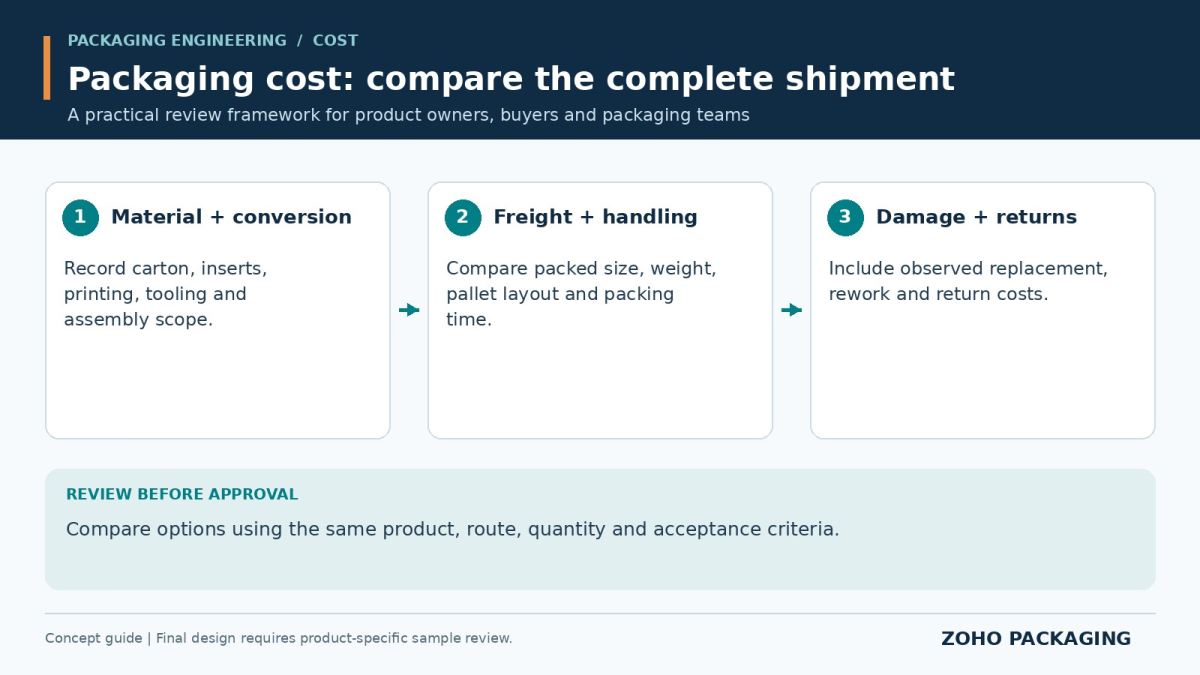 Compare options using the same product, route, quantity and acceptance criteria.
- Unit price per carton
- Material cost
That’s the wrong metric.
👉 Real cost = Packaging + Shipping + Damage + Handling
Example:
- Cheap box → damage → replacement cost
- Oversized box → higher freight cost
- Over-designed packaging → unnecessary expense
👉 Saving on packaging can cost you more overall
1. Cost Structure Breakdown (What You’re Actually Paying)
Your real cost includes:
- Packaging material cost
- Shipping cost (weight & volume)
- Damage & return cost
- Handling & labor cost
- Storage cost
👉 Optimization = balancing ALL factors
2. Right-Sizing (The Fastest Cost Reduction)
Oversized packaging is one of the biggest cost drivers.
Problems:
- Higher dimensional weight
- Wasted container space
- Increased material usage
Solution:
- Custom-fit packaging
- Reduce empty space
- Optimize dimensions
👉 Smaller box = lower cost
3. Material Optimization
Many companies overpay for strength they don’t need.
Common issue:
- Using thicker board “just to be safe”
Engineering approach:
- Match material to actual load
- Use high-performance liners
- Optimize structure instead of thickness
👉 Same performance, lower cost
4. Damage Cost Reduction (Hidden Profit Killer)
Damage is one of the biggest hidden costs.
Impact:
- Product replacement
- Return logistics
- Customer dissatisfaction
- Brand damage
👉 Investing in better packaging reduces total cost
5. Container Utilization (Big Money Factor)
Container space = money.
Optimization:
- Increase units per container
- Reduce empty space
- Improve stacking efficiency
👉 Better utilization = lower cost per unit
6. Lightweight Strategy
Shipping cost is heavily influenced by weight.
Approach:
- Reduce unnecessary material
- Use lightweight high-strength designs
- Optimize packaging geometry
👉 Lower weight = lower freight cost
7. Process Optimization
Packaging affects operations.
Improvements:
- Faster packing time
- Easier handling
- Reduced labor cost
👉 Efficiency = cost savings
8. Real Case (Cost Optimization Result)
Before:
- Oversized cartons
- High shipping cost
- Frequent damage
After:
- Right-sized packaging
- Structural optimization
- Improved container loading
👉 Total cost reduced significantly
👉 Damage reduced
👉 Profit margin increased
Why Most Companies Fail at Cost Optimization
Because they focus on:
- Unit price
- Supplier quotes
Instead of:
👉 Total system cost
What We Provide (ZOHO Packaging)
- Export packaging cost analysis
- Structural optimization
- Material selection strategy
- Container loading optimization
- Damage reduction engineering
- End-to-end packaging solutions
Positioning:
👉 We don’t reduce packaging cost — we reduce total logistics cost
If you are:
- Paying too much for shipping
- Experiencing hidden packaging costs
- Scaling export operations
👉 Talk to us.
ZOHO Packaging — Engineered Solutions for Cost-Efficient Export
FAQ
Q1: What is the biggest mistake in packaging cost management?
The biggest mistake is focusing only on the unit price of packaging. While a cheaper box may reduce upfront costs, it can lead to higher overall expenses due to damage, inefficient shipping, and increased handling. True cost optimization requires evaluating the entire logistics system, including freight, storage, and risk factors.
Q2: How can packaging reduce shipping costs?
Packaging affects both weight and volume, which are key factors in shipping costs. By reducing unnecessary material and optimizing dimensions, companies can lower freight charges. Additionally, better packaging design can improve container utilization, allowing more units per shipment.
Q3: Is it worth investing in better packaging?
Yes. While engineered packaging may have a higher upfront cost, it often reduces total cost by minimizing damage, improving efficiency, and lowering shipping expenses. Over time, this leads to significant savings and better performance.
Q4: What is dimensional weight and why is it important?
Dimensional weight is a pricing method used by carriers that considers package size in addition to weight. Large but lightweight packages can still incur high costs. Optimizing packaging dimensions is essential for reducing these charges.
Q5: How does damage impact total cost?
Damage leads to product replacement, return logistics, and potential loss of customers. It also affects brand reputation. Reducing damage through better packaging design can significantly improve profitability.
Q6: What is container utilization?
Container utilization refers to how efficiently space is used within a shipping container. Better utilization means more products per shipment, which lowers cost per unit. Poor utilization results in wasted space and higher costs.
Q7: Can lightweight packaging reduce cost without increasing risk?
Yes, if properly designed. Lightweight packaging focuses on removing unnecessary material while maintaining strength. This reduces shipping cost without compromising protection.
Q8: How do you optimize packaging for export?
The process involves analyzing product requirements, shipping conditions, and cost factors. Engineers then design a packaging solution that balances protection, efficiency, and cost. This includes material selection, structural design, and logistics integration.
Q9: What industries benefit most from packaging optimization?
Industries with high shipping volumes, heavy products, or fragile items benefit the most. This includes manufacturing, e-commerce, electronics, and industrial equipment sectors.
Q10: Why work with a packaging engineering partner?
Because cost optimization requires a holistic approach. An engineering partner considers all aspects of packaging and logistics, ensuring that solutions are efficient, reliable, and cost-effective. This leads to better long-term results compared to standard solutions.