Why Packaging Fails During Sea Shipping (And How to Prevent It)
For many Australian businesses importing goods from Asia, one issue continues to cause unnecessary losses:
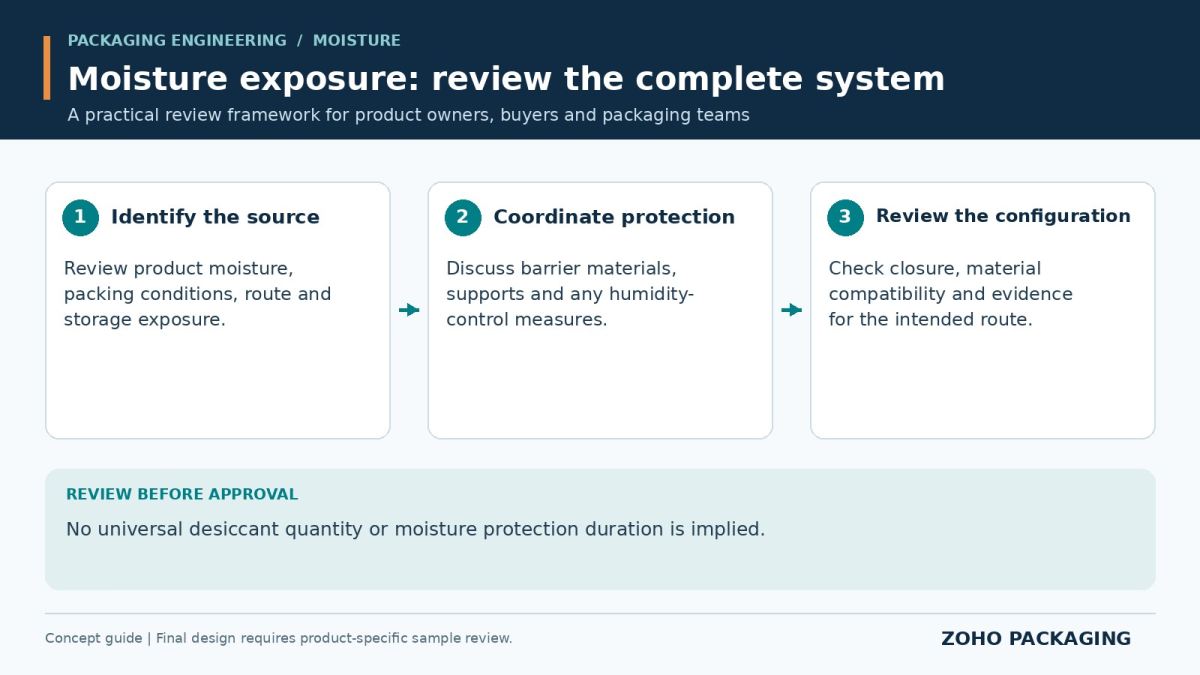 No universal desiccant quantity or moisture protection duration is implied.
👉 Packaging failure during sea shipping
Damaged products, collapsed cartons, and inconsistent packaging performance are more common than most companies expect.
The problem is not just poor materials —
it’s poor packaging design.
In this article, we break down the real reasons packaging fails during sea freight and how to fix them.
🚨 The Real Cost of Packaging Failure
When packaging fails, the impact goes far beyond damaged boxes:
- Product damage and replacement costs
- Customer complaints and brand damage
- Increased logistics handling issues
- Delays in distribution
👉 In many cases, the packaging cost saved is far less than the loss it creates.
1️⃣ Humidity: The Invisible Killer
Sea shipping exposes packaging to high humidity levels for extended periods.
Corrugated boxes absorb moisture, which reduces their strength significantly.
What happens:
- Paper fibers weaken
- Compression strength drops
- Boxes become soft and unstable
👉 A box that performs well in dry conditions may fail completely at sea.
How to prevent it:
- Use moisture-resistant materials
- Adjust paper grade based on shipping conditions
- Design safety margins into structural strength
2️⃣ Stacking Pressure: The Silent Damage
During sea freight, cartons are stacked for long periods — often weeks.
The bottom boxes تحمل the weight of all cartons above them.
If not properly designed, this leads to:
- Box collapse
- Deformation
- Product compression damage
Key concept:
Packaging must be designed for stacking load, not just product weight.
👉 This is where engineering calculations become critical.
3️⃣ Poor Structural Design (The Most Common Problem)
Many suppliers focus on material thickness rather than structure.
But in reality:
👉 Strength comes from load distribution, not just thicker board.
Common design mistakes:
- Weak corners
- Uneven load paths
- Incorrect flute selection
- Oversized boxes with empty space
Result:
Even thick cartons can fail under pressure.
4️⃣ Over- or Under-Packaging
Both extremes create problems.
Over-packaging:
- Higher material cost
- Increased shipping volume
- Inefficient container usage
Under-packaging:
- Insufficient strength
- Higher damage rate
👉 The goal is optimized packaging, not maximum packaging.
5️⃣ Pallet and Container Misalignment
Packaging design does not exist in isolation.
If carton size does not match pallet or container dimensions:
- Wasted space
- Uneven stacking
- Increased risk of collapse
👉 Good packaging must integrate:
- Box size
- Pallet layout
- Container loading strategy
🟨 The Engineering Solution
Most packaging failures are not random — they are predictable.
A proper solution includes:
- Structural design based on load
- Material selection based on environment
- Pallet and container optimization
- Safety margin for real shipping conditions
👉 This approach reduces damage rate significantly.
🧠 Key Insight: Packaging Is a System, Not a Box
The biggest mistake companies make:
Treating packaging as a product instead of a system.
A well-designed packaging system considers:
- Product characteristics
- Shipping environment
- Logistics flow
- Handling conditions
👉 When these factors align, packaging performs reliably.
Stop Losing Money on Packaging Failures
At Zoho Packaging, we design packaging based on real shipping conditions — not assumptions.
We help businesses:
- Reduce damage rates
- Optimize packaging cost
- Improve shipping efficiency
- Custom corrugated packaging
- Export packaging solutions
- Engineering-based design
👉 Get a Free Packaging Assessment
👉 Request a Quote in 24 Hours
🟪 FAQ
1. Why does packaging fail during sea shipping?
Main causes include humidity, stacking pressure, poor structural design, and incorrect material selection.
2. How does humidity affect corrugated boxes?
Humidity weakens paper fibers, reducing compression strength and making boxes more prone to collapse.
3. What is the biggest reason for packaging failure?
Poor structural design is the most common reason, especially when load distribution is not considered.
4. Can thicker cardboard prevent damage?
Not always. Structural design is more important than thickness alone.
5. What is stacking load in packaging?
It refers to the weight a box must تحمل when stacked under other cartons during shipping.
6. How can I reduce packaging damage?
Use engineering-based design, proper materials, and optimize pallet configuration.
7. Why do boxes collapse during shipping?
Usually due to insufficient compression strength and poor stacking design.
8. Does packaging design affect shipping cost?
Yes. Optimized packaging reduces wasted space and improves container efficiency.
9. Should packaging be customized for export?
Yes. Export conditions are very different from domestic shipping.
10. How can I test packaging performance?
Through methods like compression testing, drop testing, and real-world simulation.