UN Certified Packaging: What You Need to Know for Exporting Dangerous Goods
When exporting dangerous goods — such as lithium batteries, chemicals, or hazardous materials — packaging is not just about protection.
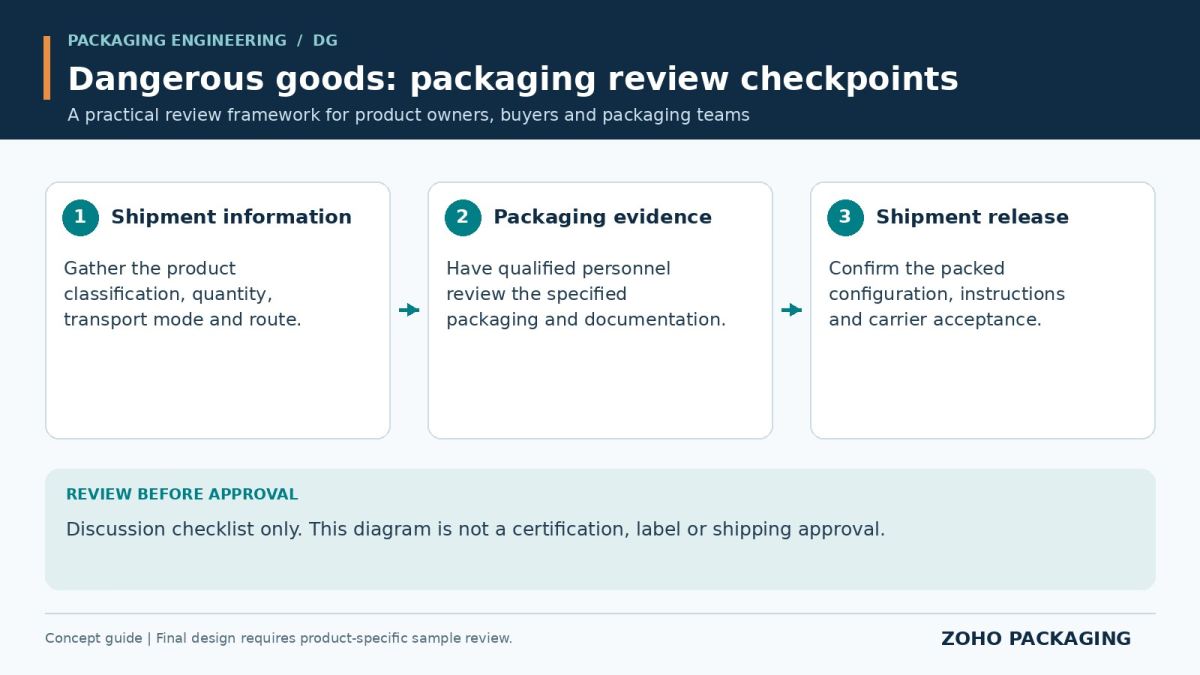 Discussion checklist only. This diagram is not a certification, label or shipping approval.
👉 It is about compliance.
Using non-certified packaging can result in:
- Shipment rejection
- Fines and penalties
- Safety risks
- Delays in logistics
This is why UN certified packaging is essential.
⚠️ What Is UN Certified Packaging?
UN certified packaging refers to packaging that meets the standards set by the United Nations for transporting dangerous goods.
These standards ensure that packaging can withstand:
- Impact (drop tests)
- Stacking pressure
- Leakage and damage
👉 Only packaging that passes these tests can carry a UN marking.
📦 What Is a UN 4G Box?
A UN 4G box is one of the most common types of UN certified packaging.
- 4G = fiberboard box (corrugated)
- Suitable for solid dangerous goods
- Widely used for lithium batteries and industrial products
Example marking:
UN 4G/Y30/S/25
This code indicates:
- Packaging type
- Performance level
- Weight limit
- Certification year
👉 Understanding this marking is critical for compliance.
🚨 Why UN Packaging Matters
Many exporters underestimate the importance of UN certification.
Without proper packaging:
- Goods may be rejected at customs
- Airlines or shipping lines may refuse cargo
- Liability risks increase significantly
👉 Compliance is not optional — it is mandatory.
1️⃣ Required Tests for UN Packaging
To obtain UN certification, packaging must pass strict tests:
✔ Drop Test
Simulates real-world handling and impact
✔ Stacking Test
Ensures packaging can withstand vertical load over time
✔ Vibration / Handling Simulation
Replicates transport conditions
👉 These tests ensure packaging performs under real logistics stress.
2️⃣ UN Packaging Levels (X / Y / Z)
UN packaging is classified into three levels:
- X: High danger (most strict)
- Y: Medium danger
- Z: Low danger
👉 Choosing the correct level depends on your product classification.
3️⃣ Common Mistakes in UN Packaging
Many businesses make costly errors:
❌ Using non-certified cartons
❌ Misinterpreting UN markings
❌ Ignoring weight limits
❌ Reusing packaging incorrectly
👉 These mistakes can lead to shipment failure.
4️⃣ UN 4G vs Wooden Crates
Depending on your product, you may need different packaging:
UN 4G (Corrugated Box)
- Lighter
- Cost-effective
- Suitable for smaller or medium loads
UN Wooden Crates
- Higher strength
- Suitable for heavy or industrial goods
- More durable for long-distance shipping
👉 Choosing the right type is critical for both cost and compliance.
5️⃣ UN Packaging Is Not Just a Box — It’s a System
UN compliance requires:
- Correct packaging structure
- Proper internal cushioning
- Secure sealing methods
- Accurate labeling
👉 Even a certified box can fail if used incorrectly.
🟨 Engineering + Compliance = Safe Export
The best approach combines:
- Regulatory compliance
- Structural engineering
- Real-world logistics understanding
👉 This ensures both safety and efficiency.
🧠 Key Insight
UN packaging is not just about passing a test.
It is about:
- Protecting people
- Protecting products
- Protecting your business
👉 A mistake here is not just costly — it can be critical.
🟥 CTA(高單價成交)
Need UN Certified Packaging for Export?
At Zoho Packaging, we provide compliant and engineered packaging solutions for dangerous goods.
- UN 4G certified boxes
- UN wooden crates
- Packaging design & testing support
- Export-ready solutions
👉 Get a Free Consultation
👉 Request a Quote in 24 Hours
🟪 FAQ(10題)
1. What is UN certified packaging?
Packaging that meets UN standards for transporting dangerous goods.
2. Is UN packaging mandatory?
Yes, for most dangerous goods including lithium batteries and chemicals.
3. What does UN 4G mean?
It refers to a fiberboard (corrugated) box approved for dangerous goods transport.
4. Can I reuse UN packaging?
Only under specific conditions and if it remains compliant.
5. What happens if I don’t use UN packaging?
Your shipment may be rejected, fined, or delayed.
6. What is the difference between X, Y, and Z ratings?
They represent different levels of danger and required strength.
7. How do I choose the right UN packaging?
Based on your product classification, weight, and transport method.
8. Are UN wooden crates stronger than cartons?
Yes, they are better for heavy-duty applications.
9. Can UN packaging reduce damage?
Yes, it is designed to withstand extreme conditions.
10. How long does certification take?
Typically several weeks, depending on testing and approval processes.