When Packaging Fails, You Don’t Just Lose Products—You Lose Profit
Most companies don’t realize their packaging is failing…
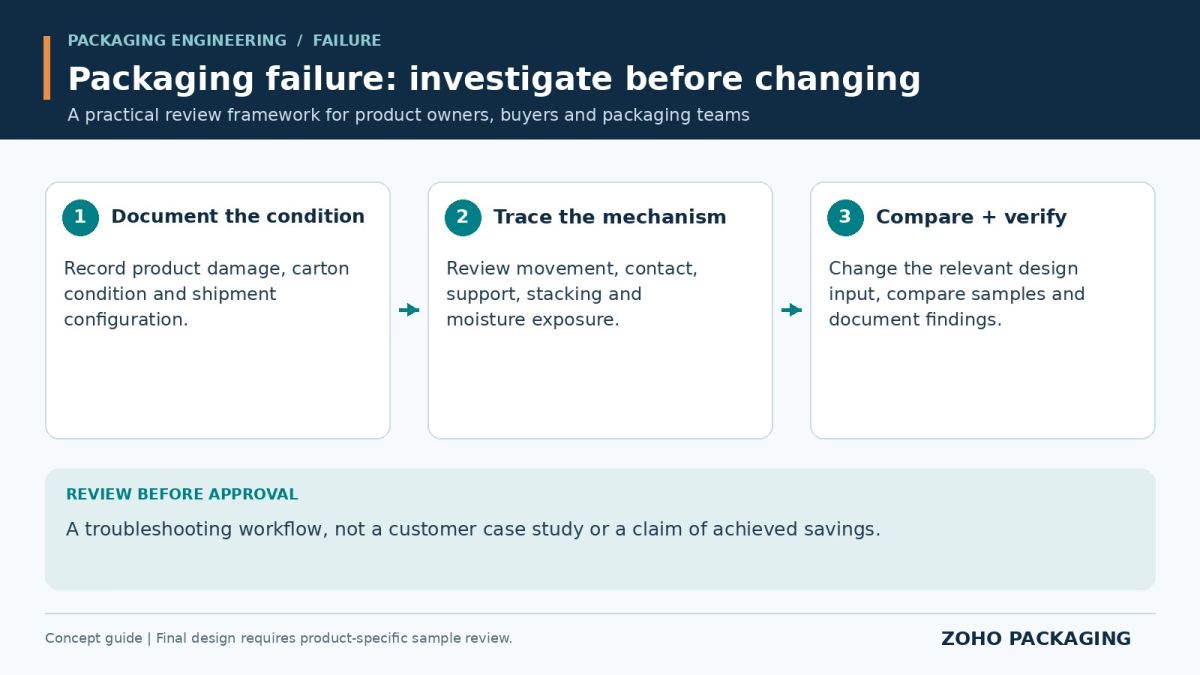 A troubleshooting workflow, not a customer case study or a claim of achieved savings.
Until the damage arrives.
This case study shows a real-world scenario where automotive parts were consistently damaged during export, and how engineering-based packaging solved the problem.
📦 Case Overview
Industry: Automotive Parts Manufacturer
Product: Brake Discs & Shock Absorbers
Shipping Method: Ocean Freight (Asia → US / Europe)
Problem: High damage rate during transit
❌ The Problem
The client was using:
- Standard corrugated cartons
- Basic cushioning materials
- No internal fixation system
At first glance, everything seemed fine.
But after shipping, they experienced:
- Scratched brake discs
- Bent shock absorber rods
- Carton deformation
- Internal product collisions
💥 The Real Cost of Packaging Failure
The issue wasn’t just product damage.
It was the hidden cost behind it:
- Product replacement costs
- Return shipping fees
- Customer complaints
- Delayed delivery timelines
- Loss of trust from buyers
The packaging cost was low.
The damage cost was not.
🔍 Root Cause Analysis
After analyzing the packaging system, we identified:
1. No Load Distribution Design
Heavy parts were putting pressure on a single point → carton collapse.
2. No Internal Fixation
Products were free to move → collision damage.
3. No Surface Protection
Metal parts directly contacted each other → scratches.
4. No Moisture Protection
Ocean humidity → corrosion risk.
🛠️ The Solution: Engineered Packaging System
We redesigned the entire packaging approach.
✔ Reinforced Corrugated Structure
- Multi-wall (5-ply / 7-ply) cartons
- Bottom reinforcement
- Designed based on product weight
✔ Internal Fixation System
- Custom inserts
- Multi-point support
- Zero-movement design
✔ Anti-Scratch Protection
- Individual separation
- Protective layers
✔ Moisture Control
- Barrier materials
- Optional desiccants
✔ Pallet Optimization
- Stable stacking
- Improved container loading
- Reduced bottom pressure
📊 Results After Implementation
After switching to engineered packaging:
- Damage rate reduced by over 80%
- Return cases significantly decreased
- Customer complaints minimized
- Shipping stability improved
Most importantly:
The client stopped losing money on logistics.
🧠 Key Takeaway
Packaging failure is not random.
It is predictable—and preventable.
If your packaging is not engineered, your damage rate is not a surprise.
Why This Matters for Your Business
If you are exporting automotive parts, you are already exposed to:
- Long-distance shipping risks
- Multiple handling stages
- High-value product exposure
The question is not “Will damage happen?”
The question is:
👉 “Is your packaging designed to prevent it?”
Experiencing damage during automotive parts shipping? Let’s fix the root cause.
👉 Request a packaging evaluation
👉 Get a custom packaging solution
👉 Talk to our engineering team
❓ FAQ
1. Why do automotive parts get damaged during shipping?
Most damage is caused by poor packaging design, including lack of internal fixation, weak structure, and no protection against movement.
2. Can better packaging really reduce damage?
Yes. Engineering-based packaging can significantly reduce damage rates and logistics risk.
3. What is the biggest mistake in packaging design?
Relying only on material thickness instead of structural design and load distribution.
4. How do you analyze packaging failure?
We evaluate product weight, movement, load points, and shipping conditions to identify root causes.
5. Do I need custom packaging for automotive parts?
In most cases, yes. Standard packaging does not account for weight, shape, and transport risks.
6. Can packaging reduce total cost?
Absolutely. Reducing damage lowers replacement, return, and complaint costs.
7. Do you support testing and validation?
Yes. We design based on real shipping conditions and can support testing standards.
8. What industries benefit from this approach?
Automotive, electronics, machinery, and heavy industrial products.
9. How long does it take to redesign packaging?
Depending on complexity, typically a few days to a few weeks.
10. How do I get started?
Send us your product and shipping details—we’ll analyze your current packaging and recommend improvements.
“Packaging failure is invisible—until it becomes expensive.”