Article文章專區
2026/04/07
Before vs After Packaging Comparison | Reduce Damage with Engineered Packaging
See the Difference: Packaging That Fails vs Packaging That Works
Most packaging looks fine…
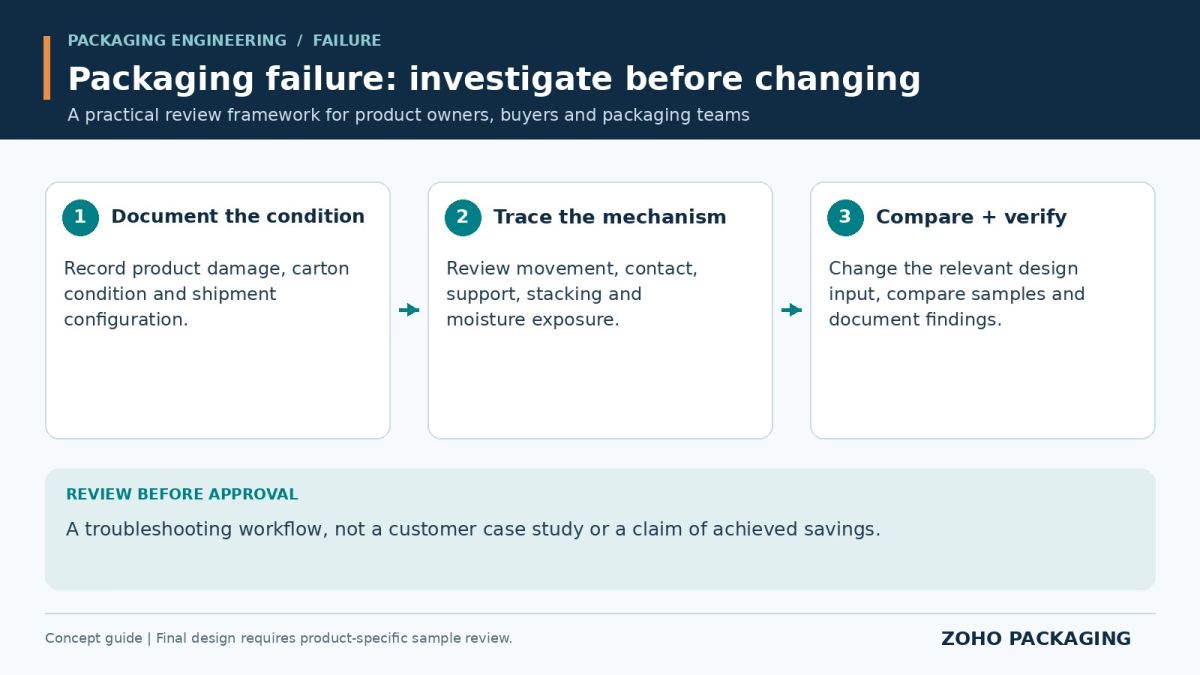 A troubleshooting workflow, not a customer case study or a claim of achieved savings.
Until it goes through real shipping conditions.
This page shows the real difference between standard packaging and engineered packaging systems.
❌ BEFORE: Standard Packaging (What Most Companies Use)
Common Setup:
- Regular corrugated cartons
- Basic cushioning materials
- No internal fixation
- No load distribution design
What Happens in Real Shipping:
- Products shift inside the box
- Surface scratches occur
- Heavy parts collapse the carton bottom
- Stacking causes deformation
- Damage appears after delivery
The Result:
- High damage rate
- Customer complaints
- Product returns
- Increased logistics cost
Looks fine at the warehouse.
Fails in real shipping.
✅ AFTER: Engineered Packaging (What We Design)
Upgraded System:
- Reinforced multi-wall corrugated structure
- Internal fixation system (no movement)
- Anti-scratch separation design
- Load distribution engineering
- Pallet-optimized layout
What Happens in Real Shipping:
- Products stay fixed in position
- No internal collision
- Cartons maintain structural integrity
- Stable stacking under pressure
- Consistent delivery quality
The Result:
- Significant damage reduction
- Lower return rate
- Improved customer satisfaction
- Better logistics efficiency
Designed for shipping.
Not just storage.
📊 Real Impact Comparison
| Category |
BEFORE (Standard Packaging) |
AFTER (Engineered Packaging) |
| Product Movement |
Uncontrolled |
Fully fixed |
| Surface Protection |
None / minimal |
Structured separation |
| Load Distribution |
Poor |
Engineered |
| Damage Rate |
High |
Significantly reduced |
| Customer Complaints |
Frequent |
Rare |
| Total Cost |
Unpredictable |
Controlled |
🧠 Why This Happens
Most companies focus on:
👉 Material thickness
👉 Box price
But the real factor is:
👉 Packaging structure design
Packaging doesn’t fail because it’s cheap.
It fails because it’s not engineered.
🚗 Real Example (Automotive Parts)
BEFORE:
- Brake discs stacked together
- Shock absorbers moving freely
- No internal support
👉 Result: scratches, bending, returns
AFTER:
- Individual separation
- Fixed positioning
- Reinforced bottom structure
👉 Result: stable delivery, zero complaints
💰 The Hidden ROI of Better Packaging
Better packaging is not a cost.
It’s a cost control system.
It reduces:
- Product replacement
- Return logistics
- Customer complaints
- Brand damage
Still using standard packaging? You’re probably paying for it somewhere else.
👉 Request a packaging comparison
👉 Get a redesign recommendation
👉 Talk to our engineering team
❓ FAQ
1. What is the biggest difference between standard and engineered packaging?
Engineered packaging focuses on structure, load distribution, and movement control—not just materials.
2. Can better packaging really reduce damage?
Yes. Proper design can reduce damage rates dramatically.
3. Why does packaging fail during shipping?
Because it’s designed for storage, not for real logistics conditions.
4. Is thicker carton always better?
No. Structure matters more than thickness.
5. How do you measure improvement?
Through reduced damage rates, fewer returns, and better delivery consistency.
6. Can you evaluate my current packaging?
Yes. We can analyze your packaging and identify failure points.
7. Do I need custom packaging?
If your product is heavy, fragile, or high-value—yes.
8. Does this apply to all industries?
Yes. Especially automotive, electronics, and industrial products.
9. How fast can you redesign packaging?
Depending on complexity, from a few days to a few weeks.
10. How do I start?
Send us your product and shipping details—we’ll provide a solution.
“If your packaging only works in the warehouse, it doesn’t work.”