Material Optimization Is Not About Using Cheaper Paper
Most companies think:
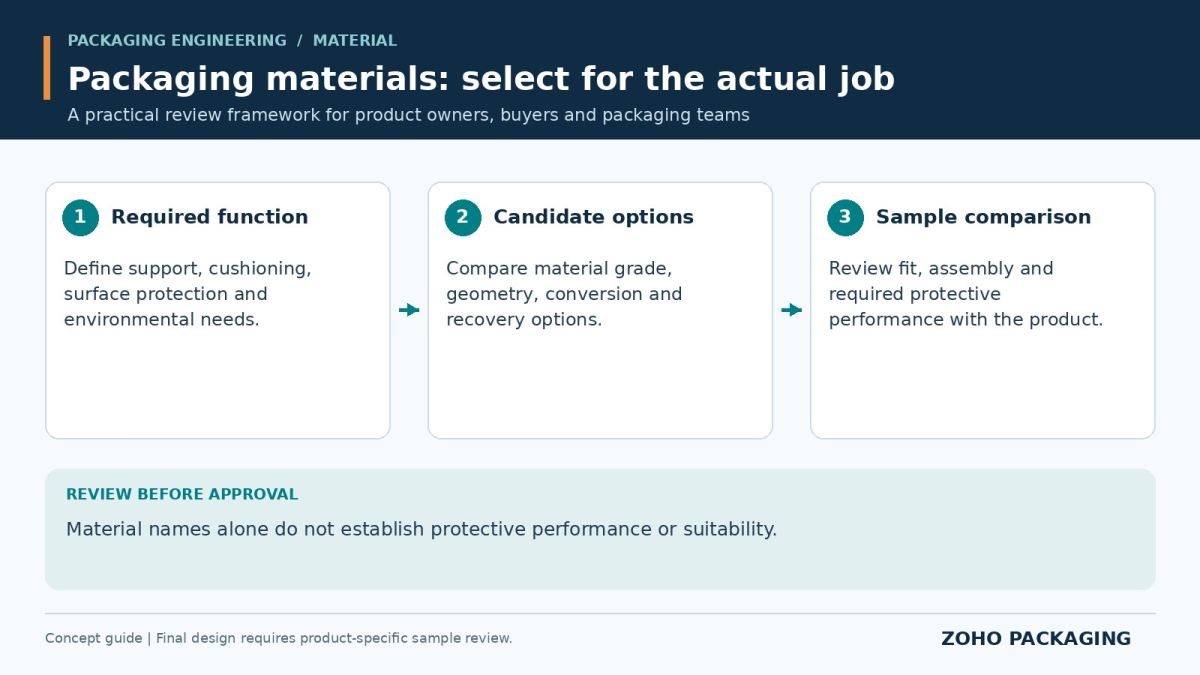 Material names alone do not establish protective performance or suitability.
👉 “Use cheaper board = save cost”
That’s wrong.
👉 The real goal is:
Use the RIGHT material in the RIGHT structure
The Core Problem
Packaging failure usually comes from:
- Wrong board grade
- No structural support
- Ignoring stacking conditions
- No understanding of ECT / BCT
👉 Material alone does NOT define strength
👉 Structure + material = performance
Understanding Corrugated Material (Simple but Critical)
Corrugated board strength depends on:
- Flute type (A / B / C / E / BC / AB / AAA)
- Paper quality (kraft vs recycled)
- Board combination (3-ply / 5-ply / 7-ply)
ECT vs BCT — The Key to Material Optimization
📌 ECT (Edge Crush Test)
Measures vertical compression strength of the board.
👉 Important for:
- Stacking resistance
- Load-bearing capacity
📌 BCT (Box Compression Test)
Measures how much weight a box can تحمل before collapsing.
👉 Real-world performance indicator
👉 Key Insight:
- High ECT ≠ strong box
- Good structure + correct material = strong box
How We Optimize Material
1️⃣ Match Material to Load Requirement
We analyze:
- Product weight
- Stacking height
- Shipping conditions
👉 Then select correct board grade
NOT over-spec, NOT under-spec
2️⃣ Reduce Over-Engineering
Many companies use:
❌ Too thick board
❌ Too many layers
👉 Result: wasted cost
We optimize to:
- Use minimal required strength
- Maintain performance
3️⃣ Reinforce Structure Instead of Increasing Material
Instead of upgrading board:
👉 We improve:
- Load path
- Corner strength
- Internal support
👉 Result: stronger box with less material
4️⃣ Moisture & Export Consideration
For export packaging:
- Humidity reduces strength
- Long transit increases risk
👉 We adjust material accordingly:
- Higher safety margin
- Moisture-resistant design
5️⃣ Lightweight Strategy (Smart, Not Risky)
We reduce:
- Board weight
- Shipping weight
BUT maintain:
- Structural integrity
- Protection performance
Before vs After
| Factor |
Before |
After |
| Material Cost |
High |
Optimized |
| Board Thickness |
Overbuilt |
Balanced |
| Strength |
Unstable |
Controlled |
| Damage Rate |
High |
Reduced |
Common Mistakes in Material Selection
❌ Choosing board by price
❌ Ignoring stacking height
❌ No pallet calculation
❌ No understanding of ECT/BCT
👉 Result: unpredictable performance
Who Needs Material Optimization
- Automotive parts suppliers
- Export manufacturers
- Heavy equipment packaging
- E-commerce high-volume brands
CTA(轉單)
🚀 Not sure what board grade you should use?
👉 Get a Free Material Optimization Analysis
📊 FAQ
Q1: What is material optimization in packaging?
Material optimization in packaging refers to selecting and using the most appropriate materials to achieve the required performance at the lowest total cost. This process involves analyzing product weight, stacking conditions, shipping environment, and structural design. Instead of simply choosing cheaper or stronger materials, optimization focuses on balancing strength, cost, and efficiency. The goal is to use just enough material to ensure protection without over-engineering, which can increase cost unnecessarily.
Q2: What is the difference between ECT and BCT?
ECT (Edge Crush Test) measures the vertical compression strength of corrugated board, while BCT (Box Compression Test) measures the overall strength of a completed box under load. ECT is a material-level indicator, while BCT reflects real-world performance. A high ECT value does not automatically guarantee a strong box, because structural design also plays a critical role. Understanding both ECT and BCT is essential for optimizing packaging material and ensuring reliable performance.
Q3: How do I choose the right corrugated board?
Choosing the right corrugated board requires evaluating several factors, including product weight, stacking height, transportation conditions, and required durability. Different flute types and board combinations provide different levels of strength and cushioning. Instead of relying on standard options, it is important to match the material to the specific application. Proper selection ensures adequate protection while avoiding unnecessary cost.
Q4: Can I reduce material cost without increasing risk?
Yes, material cost can often be reduced without increasing risk by improving structural design and selecting the appropriate board grade. Many packaging systems are overbuilt, using more material than necessary. By optimizing load distribution and reinforcing critical areas, it is possible to maintain or even improve performance while reducing material usage. This approach requires engineering analysis rather than simple cost-cutting.
Q5: Why does packaging fail even with strong materials?
Packaging can fail even with strong materials if the structural design is inadequate. Factors such as poor load distribution, weak corners, and lack of internal support can lead to failure under real-world conditions. Strong material alone cannot compensate for poor design. Effective packaging requires a combination of appropriate material and well-designed structure to ensure performance.
Q6: How does moisture affect corrugated packaging?
Moisture significantly reduces the strength of corrugated board by weakening the paper fibers and adhesive bonds. In high-humidity environments or during sea shipping, this can lead to reduced compression strength and increased risk of collapse. To address this, packaging design must include appropriate safety margins and, in some cases, moisture-resistant materials or coatings. Considering environmental conditions is essential for reliable performance.
Q7: What is over-engineering in packaging?
Over-engineering occurs when packaging uses more material or strength than necessary to achieve the required performance. While this may provide a sense of safety, it often leads to higher material and shipping costs without delivering additional value. Over-engineered packaging can also reduce efficiency by increasing weight and size. Optimization aims to eliminate unnecessary excess while maintaining sufficient protection.
Q8: Is thicker board always better?
No, thicker board is not always better. While it may provide higher strength, it also increases cost and weight. In many cases, a well-designed structure using a thinner board can achieve similar or better performance. The key is to balance material properties with structural design. Simply increasing thickness is not an efficient or cost-effective solution.
Q9: How can lightweight packaging maintain strength?
Lightweight packaging maintains strength by optimizing structural design and reinforcing critical areas. This includes improving load paths, using strategic reinforcements, and selecting appropriate materials. By focusing on how forces are distributed, it is possible to reduce weight without compromising performance. This approach requires careful analysis and design.
Q10: When should I review my packaging materials?
Packaging materials should be reviewed whenever there are changes in product design, shipping methods, or logistics requirements. Regular evaluation can also identify opportunities for cost reduction and performance improvement. Even if current packaging appears to work, optimization can often deliver significant benefits. Continuous improvement is key to maintaining efficiency and competitiveness.