Packaging Failure Is Not an Accident — It’s a Design Problem
Most food brands only realize packaging issues after:
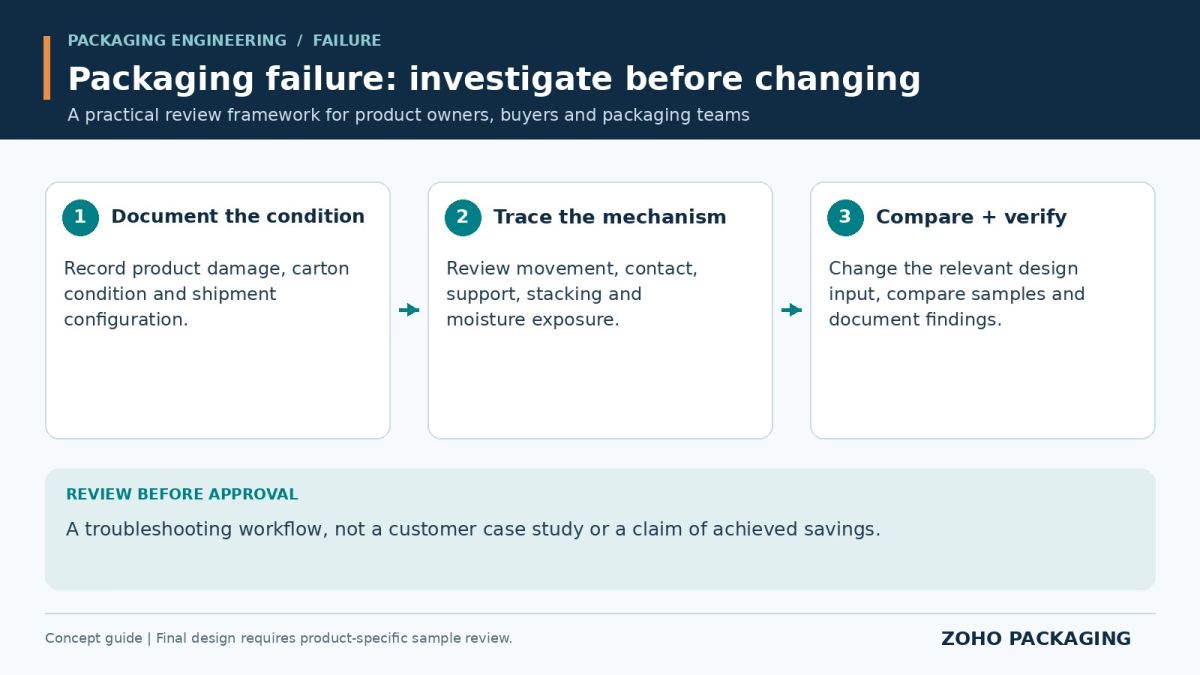 A troubleshooting workflow, not a customer case study or a claim of achieved savings.
- customer complaints
- product damage
- rising logistics cost
But the truth is simple:
Packaging failure is predictable.
And more importantly—
👉 It is preventable.
Case Study #1 — Snack Brand Export Damage Problem
Problem
A snack brand exporting to the US faced:
- cartons collapsing during stacking
- crushed inner products
- damage rate: 4.2%
Root Cause
Not material issue.
👉 Structural failure
- incorrect load distribution
- weak vertical compression design
- over-reliance on thicker board
Solution
We redesigned:
- internal structure reinforcement
- load-bearing path optimization
- reduced unnecessary material layers
Result
✔ Damage rate ↓ from 4.2% → 0.8%
✔ Packaging cost ↓ 12%
✔ Shipping stability ↑ significantly
Insight
Stronger packaging is not thicker — it’s smarter.
Case Study #2 — Frozen Food Packaging Collapse
Problem
Frozen food supplier experienced:
- carton deformation in cold storage
- moisture weakening structure
- pallet stacking instability
Root Cause
- wrong board selection for humidity
- no moisture-resistant treatment
- stacking design ignored real conditions
Solution
- moisture-resistant corrugated material
- reinforced bottom structure
- adjusted stacking configuration
Result
✔ zero structural collapse
✔ improved stacking height
✔ reduced warehouse loss
Insight
Environment matters more than material thickness.
Case Study #3 — Takeaway Packaging Failure
Problem
Delivery packaging for hot food:
- bottom collapse
- leakage issues
- poor customer experience
Root Cause
- weak base structure
- no load distribution design
- grease weakening material
Solution
- reinforced base geometry
- grease-resistant coating
- structural locking design
Result
✔ no collapse complaints
✔ improved brand perception
✔ higher customer retention
Insight
Packaging is part of the product experience.
Case Study — Over-Packaging Cost Problem
Problem
A food brand used:
- double-layer packaging
- oversized cartons
- excessive filler material
Resulting Issues
- high packaging cost
- inefficient pallet loading
- increased shipping fees
Solution
- optimized carton size
- redesigned internal support
- eliminated unnecessary materials
Result
✔ Packaging cost ↓ 18%
✔ Shipping cost ↓ 15%
✔ More units per pallet
Insight
Over-packaging is hidden profit loss.
Case Study #5 — Retail Ready Packaging (RRP) Upgrade
Problem
Retail brand faced:
- repacking labor cost
- inefficient shelf display
- damaged products during store handling
Solution
- RRP structural redesign
- easy-open display system
- integrated shipping + display box
Result
✔ Reduced labor cost
✔ Faster shelf placement
✔ Improved retail presentation
Insight
Good packaging reduces labor—not just damage.
Before vs After — What Actually Changes
| Factor |
Before |
After |
| Damage Rate |
3–5% |
<1% |
| Packaging Cost |
High |
Optimized |
| Shipping Efficiency |
Low |
Improved |
| Customer Complaints |
Frequent |
Minimal |
| Brand Perception |
Average |
Premium |
What These Case Studies Prove
Across all cases, the pattern is clear:
❌ Wrong Approach
- use thicker material
- increase cost
- ignore structure
- ignore logistics
✔ Right Approach
- optimize structure
- reduce material
- design for real conditions
- validate performance
Key Formula
Packaging performance = Structure × Material × Logistics Design
Why Most Packaging Fails
Because suppliers focus on:
- price per box
- material only
- short-term solution
Instead of:
- total cost per shipment
- long-term performance
- engineering validation
Why Brands Switch to Engineering-Based Packaging
They want:
✔ predictable cost
✔ scalable packaging system
✔ fewer complaints
✔ stronger brand trust
Zoho Packaging Approach
We don’t guess.
We engineer.
What We Do
- packaging structure design
- material optimization
- pallet & logistics planning
- performance validation
What You Get
✔ lower total cost
✔ higher shipping stability
✔ reduced risk
✔ long-term scalability
Final Insight
Most companies try to fix packaging problems after damage happens.
Smart companies do this instead:
Design packaging that prevents damage from the start.
FAQ
1. What is a food packaging case study?
A food packaging case study shows real examples of packaging problems, their causes, and how engineering solutions improved performance and reduced cost.
2. What are common food packaging failures?
Common failures include carton collapse, moisture damage, over-packaging, and inefficient stacking—all caused by poor structural design.
3. How can packaging reduce product damage?
By optimizing structure, load distribution, and material selection, packaging can significantly reduce damage during transport and storage.
4. Is thicker packaging always better?
No. Thicker material increases cost but does not guarantee better performance. Structural design is more important.
5. How much can packaging optimization save?
Most companies see 10–20% cost reduction through better design, improved pallet efficiency, and reduced damage.
6. What industries benefit from packaging optimization?
Food, FMCG, e-commerce, frozen goods, and export businesses benefit the most from optimized packaging systems.
7. What is RRP packaging?
Retail Ready Packaging (RRP) allows products to be shipped and displayed in the same box, reducing labor and improving efficiency.
8. How does packaging affect logistics cost?
Packaging size and structure impact pallet loading and shipping efficiency, directly affecting freight costs.
9. How do I evaluate if my packaging is inefficient?
High damage rates, excessive material use, and poor pallet utilization are key indicators of inefficient packaging.
10. How do I improve my current packaging?
Start with a packaging audit, then redesign structure, optimize materials, and validate performance through testing.