Carton Collapse Is Not Random — It’s Calculated Failure
If your cartons collapse during shipping or storage, it’s not bad luck.
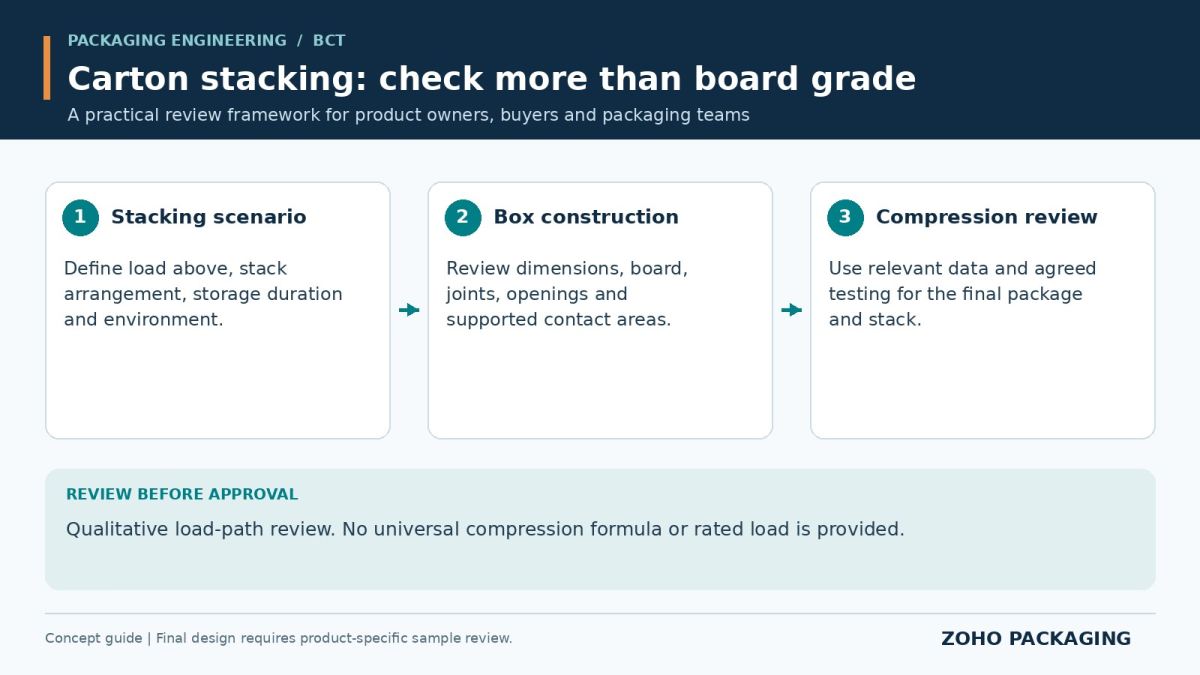 Qualitative load-path review. No universal compression formula or rated load is provided.
👉 It’s a BCT calculation error
Most companies:
- guess stacking strength
- rely on thicker material
- ignore humidity
Result
❌ cartons collapse
❌ products damaged
❌ cost increases
Reality
If you can calculate it, you can prevent it.
What Is BCT (Box Compression Test)
BCT measures how much vertical load a carton can withstand before collapsing.
Core Formula(簡化工程版)
BCT=k×ECT×P×tBCT = k \times ECT \times \sqrt{P \times t}BCT=k×ECT×P×t
Variables:
- BCT = Box Compression Strength
- ECT = Edge Crush Test
- P = Perimeter of box
- t = thickness
- k = constant
Key Insight
👉 BCT is NOT only about material
👉 It’s about structure + geometry + environment
Why Your Cartons Collapse (Real Reasons)
1. Wrong BCT Estimation
Most suppliers:
- don’t calculate
- or use wrong assumptions
2. Ignoring Stacking Duration
Stacking for:
- 1 day ≠ 30 days
- warehouse ≠ sea shipping
👉 Long-term load causes fatigue
3. Humidity Impact
Humidity reduces strength by:
👉 30%–50%
4. Poor Load Distribution
Weak points:
- corners
- edges
- unsupported panels
Conclusion
Cartons don’t fail everywhere—they fail at the weakest point.
How to Calculate Required BCT
Step 1 — Calculate Total Load
Total load =
(weight per carton) × (stacking layers)
Step 2 — Apply Safety Factor
Typical safety factor:
- warehouse: 3–4
- export shipping: 4–6
Step 3 — Required BCT
Required BCT=Load×Safety FactorRequired\ BCT = Load \times Safety\ FactorRequired BCT=Load×Safety Factor
Example
- carton weight: 10 kg
- stacking: 5 layers
Load = 50 kg
Safety factor = 5
👉 Required BCT = 250 kg
ECT vs BCT — What’s the Difference?
ECT(Edge Crush Test)
- measures paperboard strength
- material-level property
BCT(Box Compression Test)
- measures final box strength
- system-level performance
Key Insight
High ECT does NOT guarantee high BCT.
👉 Because structure matters more than material alone.
How to Increase BCT Without Increasing Cost
1. Improve Structural Design
- reinforce corners
- optimize folding geometry
- add load-bearing paths
2. Optimize Box Dimensions
👉 Wrong proportions reduce strength
- too tall → easier collapse
- too wide → uneven load
3. Improve Pallet Stacking Pattern
- column stacking vs interlock
- load distribution alignment
4. Use Double Wall Strategically
👉 Not everywhere—only where needed
Golden Rule
Don’t add material—optimize structure first.
Real Case — BCT Optimization
Before
- no BCT calculation
- random board selection
- collapse during shipping
After
- BCT calculated
- structure redesigned
- optimized stacking
Result
✔ damage rate ↓ from 3.5% → 0.6%
✔ material cost ↓ 10%
✔ stable stacking performance
The Hidden Killer — Humidity
What Happens in Real Shipping
- sea freight = high humidity
- warehouse = long-term stacking
Effect on BCT
👉 strength reduction up to 50%
Solution
- moisture-resistant board
- higher safety factor
- packaging design adjustment
Common BCT Mistakes
❌ Using lab test data only
❌ Ignoring real shipping conditions
❌ Over-relying on thicker material
❌ Not considering pallet stacking
Result
- unexpected collapse
- hidden cost loss
Engineering vs Guessing
| Guess-Based Packaging |
Engineering-Based Packaging |
| no calculation |
BCT calculated |
| overdesign |
optimized design |
| high cost |
cost-efficient |
| unstable |
predictable |
Zoho BCT Engineering Approach
Step 1 — Load Analysis
- product weight
- stacking layers
Step 2 — BCT Calculation
- required strength
- safety factor applied
Step 3 — Structural Optimization
- load path design
- weak point reinforcement
Step 4 — Material Matching
- correct ECT selection
- avoid over-spec
Step 5 — Validation
- compression test
- real-world simulation
Result
✔ no collapse
✔ lower cost
✔ predictable performance
Final Insight
Most companies fix packaging after it fails.
Smart companies do this:
Calculate failure before it happens.
FAQ
1. What is BCT in packaging?
BCT (Box Compression Test) measures how much weight a carton can withstand before collapsing, crucial for stacking and shipping.
2. How do I calculate required BCT?
Multiply total stacking load by a safety factor (usually 3–6 depending on conditions).
3. What affects carton compression strength?
Key factors include ECT, box dimensions, humidity, stacking duration, and structural design.
4. Does higher ECT always mean stronger boxes?
No. ECT measures material strength, but BCT depends on full box design and structure.
5. How does humidity affect BCT?
Humidity can reduce carton strength by 30–50%, especially during sea shipping.
6. What is a safe stacking factor?
Typically 3–4 for warehouse use and 4–6 for export shipping.
7. Can I reduce cost while improving strength?
Yes, by optimizing structure and design instead of increasing material thickness.
8. What is the most common cause of carton collapse?
Incorrect BCT calculation and poor structural design.
9. Should I always overdesign packaging?
No. Overdesign increases cost without guaranteeing better performance.
10. How can I improve my packaging strength?
Start with BCT calculation, optimize structure, and validate through testing.