When Standard Packaging Fails — Wooden Crates Take Over
If your shipment involves heavy equipment, high-value products, or dangerous goods, standard packaging solutions are no longer sufficient.
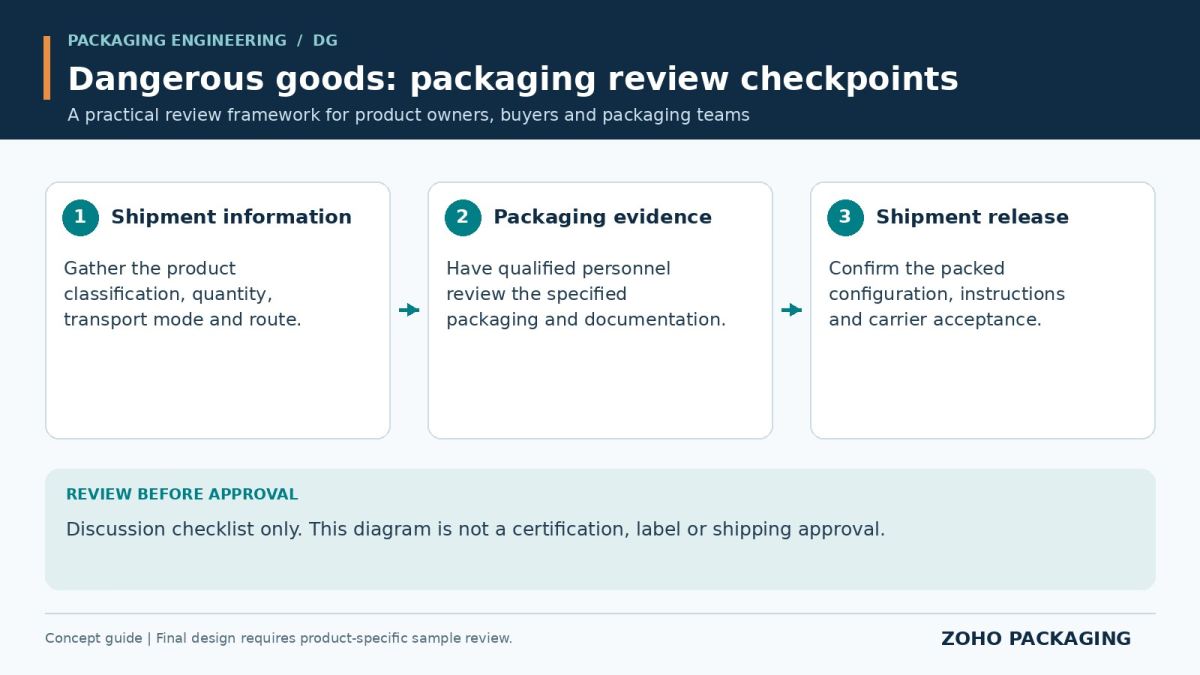 Discussion checklist only. This diagram is not a certification, label or shipping approval.
A UN wooden crate is not just packaging.
👉 It is a load-bearing structural system designed to survive real-world logistics conditions.
What Is a UN Wooden Crate?
A UN wooden crate is a certified packaging system built to:
✔ Handle extreme weight
✔ Pass UN drop and stacking tests
✔ Protect cargo during long-distance transport
✔ Meet international dangerous goods regulations
Why Most Wooden Crates Still Fail
Many crates in the market are built without engineering logic:
❌ No load calculation
❌ Weak structural design
❌ Incorrect reinforcement
❌ Ignoring stacking pressure
👉 Result: deformation, collapse, or product damage
Engineering Approach (Key Difference)
At Zoho Packaging, we design based on:
Load Path Design
Force is directed through the structure — not absorbed randomly
Structural Reinforcement
Corners, base, and support beams are optimized
Stacking Calculation
Designed to withstand container-level pressure
Internal Protection
Shock absorption + product fixation system
When to Use Wooden Crates
- Heavy machinery
- Industrial components
- Large lithium battery systems
- High-value export goods
👉 If failure is not an option — this is the solution.
Cost vs Risk
Choosing cheaper packaging often leads to:
- Product damage
- Shipment rejection
- Financial loss
👉 Packaging cost is not material cost — it is risk control
Zoho One-Line
👉 A wooden crate is not packaging — it’s an engineered structure that carries your risk.
CTA
Shipping heavy or high-value products?
Send us your specs — we’ll design a crate system that actually works.
FAQ(10題 × 每題約150字)
1. What is a UN wooden crate and when is it required?
A UN wooden crate is a certified packaging solution designed for transporting heavy or dangerous goods. It is required when standard fiberboard packaging cannot safely handle the weight, size, or risk level of the product. These crates must pass UN testing standards, including drop and stacking tests. They are commonly used for industrial equipment, large lithium battery systems, and high-value shipments. Choosing the correct packaging type ensures compliance, reduces damage risk, and prevents shipment rejection during international transport.
2. How is a wooden crate different from a regular crate?
A regular wooden crate is typically built for basic protection or storage, without engineering calculations or certification. A UN wooden crate, however, is specifically designed and tested to meet international shipping regulations. It includes structural load calculations, reinforcement strategies, and compliance markings. The difference lies in performance and reliability. While a regular crate may fail under pressure or impact, a UN-certified crate is built to withstand real logistics conditions.
3. What kind of products require wooden crate packaging?
Wooden crates are used for heavy, fragile, or high-value products that cannot be safely shipped in standard boxes. This includes industrial machinery, automotive components, large lithium battery systems, generators, and precision equipment. Any product that faces high stacking pressure, long-distance shipping, or rough handling conditions should consider wooden crate packaging. It ensures better protection and reduces the risk of costly damage.
4. Do wooden crates need to pass UN certification?
Yes, if they are used for dangerous goods, wooden crates must pass UN certification. This includes a series of tests such as drop testing and stacking tests to ensure the packaging can handle real-world conditions. Without certification, shipments may be rejected by carriers or authorities. Certification also ensures that the crate meets international safety standards, which is essential for global shipping.
5. What tests are required for UN wooden crates?
UN wooden crates must pass several tests, including drop tests to simulate impact, stacking tests to simulate long-term pressure, and sometimes vibration or compression tests. These tests ensure that the crate can maintain structural integrity during transport. Passing these tests is critical for compliance and helps prevent failures during shipping.
6. Why do some wooden crates collapse during shipping?
Most crate failures are due to poor design rather than weak materials. Common issues include lack of load calculation, incorrect force distribution, and insufficient reinforcement at key stress points. Without proper engineering, even thick wooden panels can fail under stacking pressure. A well-designed crate distributes weight evenly and supports the product effectively.
7. Is a thicker wooden crate always better?
No. Increasing material thickness does not automatically improve performance. In many cases, structural design plays a more important role than material thickness. Proper load path design, reinforcement placement, and support structure are key factors. A well-engineered crate can perform better than a thicker but poorly designed one, while also reducing unnecessary cost.
8. Can wooden crates reduce shipping damage?
Yes. Properly designed wooden crates significantly reduce the risk of damage during shipping. They provide strong structural support, protect against impact, and prevent product movement. This is especially important for heavy or sensitive equipment. Reduced damage leads to fewer returns, lower insurance claims, and improved customer satisfaction.
9. Are wooden crates more expensive than other packaging?
Wooden crates generally have higher upfront costs compared to fiberboard boxes. However, they offer better protection and reduce the risk of product loss. When considering total cost—including damage, returns, and delays—wooden crates are often the more cost-effective solution for heavy or high-value shipments.
10. How do I choose the right wooden crate design?
Choosing the right design requires understanding your product’s weight, dimensions, fragility, and shipping conditions. It also involves calculating stacking pressure and selecting the correct structural configuration. Working with an experienced packaging provider ensures that the crate is engineered for real-world performance, not just basic protection.