Packaging Problems Are Expensive — But Invisible
Most companies don’t realize they have a packaging problem until:
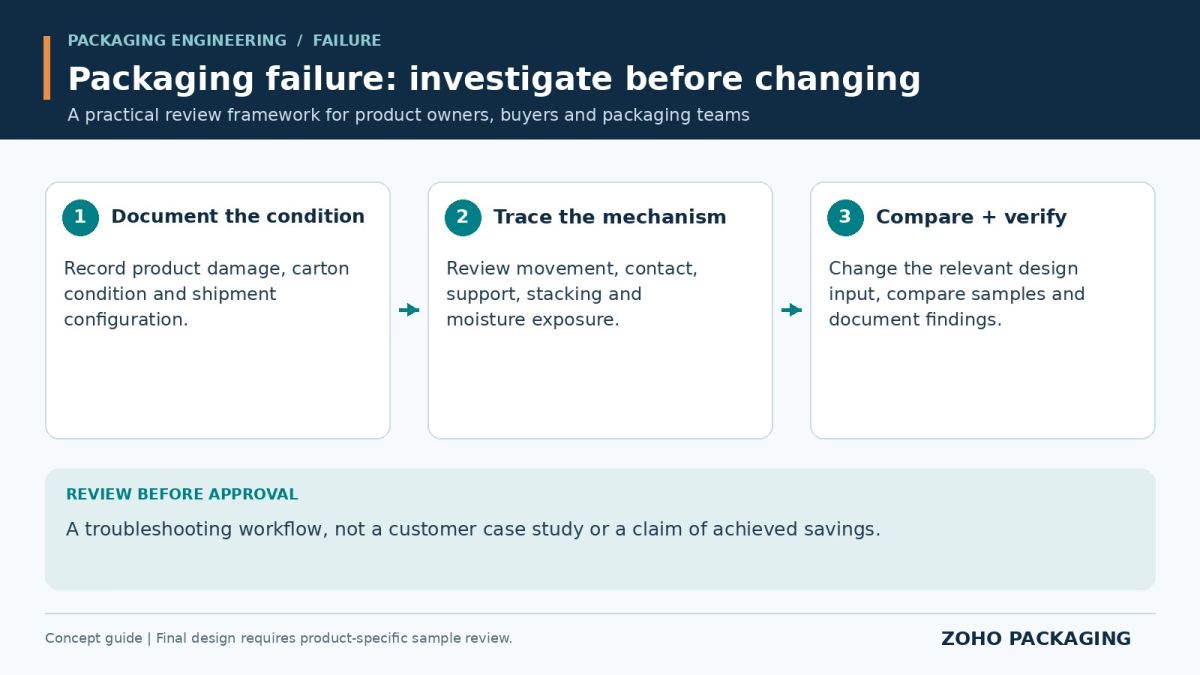 A troubleshooting workflow, not a customer case study or a claim of achieved savings.
- Products arrive damaged
- Retailers complain
- Sales drop
👉 By then, the loss has already happened
Case Study #1 — Collapse During Shipping
Problem:
- Weak carton structure
- No stacking calculation
- High humidity exposure
👉 Result:
- 18% damage rate
- Product returns increased
- Retail rejection risk
Solution:
- Reinforced corrugated structure
- BCT-based design
- Moisture-resistant material
Result:
✔ Damage rate reduced to <2%
✔ Stable stacking during transport
✔ Improved retailer confidence
Case Study #2 — Poor Retail Display Conversion
Problem:
- No tear-open design
- Staff used knives to open boxes
- Packaging broke unevenly
👉 Result:
- Messy shelf appearance
- Increased labor time
- Reduced product visibility
Solution:
- Engineered tear-line system
- Clean display conversion design
- Reinforced structure after opening
Result:
✔ Faster shelf placement
✔ Clean retail display
✔ Improved customer experience
Case Study #3 — High Shipping Cost
Problem:
- Random box dimensions
- Poor pallet layout
- Low container utilization
👉 Result:
- 25% higher shipping cost
- Inefficient logistics
Solution:
- Optimized box size
- Pallet layout redesign
- Container loading optimization
Result:
✔ 20% reduction in shipping cost
✔ Increased units per shipment
✔ Improved logistics efficiency
Case Study #4 — Over-Engineered Packaging
Problem:
- Excessive material usage
- Overly thick corrugated layers
- High packaging cost
👉 Result:
- Increased unit cost
- Reduced competitiveness
Solution:
- Load distribution redesign
- Material optimization
- Structural efficiency improvement
Result:
✔ 15% material cost reduction
✔ Maintained strength
✔ Improved profit margin
The Pattern: All Problems Come From One Thing
👉 Lack of engineering
Most packaging failures are caused by:
- No structural calculation
- No pallet planning
- No real-world testing
What These Case Studies Prove
Packaging is not a cost.
👉 It’s a profit system
When engineered correctly:
✔ Lower damage rate
✔ Lower shipping cost
✔ Better retail performance
✔ Higher sales conversion
Who Should Read This?
- Retail brands
- Export companies
- Importers
- E-commerce sellers entering retail
- Industrial product suppliers
If you think your packaging is “fine”…
👉 You probably haven’t calculated the real loss.
Let’s find it.
Contact us now
ZOHO01.COM
Your Packaging Engineering Partner
FAQ
1. What is a packaging case study and why is it important?
A packaging case study is a real-world example that shows how packaging design impacts performance, cost, and sales. It helps businesses understand actual problems such as product damage, inefficient logistics, or poor retail display. By analyzing real cases, companies can identify risks early and apply proven solutions. Case studies are important because they reveal hidden costs that are not visible in standard pricing, allowing better decision-making and long-term cost optimization.
2. What are the most common packaging failures in retail?
The most common failures include weak structural design, poor pallet layout, lack of tear-open functionality, and over-engineered materials. These issues lead to product damage, inefficient handling, and poor shelf presentation. Many suppliers focus only on appearance or cost, ignoring real-world performance. As a result, packaging may look good initially but fails during shipping or retail use, causing financial losses.
3. How does packaging failure affect business profit?
Packaging failure directly impacts profit through product damage, returns, replacement costs, and lost sales opportunities. Additionally, inefficient packaging increases shipping and labor costs. Retailers may also reject poorly performing packaging, leading to lost contracts. Over time, these issues significantly reduce overall profitability, even if the initial packaging cost seems low.
4. How can packaging engineering reduce damage rates?
Packaging engineering focuses on load distribution, material strength, and structural stability. By calculating factors like BCT and optimizing reinforcement points, packaging can withstand stacking and transport conditions. Proper cushioning and design also protect products from vibration and impact. These improvements significantly reduce damage rates and improve supply chain reliability.
5. What role does pallet optimization play in packaging?
Pallet optimization ensures that packaging fits efficiently within standard pallet sizes, maximizing space usage and stability. Proper layout reduces shipping costs, prevents product movement, and improves handling efficiency. It also supports better stacking performance, reducing the risk of collapse during transport.
6. Why is tear-open design important in retail packaging?
Tear-open design allows packaging to convert quickly into a display unit without tools. This reduces labor time and improves shelf presentation. Poor tear design can cause uneven tearing and structural damage, negatively affecting product appearance and retail efficiency.
7. Can packaging optimization reduce overall cost?
Yes. By improving structure, size, and layout, packaging optimization reduces shipping, damage, and labor costs. Even if the unit cost increases slightly, the total cost across the supply chain is significantly lower, resulting in higher profit margins.
8. How long does it take to fix packaging issues?
Typically, it takes 2–4 weeks to analyze, redesign, and test packaging solutions. The timeline depends on complexity and testing requirements. Investing this time helps prevent long-term losses.
9. Are case studies useful for small businesses?
Yes. Small businesses can benefit greatly from case studies by learning from others’ mistakes and avoiding costly trial and error. Applying proven strategies helps them compete more effectively in retail markets.
10. What is the biggest lesson from packaging case studies?
The biggest lesson is that packaging should be treated as a system, not just a box. Successful packaging integrates engineering, logistics, and retail performance. Companies that adopt this approach achieve better efficiency, lower costs, and higher sales.