Air Freight Packaging Solutions That Reduce Cost and Protect Speed
Air freight is fast — but it is also expensive.
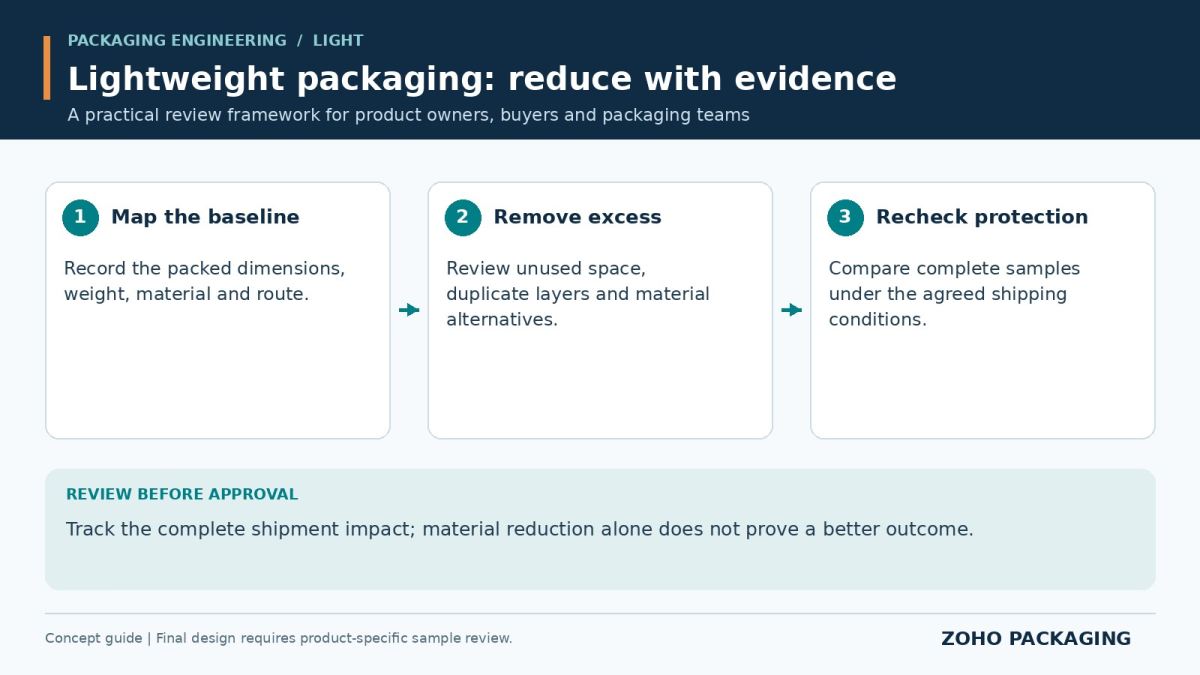 Track the complete shipment impact; material reduction alone does not prove a better outcome.
Every extra kilogram, every unnecessary cubic inch, directly increases your shipping cost. This is why air freight packaging solutions focus on one core principle:
Maximum protection with minimum weight.
At Zoho Packaging, we design air freight packaging systems that reduce dimensional weight, protect high-value goods, and ensure products arrive safely without overpaying for shipping.
Why Air Freight Packaging Is Different
Air freight is not just faster — it operates under a completely different cost structure.
You are charged based on:
- actual weight
- dimensional weight (volumetric weight)
- space efficiency
This means poor packaging design can double your shipping cost even if the product itself is small.
Common air freight challenges include:
- oversized cartons increasing volumetric weight
- insufficient protection for fragile products
- over-packaging adding unnecessary weight
- poor internal structure causing product movement
- damage during airport handling and transfers
Core Strategy: Reduce Weight Without Reducing Protection
Air freight packaging is a balance between engineering strength and weight optimization.
1. Lightweight Structural Design
We reduce unnecessary material while maintaining strength.
Methods include:
- optimized corrugated flute selection
- structural reinforcement instead of thicker board
- redesigning box geometry for strength distribution
2. Dimensional Weight Optimization
Air freight cost is heavily affected by volume.
We design packaging to:
- minimize empty space
- fit products tightly and efficiently
- align with standard cargo dimensions
This directly reduces shipping cost.
3. Shock Protection for High-Speed Handling
Air cargo is handled quickly, often with less care than expected.
We design:
- shock-absorbing internal structures
- tight-fit inserts to prevent movement
- anti-impact packaging systems
4. High-Value Product Protection
Air freight is often used for:
- electronics
- precision components
- urgent shipments
- high-value goods
These require packaging that minimizes both physical damage and financial risk.
5. Efficient Packing for Fast Operations
Speed matters in air freight.
Packaging should be:
- easy to assemble
- easy to pack
- easy to handle at airports and warehouses
Operational efficiency reduces errors and delays.
Air Freight vs Sea Freight Packaging
Understanding the difference is critical.
| Factor |
Air Freight Packaging |
Sea Freight Packaging |
| Priority |
Weight reduction |
Strength & durability |
| Cost driver |
Volume & weight |
Distance & time |
| Risk |
Impact handling |
Compression & humidity |
| Design focus |
Lightweight + protection |
Heavy duty + stacking |
| Packaging style |
Compact & optimized |
Reinforced & stable |
Common Air Freight Packaging Mistakes
Most companies overpay because of poor packaging design.
Typical issues include:
- using oversized cartons
- leaving empty space inside packaging
- adding unnecessary protective material
- ignoring volumetric weight calculation
- not redesigning packaging for air transport
Air Freight Packaging for Different Industries
Electronics
→ lightweight + anti-shock + precision fit
Automotive small parts
→ compact + anti-scratch + stable positioning
Medical devices
→ high protection + clean packaging + compliance
Luxury / branded products
→ protection + presentation balance
Urgent shipments
→ fast packing + reliable protection
Reduce Air Freight Cost Through Packaging Engineering
Air freight is expensive — but bad packaging makes it worse.
A well-designed air freight packaging solution can:
- reduce dimensional weight
- lower shipping cost per unit
- prevent product damage
- improve packing efficiency
- speed up logistics operations
You don’t save money by using cheaper packaging.
You save money by using smarter packaging.
Our Air Freight Packaging Approach
We design packaging based on:
- product size and weight
- fragility and surface sensitivity
- shipping urgency
- airline cargo constraints
- cost vs protection balance
Our solutions include:
- lightweight corrugated packaging
- custom inserts and internal protection
- compact packaging design
- packaging redesign for cost reduction
- export-ready air cargo packaging systems
Built for Speed, Designed for Efficiency
Air freight is about speed — but packaging determines cost.
At Zoho Packaging, we help exporters ship faster, safer, and more efficiently.
Because in air shipping, every gram matters.
FAQ(每題150字以上)
1. What are air freight packaging solutions?
Air freight packaging solutions are packaging systems designed specifically for air transportation. They focus on reducing weight, minimizing dimensional size, and protecting products during fast handling. Unlike sea freight packaging, air freight packaging must balance cost efficiency and protection, since shipping cost is directly affected by both weight and volume. Proper design helps reduce expenses while ensuring safe delivery.
2. What is dimensional weight in air freight?
Dimensional weight is the calculated weight based on package size rather than actual weight. Airlines charge based on whichever is higher — actual or dimensional weight. If packaging is too large, even a light product can become expensive to ship. This is why packaging optimization is critical in air freight.
3. How can packaging reduce air freight cost?
Packaging can reduce cost by minimizing size, reducing material weight, and improving product fit inside the carton. Efficient packaging design reduces dimensional weight, allowing more products per shipment and lowering total shipping expenses.
4. What types of products need air freight packaging?
High-value, urgent, fragile, or time-sensitive products such as electronics, medical devices, precision parts, and samples often require air freight packaging solutions. These products need strong protection but also efficient weight control.
5. Is lighter packaging always better?
Not always. Packaging must still provide enough protection. The goal is not the lightest packaging, but the most efficient design that balances protection and cost.
6. How does air freight handling affect packaging?
Air cargo is handled quickly and often transferred multiple times. This increases the risk of drops, impacts, and vibration. Packaging must be designed to absorb shock and prevent internal movement.
7. What is the biggest mistake in air freight packaging?
The biggest mistake is ignoring dimensional weight. Many companies use oversized boxes or unnecessary materials, which significantly increases shipping cost.
8. Can air freight packaging prevent product damage?
Yes. With proper design, including internal cushioning and structural support, packaging can protect products from impact, vibration, and handling stress during air transport.
9. How is air freight packaging different from sea freight packaging?
Air freight focuses on lightweight and compact design, while sea freight focuses on strength and long-term durability. Using the wrong approach can either increase cost or increase risk of damage.
10. Why should packaging be optimized for air cargo?
Because air freight cost is highly sensitive to packaging design. Optimized packaging reduces cost, improves efficiency, and ensures products arrive safely without unnecessary expense.