Heavy Duty Export Packaging That Handles Real Shipping Stress
Shipping heavy products is not just about using thicker boxes.
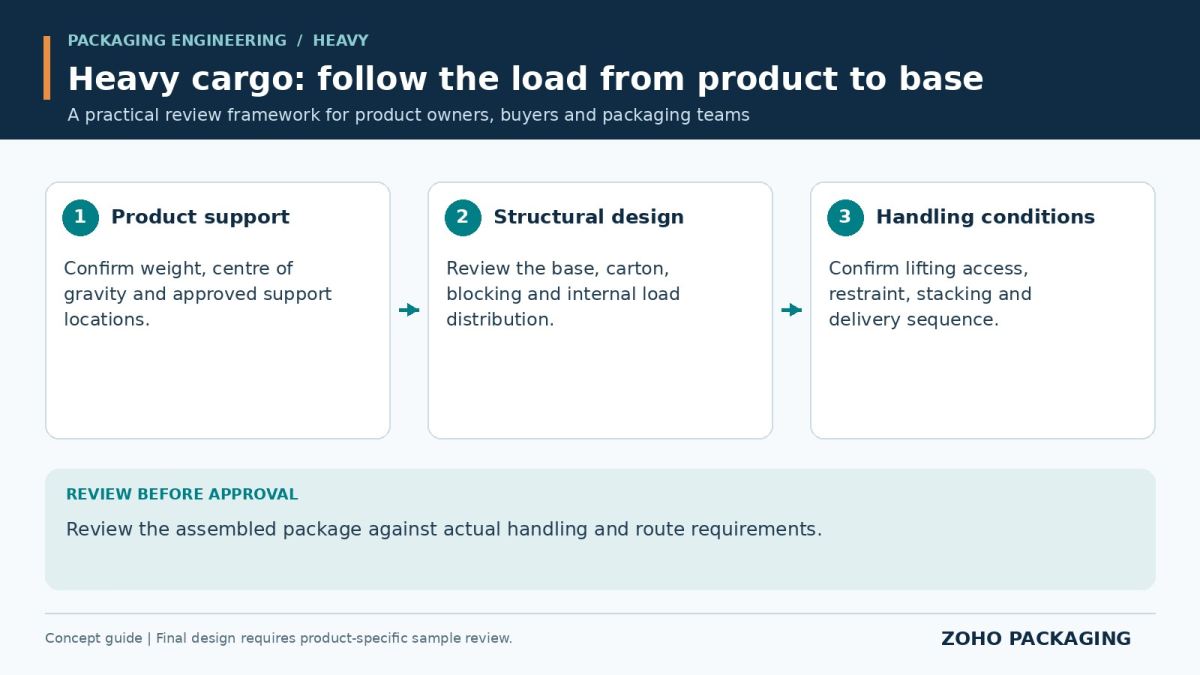 Review the assembled package against actual handling and route requirements.
It is about understanding load distribution, stacking pressure, and real-world logistics stress.
Heavy duty export packaging is designed to protect industrial goods, machinery parts, and high-weight products during international transportation — where failure is expensive and often unacceptable.
At Zoho Packaging, we design packaging systems that handle real shipping conditions, not just theoretical strength.
Why Heavy Duty Export Packaging Is Critical
When dealing with heavy products, the risk is multiplied.
Common issues include:
- carton collapse under weight
- bottom failure during lifting
- product movement causing internal damage
- pallet instability during transport
- damage during loading and unloading
Unlike lightweight goods, heavy cargo generates continuous stress on the packaging structure.
If the structure fails, everything fails.
Core Engineering Principles of Heavy Duty Packaging
1. Load Distribution Design
Heavy packaging is not about thicker material — it is about how the force travels.
We design:
- structural support paths
- reinforced corners and edges
- weight distribution systems
This prevents pressure from concentrating in weak points.
2. Reinforced Corrugated Structure
For heavy export packaging, standard cartons are often not enough.
We use:
- multi-wall corrugated board (double wall / triple wall)
- high ECT / BCT performance materials
- reinforced bottom structures
The goal is to maintain integrity under heavy load and long stacking periods.
3. Bottom Strength & Lifting Safety
Many failures happen at the bottom of the box.
We design packaging that:
- supports lifting and handling
- prevents bottom breakage
- distributes weight evenly across the base
4. Internal Fixation & Movement Control
Heavy products can still move — and when they do, damage is severe.
We use:
- blocking systems
- internal supports
- partitions and cushioning
- custom-fit inserts
No movement = no damage.
5. Pallet Integration & Stability
Heavy cargo must be stable on pallets.
We optimize:
- pallet layout
- load balance
- stacking patterns
- compatibility with strapping and wrapping
Common Heavy Duty Packaging Failures
Most problems come from poor design logic.
Typical failures include:
- using standard cartons for heavy products
- ignoring load distribution
- weak bottom structure
- poor pallet alignment
- insufficient internal support
These issues often lead to product damage, customer complaints, and financial loss.
Applications of Heavy Duty Export Packaging
Industrial machinery components
→ high load, precision protection
Automotive parts (rotors, suspension, engines)
→ heavy + anti-shock + anti-scratch
Metal parts and tools
→ weight concentration + surface protection
Electromechanical equipment
→ heavy + fragile combination
Large format export products
→ structural + logistics integration
Corrugated vs Wooden Packaging (Key Decision)
For heavy export packaging, customers often choose between:
Corrugated Heavy Duty Packaging
- lighter weight
- lower cost
- easier handling
- recyclable
- suitable for many export scenarios
Wooden Packaging
- extremely high load capacity
- suitable for oversized or ultra-heavy equipment
- required in certain export regulations
👉 The key is not choosing the strongest option —
👉 It is choosing the right structure for your product and shipping method.
Reduce Loss, Not Just Packaging Cost
Heavy cargo damage is expensive.
It includes:
- product replacement
- shipping cost duplication
- project delays
- customer dissatisfaction
A properly engineered heavy duty export packaging solution can:
- prevent structural failure
- reduce damage rate
- improve logistics efficiency
- protect your profit
Our Heavy Duty Packaging Approach
We design based on:
- product weight and load points
- transport method (sea / air)
- stacking requirements
- pallet and container logic
- handling conditions
Our solutions include:
- reinforced corrugated export cartons
- heavy load packaging systems
- custom internal support structures
- pallet-integrated packaging design
- packaging redesign for damage reduction
Built for Industrial Reality
Heavy duty packaging must work in real environments:
- forklifts
- warehouses
- containers
- long-distance shipping
At Zoho Packaging, we focus on performance under pressure.
Because for heavy products, packaging is not just protection.
It is risk control.
FAQ(每題150字以上)
1. What is heavy duty export packaging?
Heavy duty export packaging refers to packaging solutions designed for heavy, industrial, or high-load products. It focuses on structural strength, load distribution, and long-distance durability. Unlike standard packaging, it must handle stacking pressure, handling stress, and transportation risks without failure.
2. What products need heavy duty packaging?
Products such as industrial machinery, automotive parts, metal components, generators, and large equipment typically require heavy duty export packaging. These products are heavy and often sensitive to movement or impact.
3. Is thicker packaging always better for heavy products?
Not necessarily. The key is structural design, not just thickness. Proper load distribution and reinforcement can be more effective than simply adding more material.
4. What causes heavy packaging to fail?
Common causes include weak bottom structure, poor load distribution, insufficient internal support, and using standard cartons for heavy products.
5. Can corrugated packaging handle heavy loads?
Yes, with proper design. Multi-wall corrugated board and reinforced structures can handle significant weight when engineered correctly.
6. When should wooden packaging be used?
Wooden packaging is suitable for extremely heavy or oversized products, or when required by export regulations. However, it is heavier and more expensive.
7. How does pallet design affect heavy cargo?
Pallet design affects load stability and handling safety. Poor pallet alignment can lead to shifting and damage during transport.
8. Can heavy duty packaging reduce damage?
Yes. Proper design minimizes movement, distributes load, and strengthens structure, significantly reducing damage risk.
9. What is the biggest mistake in heavy packaging?
Using standard packaging without considering weight distribution and transport conditions.
10. Why is heavy duty packaging important for export?
Because export shipping involves long distances and multiple handling stages. Strong, well-designed packaging ensures products arrive safely and reduces financial loss.