Export Packaging Testing Standards That Ensure Real Shipping Performance
Packaging is not proven by design.
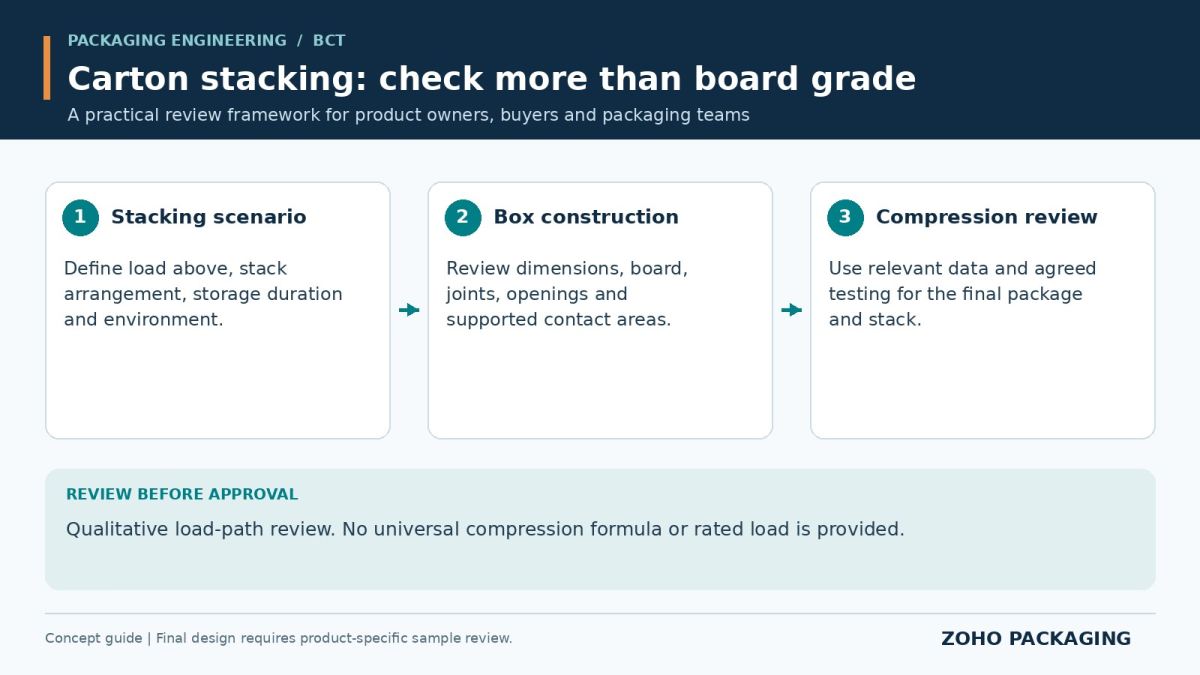 Qualitative load-path review. No universal compression formula or rated load is provided.
It is proven by testing.
Export packaging testing standards exist for one reason:
👉 To simulate real shipping conditions before failure happens.
At Zoho Packaging, we design packaging based on real-world performance — supported by testing logic and engineering validation.
Why Packaging Testing Is Critical
Without testing, packaging is just a guess.
Export shipping involves:
- drops
- vibration
- stacking pressure
- environmental changes
If packaging fails during transit:
- products are damaged
- costs increase
- customers lose trust
👉 Testing reduces uncertainty and risk.
Key Export Packaging Testing Standards
1. ISTA Testing (International Safe Transit Association)
ISTA standards simulate real shipping environments.
Common standards include:
- ISTA 1A → basic drop and vibration test
- ISTA 3A → advanced e-commerce and distribution simulation
These tests evaluate packaging performance under controlled conditions.
2. Drop Test (Impact Simulation)
Drop testing simulates handling impact.
Packaging is dropped from specific heights to test:
- shock resistance
- structural integrity
- product protection
This is critical for fragile and high-value goods.
3. Compression Test (BCT – Box Compression Test)
Compression testing measures how much load a box can withstand.
It evaluates:
- stacking strength
- structural stability
- long-term load performance
👉 Especially important for sea freight and pallet stacking.
4. Stacking Test (Long-Term Load Simulation)
Stacking tests simulate:
- warehouse storage
- container stacking
- long-duration pressure
This ensures packaging does not collapse over time.
5. Vibration Test (Transport Simulation)
Vibration testing simulates:
- truck transport
- sea movement
- air cargo handling
It evaluates:
- internal movement
- product stability
- packaging durability
Testing vs Real-World Conditions
Testing is not about perfection.
It is about reducing risk.
Good packaging design considers:
- test results
- real shipping conditions
- environmental factors
👉 Testing validates design — but engineering makes it work.
Common Mistakes Without Testing
- assuming packaging is strong enough
- using standard designs without validation
- ignoring stacking conditions
- not considering vibration and impact
- testing only in ideal conditions
When You Need Packaging Testing
Export shipping (sea & air)
→ high risk environment
Heavy products
→ stacking and load stress
Fragile items
→ impact sensitivity
High-value goods
→ low tolerance for failure
New product launches
→ unknown packaging performance
Packaging Testing = Risk Management
Testing helps:
- reduce damage rate
- improve packaging reliability
- validate design decisions
- build customer confidence
Our Testing-Based Packaging Approach
We design with testing in mind:
- structural performance
- load capacity
- impact resistance
- environmental conditions
We support:
- packaging validation logic
- test-based design improvements
- export-ready packaging systems
- engineering-driven packaging solutions
Built on Engineering, Not Assumptions
Anyone can make a box.
Not everyone can prove it works.
At Zoho Packaging, we design packaging that is:
- tested
- validated
- reliable
Because:
👉 If packaging is not tested, it is not proven.
FAQ(每題150字以上)
1. What are export packaging testing standards?
Export packaging testing standards are methods used to evaluate packaging performance under shipping conditions. These include drop tests, compression tests, vibration tests, and ISTA standards.
2. What is ISTA testing?
ISTA testing is a set of standardized tests that simulate real-world shipping conditions. It helps evaluate how packaging performs during transportation.
3. Why is drop testing important?
Drop testing simulates handling impact. It ensures packaging can protect products from damage caused by drops during shipping.
4. What is a compression test (BCT)?
A compression test measures how much weight a box can تحمل before collapsing. It is critical for stacking performance.
5. What is stacking testing?
Stacking testing simulates long-term pressure from stacked cartons in warehouses or containers.
6. What is vibration testing?
Vibration testing simulates movement during transport and evaluates packaging stability.
7. Is testing required for all export packaging?
Not always, but it is highly recommended for high-risk, high-value, or heavy products.
8. Can testing prevent all damage?
No, but it significantly reduces risk and improves reliability.
9. What is the biggest mistake without testing?
Assuming packaging will perform well without validation.
10. How do you start packaging testing?
By defining product requirements, selecting test methods, and validating packaging performance.