Article文章專區
2026/04/09
Shock & Drop Test Design | Packaging Testing for Impact Protection & Shipping Safety
Shock & Drop Test Design — Because Every Package Will Be Dropped
Every shipment will experience:
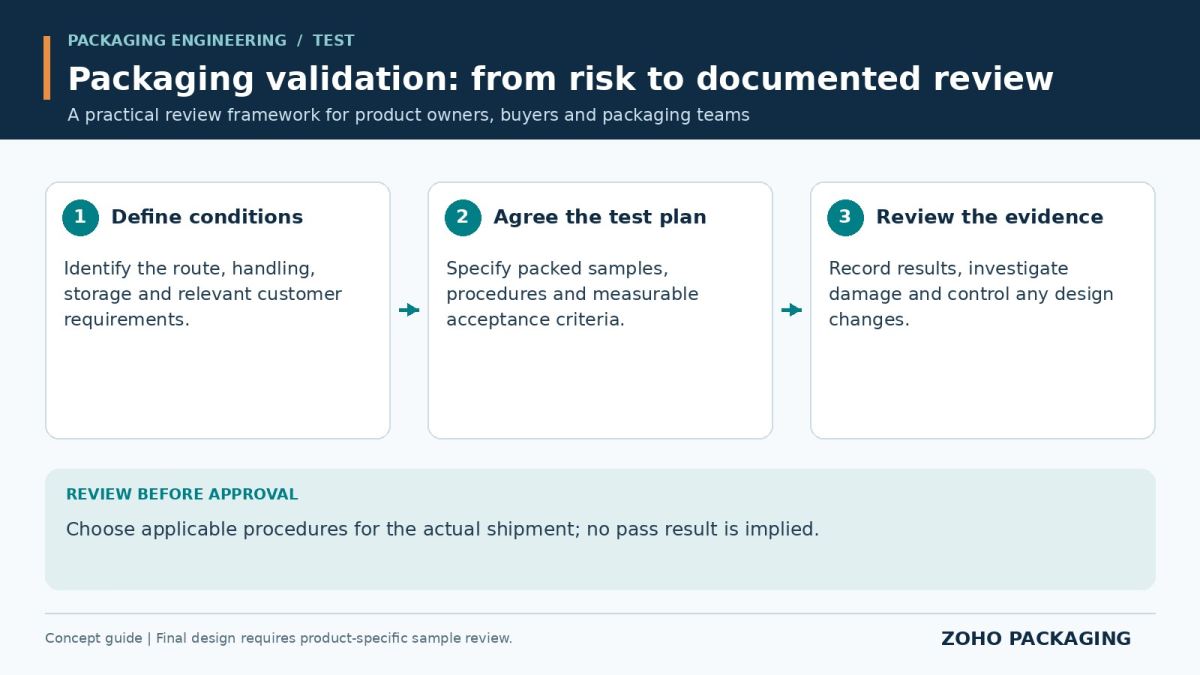 Choose applicable procedures for the actual shipment; no pass result is implied.
- drops
- impacts
- rough handling
👉 The only question is:
Will your packaging survive it?
Shock and drop test design ensures your packaging can handle real-world handling conditions before it reaches your customer.
At Zoho Packaging, we design packaging systems based on testing logic, not assumptions.
Why Drop Testing Matters
During shipping, packages are:
- dropped during handling
- impacted during loading/unloading
- exposed to unpredictable conditions
Without proper design:
- products are damaged
- returns increase
- costs multiply
What Is Drop Test in Packaging
Drop testing simulates:
👉 real handling conditions
It evaluates:
- impact resistance
- structural integrity
- product protection
Typical Drop Test Conditions
Common parameters:
- drop height (varies by weight)
- drop orientation (corner, edge, flat)
- number of drops
👉 These simulate real logistics scenarios.
Shock vs Drop — What’s the Difference
| Factor |
Shock |
Drop |
| Type |
sudden force |
impact from fall |
| Duration |
very short |
slightly longer |
| Cause |
vibration/impact |
handling drop |
| Focus |
force absorption |
structural resistance |
👉 Both must be considered together.
Core Principles of Shock & Drop Test Design
1. Energy Absorption
Packaging must:
- absorb impact energy
- reduce force transmission
- protect internal components
2. Structural Reinforcement
Critical areas:
👉 These are the most common failure points
3. Internal Cushioning System
We design:
- shock-absorbing layers
- cushioning structures
- controlled deformation
4. Load Distribution
Impact force must be:
- distributed
- not concentrated
5. Real-World Simulation
Design must reflect:
- actual shipping conditions
- handling scenarios
- product sensitivity
Common Drop Test Failures
- corner collapse
- insufficient cushioning
- internal movement
- structural weakness
- poor material selection
ISTA Drop Test Standards
Common standards include:
- ISTA 1A → basic drop test
- ISTA 3A → advanced simulation
👉 Used to validate packaging performance
Before vs After Testing-Based Design
Before
- packaging designed by assumption
- high damage rate
After
- packaging validated by testing
- improved performance
👉 Result:
- reduced returns
- higher reliability
Who Needs Shock & Drop Test Design
Electronics companies
→ sensitive products
E-commerce brands
→ high return risk
Export businesses
→ long-distance shipping
Industrial products
→ high-value shipments
Packaging Testing = Risk Control
Testing allows you to:
- predict failure
- improve design
- reduce uncertainty
👉 It turns packaging into a controlled system.
Our Testing-Based Design Approach
We design based on:
- product weight and fragility
- drop test requirements
- shipping conditions
- risk level
We deliver:
- shock-resistant packaging
- drop test validated design
- export-ready packaging systems
- engineering-driven solutions
Don’t Design for Ideal Conditions
Real shipping is not gentle.
At Zoho Packaging, we design packaging for:
- worst-case scenarios
- real handling conditions
- unpredictable impact
Because:
👉 If your packaging survives the drop,
it survives the shipment.
FAQ
1. What is shock and drop test design?
It is the process of designing packaging to withstand impact and drop conditions during shipping.
2. Why is drop testing important?
Because packages are frequently dropped during handling.
3. What is ISTA testing?
It is a standardized testing method to simulate shipping conditions.
4. What is the biggest failure in drop testing?
Corner collapse and insufficient cushioning.
5. Can packaging prevent all damage?
No, but it significantly reduces risk.
6. What affects drop test performance?
Structure, cushioning, and material selection.
7. How do you design for shock resistance?
By absorbing and distributing impact energy.
8. What industries need drop test design?
Electronics, e-commerce, and export industries.
9. Can drop testing reduce returns?
Yes. Better packaging reduces damage and returns.
10. How do you start drop test design?
By analyzing product and simulating real shipping conditions.