Machinery Packaging Is Not About Boxes — It’s About Risk Control
Most exporters think:
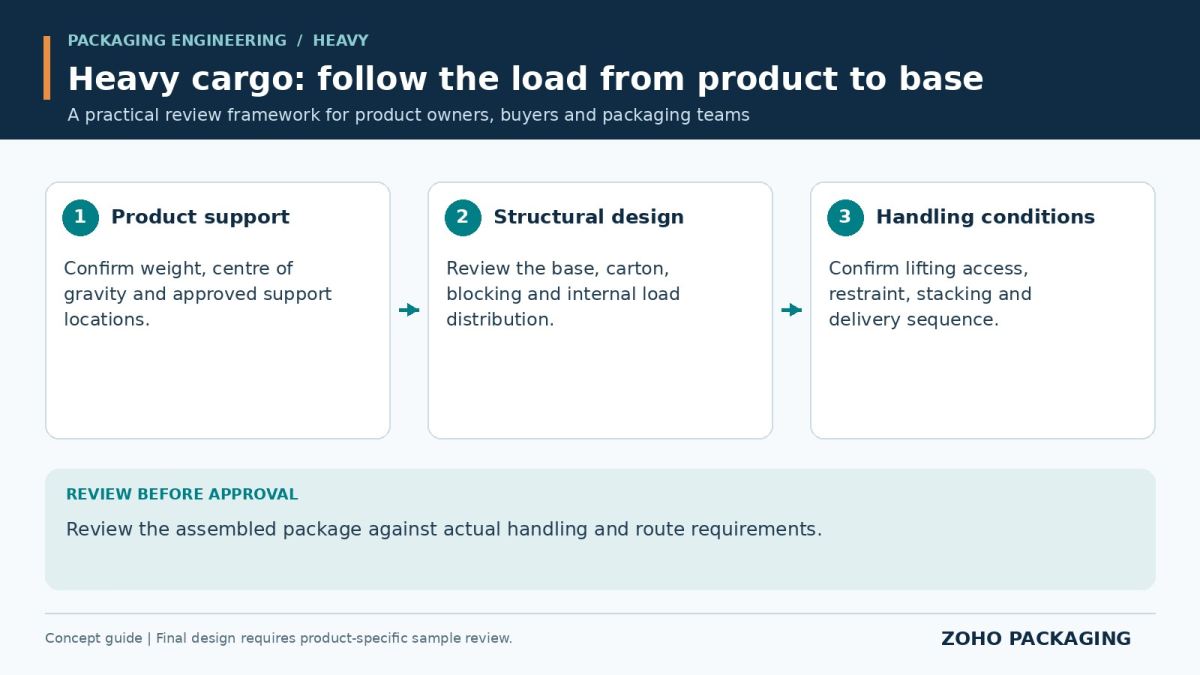 Review the assembled package against actual handling and route requirements.
- “Just make the box stronger.”
- “Add more padding and it’ll be fine.”
That mindset causes damage.
👉 Machinery packaging is about controlling force, not adding material
What Actually Damages Machinery During Export?
Your equipment doesn’t fail randomly.
It fails because of:
- Impact (Drop / Shock)
- Vibration (Long-distance transport)
- Compression (Stacking pressure)
- Moisture & corrosion (Ocean freight)
👉 If your packaging doesn’t address ALL four, failure is predictable
1. Shock Protection (Impact Engineering)
Heavy machinery doesn’t need soft padding —
it needs controlled energy absorption
Engineering approach:
- Multi-layer cushioning system
- Honeycomb paper / molded pulp structures
- EPE or hybrid shock buffers
- Load distribution design
👉 Not just “absorbing force” — but redirecting it
2. Load Path Design (The Real Key Most People Ignore)
This is where most packaging fails.
👉 Weight should NEVER be carried by weak panels
Correct structure:
- Reinforced base (critical load-bearing zone)
- Corner protection columns
- Internal fixation system
Wrong approach:
- Relying on thicker cardboard
- Random foam stuffing
- No defined load path
👉 Strength comes from structure, not thickness
3. Compression & Stacking (BCT-Oriented Design)
Export shipments are stacked. Always.
If you ignore stacking → collapse is guaranteed.
Core logic:
- BCT calculation based on stacking height
- Pallet load distribution
- Container pressure simulation
👉 Engineering mindset:
“This box is not alone — it’s part of a stacked system”
4. Moisture & Corrosion Protection (Ocean Reality)
Ocean freight = humidity + time
Solutions:
- VCI anti-corrosion packaging
- Moisture barrier liners
- Desiccant system design
- Sealed internal environment
👉 Without this:
- Rust
- Electrical failure
- Surface damage
5. Fixation System (Prevent Internal Movement)
Movement = damage
Must-have:
- Internal bracing
- Locking structures
- Custom inserts
- Anti-shift design
👉 If the machine moves inside the box,
the packaging has already failed
6. Real Case (Why Engineering Matters)
Before:
- Standard carton + foam
→ Damage during transit
→ Customer rejection
After:
- Engineered load path
- Shock + fixation system
- Moisture protection
👉 Damage rate dropped to near zero
👉 Customer retention increased
Why Most Packaging Suppliers Fail You
They sell:
- Boxes
- Materials
- Unit price
We focus on:
👉 Failure prevention engineering
What We Provide (ZOHO Packaging)
- Heavy-duty corrugated packaging (AAA / multi-wall)
- Export crates (wood / hybrid)
- Shockproof structural design
- Load path engineering
- BCT-based stacking design
- Moisture & corrosion protection systems
Positioning:
👉 We don’t sell packaging — we reduce your shipping risk
CTA (Conversion)
If your machinery:
- Gets damaged during export
- Has inconsistent packaging quality
- Requires engineering-level protection
👉 Talk to us.
ZOHO Packaging — Industrial Packaging Engineered for Export
FAQ
Q1: Why does heavy machinery still get damaged even with strong packaging?
Because strength alone is not enough. Many companies focus on using thicker materials or stronger boxes, but ignore how force is transferred through the packaging system. Machinery damage usually occurs due to impact, vibration, and internal movement—not lack of material thickness. Without proper load path design and shock absorption, force travels directly into the equipment. Effective packaging requires engineered structures that control and distribute force, not just resist it.
Q2: What is load path design and why is it important?
Load path design refers to how weight and external forces are transferred through the packaging structure. Instead of allowing stress to distribute randomly, a properly designed load path directs force through reinforced areas such as the base and corners. This prevents weak panels from collapsing and protects sensitive components. Without load path design, even heavy-duty packaging can fail under real shipping conditions.
Q3: How do you calculate stacking strength for export packaging?
Stacking strength is typically evaluated using BCT (Box Compression Test). This involves calculating how much weight a box can تحمل before collapsing, based on material strength, dimensions, and stacking conditions. Engineers also consider pallet configuration, container height, and environmental factors such as humidity. A proper BCT-based design ensures that packaging can withstand real-world stacking scenarios during storage and transport.
Q4: Is wood packaging always better for heavy machinery?
Not necessarily. While wooden crates provide strong structural support, they are heavier, more expensive, and subject to international regulations such as ISPM 15. In many cases, advanced corrugated solutions (multi-wall or hybrid designs) can provide sufficient strength with lower cost and weight. The choice depends on the machinery weight, fragility, and shipping conditions.
Q5: How do you prevent corrosion during ocean shipping?
Corrosion is caused by humidity and temperature changes during transit. Effective solutions include using VCI (Volatile Corrosion Inhibitor) materials, moisture barrier films, desiccants, and sealed packaging systems. These methods create a controlled micro-environment inside the package, preventing moisture from reaching the machinery. Without proper corrosion protection, even well-structured packaging can fail.
Q6: What is the biggest mistake in machinery packaging?
The biggest mistake is assuming that more material equals better protection. Over-packaging with foam or thicker boards without proper engineering often leads to poor force distribution and internal movement. This not only increases cost but also fails to prevent damage. The correct approach is structural design based on how forces behave during transport.
Q7: Can packaging reduce logistics costs?
Yes. Proper packaging design can optimize pallet configuration, container loading, and overall shipping efficiency. By reducing wasted space and improving stacking stability, companies can ship more units per container and lower transportation costs. Additionally, reducing damage rates also lowers replacement and warranty costs.
Q8: How do you fix machinery inside the packaging?
Fixation systems are designed to prevent internal movement during transport. This can include custom inserts, bracing structures, locking mechanisms, and base anchoring. The goal is to keep the machinery completely stable, even under vibration and impact conditions. If the product shifts inside the packaging, the protection system has failed.
Q9: When should you redesign your packaging?
If you experience frequent damage, inconsistent packing results, or rising logistics costs, it’s time to redesign. Packaging should evolve with your product, shipping routes, and business scale. Many companies continue using outdated designs that no longer match their operational needs.
Q10: Why work with a packaging engineering partner instead of a supplier?
A supplier focuses on producing packaging materials. An engineering partner focuses on solving problems. This includes analyzing failure points, optimizing structure, and ensuring compliance with export requirements. For high-value machinery, this difference directly impacts cost, reliability, and customer satisfaction.