High Load ≠ Thicker Box
It’s About Engineering the Structure
Most buyers say:
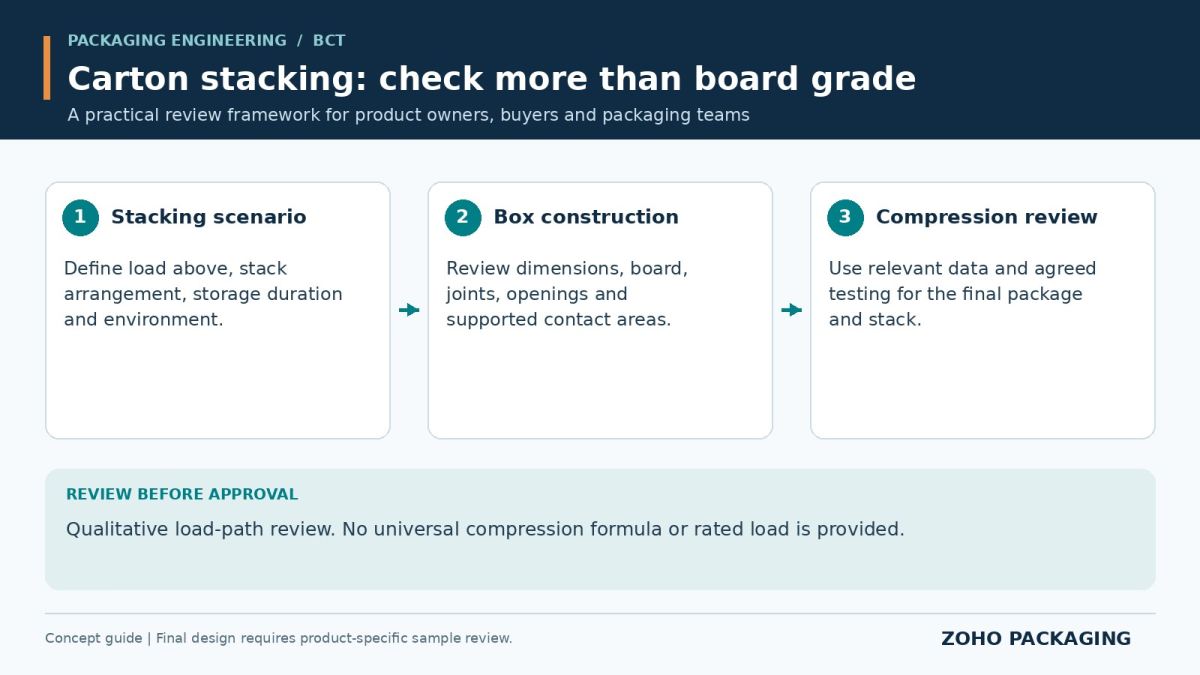 Qualitative load-path review. No universal compression formula or rated load is provided.
- “Make it thicker.”
- “Use stronger paper.”
That’s not how load capacity works.
👉 High-load cartons are engineered systems — not material upgrades
Why Cartons Collapse
Cartons don’t fail because they are “too thin”
They fail because:
- Load is not properly distributed
- Weak panels take compression
- Stacking pressure exceeds design
- Moisture reduces strength
👉 Failure is structural, not material
1. Load Path Design
This is the most important concept.
Correct principle:
👉 Load must travel through reinforced vertical structures
Key elements:
- Corner columns (primary load path)
- Reinforced edges
- Double-wall / triple-wall layering
- Base support structure
Wrong approach:
- Uniform thickness increase
- Ignoring corner strength
- No structural reinforcement
👉 If load goes through panels → collapse is inevitable
2. BCT-Oriented Design
Boxes are never alone — they are stacked.
What is BCT?
BCT = Box Compression Test
It measures how much vertical load a carton can تحمل
Engineering factors:
- Flute type (A / B / E / AA / AB / AAA)
- Board combination
- Carton dimensions
- Stacking height
- Humidity conditions
👉 Real design = matching BCT to real logistics conditions
3. Material Strategy (Not Just “Stronger Paper”)
Material matters — but only when used correctly.
Options:
- Double wall (5-ply)
- Triple wall (7-ply / AAA flute)
- High ECT liners
- Reinforced kraft layers
👉 Engineering mindset:
“Right material in the right structure”
4. Moisture Impact (The Silent Killer)
Humidity reduces carton strength dramatically.
Reality:
- 80% humidity → strength can drop 30–50%
- Ocean freight = high risk
Solutions:
- Moisture-resistant liners
- Coating / treatment
- Container environment planning
👉 Ignoring moisture = overestimating strength
5. Pallet & Container Integration
Carton strength ≠ isolated performance
Must consider:
- Pallet pattern (120×100 cm / 48×40”)
- Load distribution
- Container stacking height
- Transport vibration
👉 Packaging design must match logistics system
6. Real Case (From Collapse to Stability)
Before:
- Thicker carton (cost ↑)
- Still collapsing
After:
- Load path redesign
- BCT-based structure
- Optimized flute combination
👉 Strength increased
👉 Cost reduced
👉 Damage eliminated
Why Most Suppliers Get This Wrong
They sell:
- Thickness
- Paper weight
- Price per box
We engineer:
👉 Load capacity based on real-world conditions
What We Provide (ZOHO Packaging)
- High-load corrugated carton design
- BCT calculation & stacking simulation
- Multi-wall (AA / AB / AAA) solutions
- Export-ready heavy-duty cartons
- Pallet & container optimization
Positioning:
👉 We don’t sell cartons — we engineer load performance
If your cartons:
- Collapse during stacking
- Fail in export conditions
- Require over-spec materials
👉 Talk to us.
ZOHO Packaging — Engineered Strength for Real Logistics
FAQ
Q1: Why do cartons still collapse even when using thicker material?
Because thickness alone does not control how force moves through the structure. Many companies assume that increasing board thickness will automatically increase strength, but without proper load path design, the added material does not effectively carry the load. Compression forces may still be applied to weak panels instead of reinforced corners. Additionally, thicker materials increase cost without guaranteeing performance. True strength comes from structural design, not just material thickness.
Q2: What is load path design in carton engineering?
Load path design refers to directing vertical forces through the strongest parts of the carton, typically the corners and edges. Instead of allowing stress to distribute randomly, engineers design the structure so that weight travels through reinforced zones. This prevents panel deformation and improves stacking performance. Without proper load path design, cartons are more likely to fail even under moderate loads.
Q3: How is BCT used in carton design?
BCT (Box Compression Test) measures how much load a carton can withstand before collapsing. Engineers use BCT calculations to match packaging strength with real-world stacking conditions. This includes considering pallet stacking height, total weight, and environmental factors such as humidity. BCT-based design ensures that cartons perform reliably during storage and transport, rather than just in theoretical conditions.
Q4: Does humidity really affect carton strength?
Yes, significantly. Corrugated materials absorb moisture from the environment, which weakens the fiber structure. In high humidity conditions, such as ocean freight, carton strength can decrease by 30–50%. This is often overlooked during design, leading to unexpected failures. Proper material selection and moisture protection strategies are essential for maintaining strength.
Q5: What is the difference between double wall and triple wall cartons?
Double wall cartons (5-ply) provide moderate strength and are commonly used for medium-weight products. Triple wall cartons (7-ply or AAA flute) offer significantly higher strength and are suitable for heavy or industrial applications. However, choosing between them should not be based solely on weight. Structural design, load distribution, and shipping conditions must also be considered.
Q6: Can better design reduce packaging cost?
Yes. Many companies over-spec materials to compensate for poor design. By optimizing structure and load path, it is possible to achieve higher strength with less material. This reduces cost while improving performance. Engineering-based design focuses on efficiency rather than simply increasing material usage.
Q7: Why is pallet design important for carton strength?
Cartons are rarely used individually—they are stacked on pallets. Poor pallet patterns can create uneven load distribution, leading to localized stress and collapse. Proper pallet design ensures that weight is evenly distributed and aligned with the carton’s load-bearing structure. This significantly improves overall performance.
Q8: What is the biggest mistake in high-load carton design?
The biggest mistake is treating cartons as simple containers rather than engineered structures. Many designs ignore load paths, stacking conditions, and environmental factors. This results in overuse of materials without solving the underlying problem. Effective design requires a systems approach that considers the entire logistics chain.
Q9: How do you determine the right carton design for export?
The process involves analyzing product weight, dimensions, shipping method, stacking conditions, and environmental factors. Engineers then design a structure that matches these requirements, including selecting appropriate materials and flute combinations. Testing and simulation may also be used to validate performance.
Q10: Why work with an engineering-based packaging provider?
Because high-load packaging is not a commodity—it is a technical solution. An engineering-based provider focuses on performance, reliability, and cost optimization. This approach reduces damage, improves efficiency, and ensures consistency across shipments. For export operations, this can have a significant impact on overall business performance.