Shockproof Packaging Is Not About Soft Materials
It’s About Controlling Force
Most companies think:
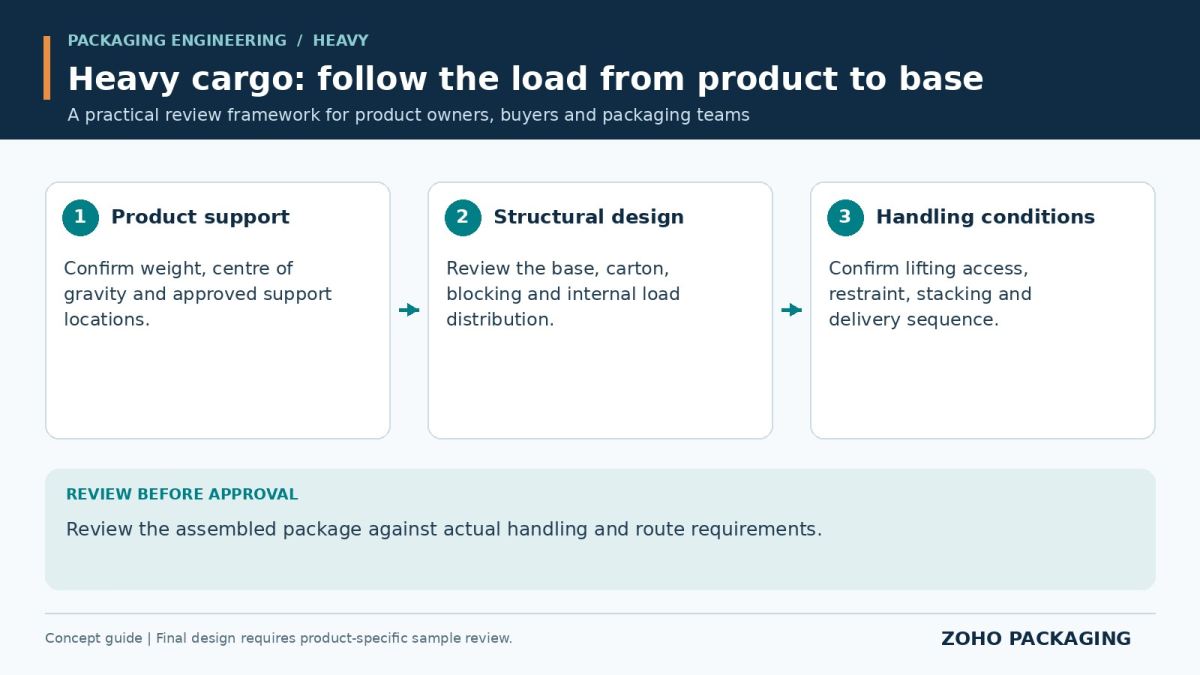 Review the assembled package against actual handling and route requirements.
- “Add more foam”
- “Use thicker cushioning”
That doesn’t solve the problem.
👉 Shockproof packaging is about controlling energy, not absorbing everything
What Actually Damages Heavy Cargo?
Heavy cargo fails due to:
- Drop impact (handling accidents)
- Continuous vibration (long-distance transport)
- Internal movement (poor fixation)
- Resonance effects (amplified vibration)
👉 If your packaging doesn’t address ALL four,
damage is only a matter of time
1. Shock Absorption vs Energy Control
Most packaging tries to “absorb impact”
Engineering approach:
👉 Control how energy travels through the system
Methods:
- Multi-layer cushioning systems
- Controlled deformation structures
- Honeycomb / molded pulp buffers
- Hybrid shock absorption materials
👉 Goal:
Reduce peak force before it reaches the product
2. Vibration Isolation (The Hidden Damage Factor)
Damage doesn’t always come from big impacts.
It often comes from:
👉 continuous micro-vibration
Solutions:
- Vibration isolation layers
- Suspension-style packaging
- Anti-resonance design
👉 Without this:
- Internal components loosen
- Precision parts misalign
- Hidden damage occurs
3. Fixation System
Shockproof ≠ loose cushioning
Must-have:
- Internal locking structures
- Base anchoring systems
- Custom-fit inserts
- Anti-shift design
👉 If the cargo moves →
the packaging has already failed
4. Load Distribution
Heavy cargo generates massive force.
Engineering logic:
- Force must be distributed across structure
- No stress concentration points
- Reinforced load paths
👉 Poor distribution = structural failure
5. Hybrid Shockproof Systems
Best performance comes from combining:
- Structural strength
- Cushioning materials
- Fixation systems
👉 Not one solution — a system
6. Real Case (From Damage to Stability)
Before:
- Foam-based cushioning only
→ Repeated damage
After:
- Engineered shock system
- Fixation + vibration isolation
- Load path control
👉 Damage eliminated
👉 Customer complaints dropped
👉 Export reliability improved
Why Most Packaging Fails
Because it’s designed as:
- Material-based
- Cost-driven
- Non-engineered
We design:
👉 Force-controlled packaging systems
What We Provide (ZOHO Packaging)
- Shockproof packaging design for heavy cargo
- Multi-layer cushioning engineering
- Vibration isolation systems
- Internal fixation design
- Load path optimization
- Export-ready industrial packaging
Positioning:
👉 We don’t add protection — we engineer impact control
If your cargo:
- Gets damaged during shipping
- Is high-value or precision equipment
- Requires consistent export performance
👉 Talk to us.
ZOHO Packaging — Engineered Shock Protection for Industrial Export
FAQ
Q1: Why doesn’t adding more foam solve shock damage?
Because foam alone does not control how energy moves through the system. While it can absorb some impact, it often allows uncontrolled force transmission or bottoming out under heavy loads. Without proper structural design, foam may compress too quickly and fail to protect the product. Effective shockproof packaging requires a system that manages energy distribution, not just absorption.
Q2: What is vibration damage and why is it important?
Vibration damage occurs from continuous small movements during transport, especially over long distances. Unlike impact damage, it is not immediately visible but can cause internal loosening, misalignment, or fatigue failure. This is particularly critical for precision equipment. Proper vibration isolation design is essential to prevent these issues.
Q3: What is the difference between shock absorption and shock control?
Shock absorption focuses on reducing impact force, while shock control involves managing how that force is distributed and transferred through the packaging system. Shock control is a more advanced approach that considers the entire structure, including load paths and material behavior. It results in more reliable protection.
Q4: Why is fixation important in shockproof packaging?
Fixation prevents internal movement, which is one of the main causes of damage. Even with good cushioning, if the product shifts inside the packaging, it can experience repeated impacts. Proper fixation ensures that the product remains stable and protected under all transport conditions.
Q5: Can shockproof packaging reduce damage rates significantly?
Yes. When properly engineered, shockproof packaging can dramatically reduce damage rates. Many companies experience repeated failures due to poor design, but after implementing engineered solutions, damage can be reduced to near zero. This also improves customer satisfaction and reduces costs.
Q6: What materials are commonly used for shockproof packaging?
Common materials include foam, honeycomb paper, molded pulp, and hybrid cushioning systems. The choice depends on the product weight, fragility, and transport conditions. Material selection should be based on performance, not just cost.
Q7: How do you test shockproof packaging performance?
Testing methods include drop tests, vibration tests, and compression tests. Standards such as ISTA protocols are often used to simulate real-world conditions. Testing ensures that the packaging performs as expected before mass production.
Q8: Is shockproof packaging necessary for all heavy cargo?
Not always, but it is highly recommended for high-value, fragile, or precision equipment. Even heavy items can be damaged if not properly protected against impact and vibration. The level of protection should match the risk level.
Q9: What is the biggest mistake in shockproof packaging design?
The biggest mistake is focusing only on materials rather than system design. Many companies add more cushioning without addressing load paths, fixation, and vibration. This leads to higher costs without improved performance.
Q10: Why choose an engineering-based packaging solution?
Because shockproof packaging is a technical challenge that requires understanding of force, materials, and logistics. An engineering-based approach ensures that all factors are considered, resulting in reliable and cost-effective solutions. This is especially important for export operations where failure can be costly.