Palletization Is Not Just Stacking
It’s a Logistics System
Most companies think:
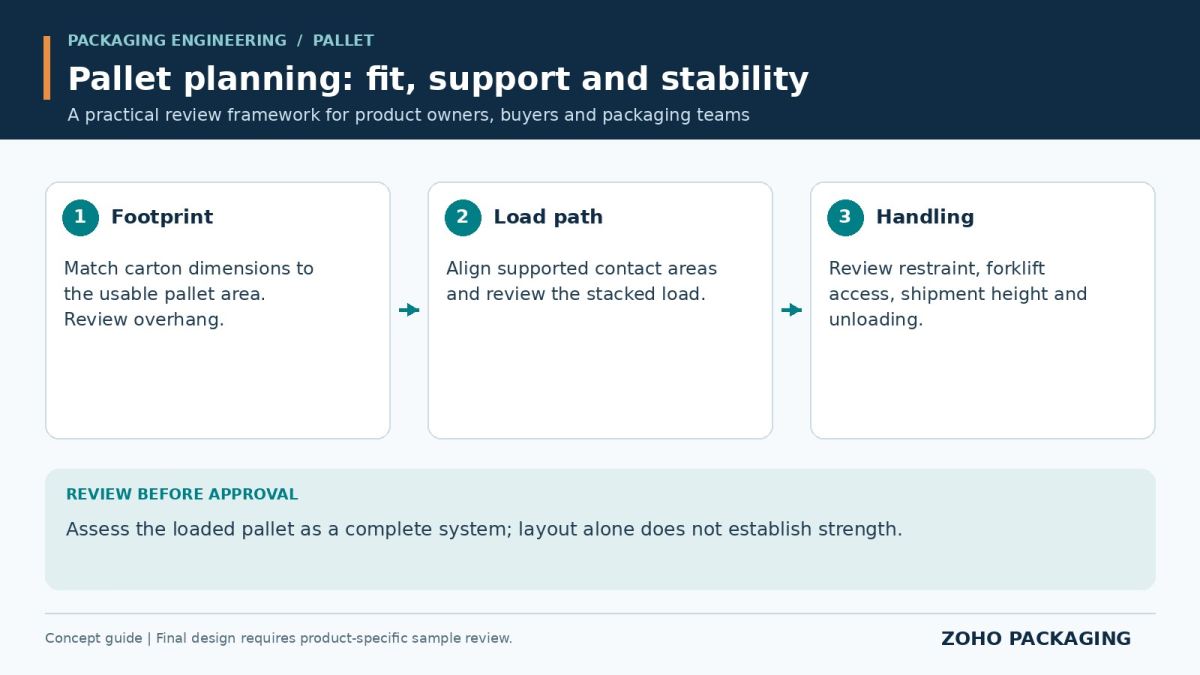 Assess the loaded pallet as a complete system; layout alone does not establish strength.
- “Just put boxes on a pallet”
That’s inefficient — and risky.
👉 Palletized packaging is a system that controls load, space, and movement
Why Palletization Matters in Export
Without proper palletization:
- Boxes collapse
- Products shift
- Space is wasted
- Damage increases
👉 With proper pallet design:
- Stable stacking
- Better container utilization
- Lower damage rates
- Faster handling
1. Pallet Pattern Design (The Foundation)
How you place cartons matters.
Key patterns:
- Column stacking (maximum strength)
- Interlocking pattern (better stability)
- Hybrid patterns (balance strength & stability)
👉 Wrong pattern = uneven load → collapse risk
2. Load Distribution (Critical for Stability)
Weight must be evenly distributed.
Engineering logic:
- Align load with carton strength (corners)
- Avoid overloading weak areas
- Balance center of gravity
👉 Poor distribution leads to tipping and crushing
3. Carton + Pallet Integration
Cartons and pallets must be designed together.
Considerations:
- Carton size vs pallet size (48×40” / 120×100 cm)
- Layer efficiency
- Edge alignment
👉 Mismatch = wasted space + instability
4. Stretch Wrapping & Securing
Securing the load is essential.
Methods:
- Stretch film wrapping
- Strapping (horizontal & vertical)
- Corner protection boards
👉 Without proper securing:
- Load shifts during transport
- Increased damage risk
5. Container Optimization (Maximize Efficiency)
Pallet design impacts container loading.
Goals:
- Maximize pallet count per container
- Reduce empty space
- Maintain airflow & accessibility
👉 Better design = lower cost per shipment
6. Export Conditions (Real-World Factors)
Palletized loads face:
- Forklift handling
- Vibration during transport
- Stacking in warehouses
- Humidity (especially ocean freight)
👉 Packaging must handle all conditions
7. Real Case (From Inefficiency to Optimization)
Before:
- Random pallet stacking
- High damage rate
- Poor container utilization
After:
- Engineered pallet pattern
- Optimized carton size
- Secure load system
👉 Damage reduced
👉 Shipping efficiency improved
👉 Cost per unit lowered
Why Most Palletization Fails
Because it’s treated as:
- A warehouse task
- A last-step operation
We treat it as:
👉 A core part of packaging engineering
What We Provide (ZOHO Packaging)
- Palletized packaging design
- Carton + pallet integration
- Load distribution engineering
- Container loading optimization
- Export-ready pallet systems
- Industrial packaging solutions
Positioning:
👉 We don’t stack boxes — we engineer shipping systems
If you are:
- Wasting container space
- Experiencing pallet collapse
- Facing export damage issues
👉 Talk to us.
ZOHO Packaging — Engineered Pallet Systems for Global Shipping
FAQ
Q1: Why is palletization important for export packaging?
Palletization improves handling efficiency, stability, and protection during shipping. By grouping products into a single unit, it reduces manual handling and minimizes the risk of damage. Proper palletization also improves space utilization in containers, lowering shipping costs. Without it, shipments are more prone to instability and inefficiency.
Q2: What is the best pallet stacking pattern?
There is no single best pattern—it depends on the product and carton strength. Column stacking provides maximum compression strength, while interlocking patterns offer better stability. Hybrid approaches are often used to balance both. The right choice depends on load requirements and transport conditions.
Q3: How does pallet design affect shipping cost?
Pallet design impacts how many units fit in a container. Optimized designs reduce empty space and increase efficiency, lowering cost per unit. Poor design leads to wasted space and higher shipping expenses.
Q4: What is the standard pallet size for export?
Common sizes include 48×40 inches (US standard) and 120×100 cm (international standard). The choice depends on the destination and logistics requirements. Designing packaging around these sizes improves efficiency.
Q5: How do you secure palletized loads?
Loads are secured using stretch wrap, strapping, and corner boards. These methods prevent movement during transport and improve stability. Proper securing is essential to avoid damage.
Q6: Can palletization reduce damage rates?
Yes. Proper palletization reduces handling and stabilizes loads, significantly lowering the risk of damage. It is one of the most effective ways to improve shipment reliability.
Q7: What is the biggest mistake in palletized packaging?
Treating it as an afterthought. Many companies design cartons first and then try to fit them onto pallets. This often leads to inefficiencies and instability. Palletization should be considered during the packaging design stage.
Q8: How do you optimize container loading?
By designing pallet size, carton dimensions, and stacking patterns together. This ensures maximum utilization of container space while maintaining stability and accessibility.
Q9: Is palletization necessary for all shipments?
Not always, but it is highly recommended for most export shipments. It improves efficiency, reduces damage, and simplifies handling. For large or heavy shipments, it is essential.
Q10: Why work with a packaging engineering partner?
Because palletization involves multiple factors, including structure, logistics, and cost optimization. An engineering-based approach ensures that all these elements are integrated into a cohesive system, resulting in better performance and efficiency.